Description
⚙️ Product Overview
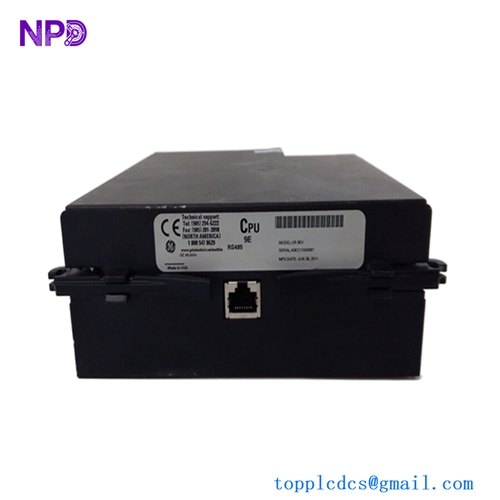
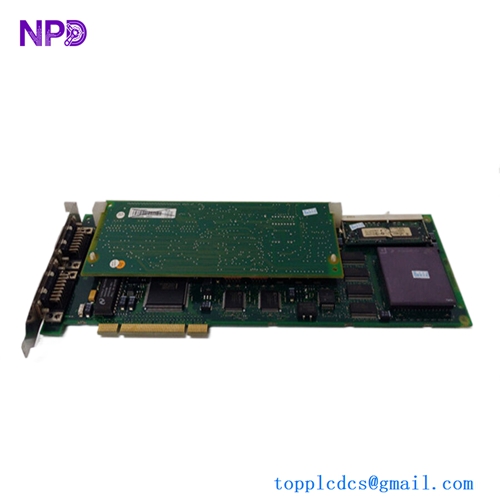
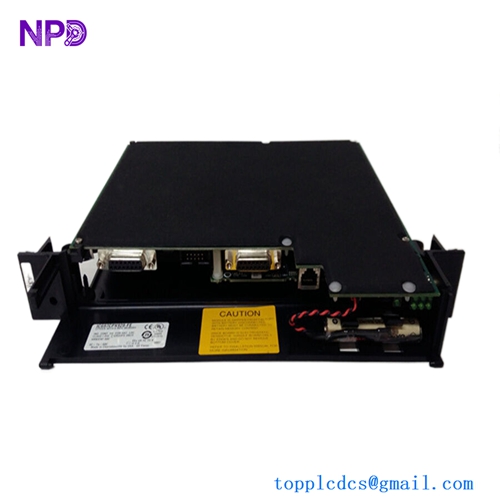
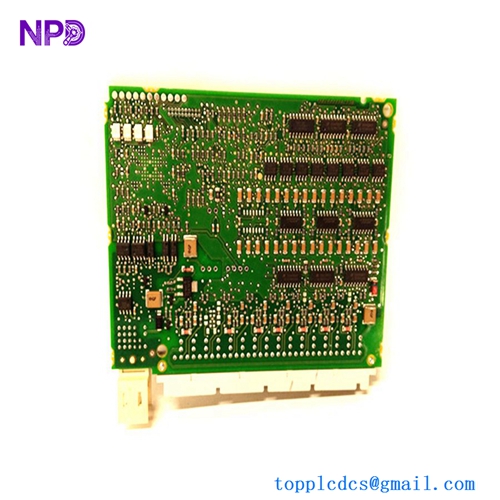
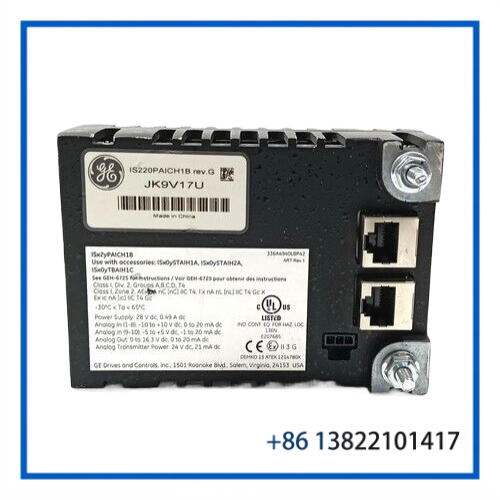
The GE IS220PAICH1B Rev.G is a PAIC Analog Input/Output I/O Pack designed for the GE Mark VIe turbine control system. It provides the electrical interface between the Mark VIe I/O network and an analog input/output terminal board, supporting analog signal acquisition, monitoring, and control functions.
The PAICH1B configuration supports both analog inputs and analog outputs and is intended for turbine control applications where accurate analog signal processing is required. The module is suitable for maintenance replacement, system restoration, and spare-parts inventory for installed GE turbine control equipment.
🔧 Key Features
- GE Mark VIe PAIC Analog I/O Pack
- Model: IS220PAICH1B
- Revision: Rev.G
- Functional designation: PAICH1B
- Supports analog input and analog output functions
- Interfaces with Mark VIe Ethernet I/O networks
- Designed for connection to an analog terminal board
- Suitable for turbine control, monitoring, and protection applications
- Industrial modular construction for control-system installation
- Appropriate for replacement and maintenance programs
- Exact terminal-board and system configuration should be verified before installation
📋 Technical Datasheet
| Parameter | Specification |
|---|---|
| Brand | GE |
| Model | IS220PAICH1B |
| Revision | Rev.G |
| Series | Mark VIe |
| Product Name | Analog Input/Output I/O Pack |
| Functional Acronym | PAIC / PAICH1B |
| Analog Channels | Up to 10 AI + 2 AO, system dependent |
| Communication | Mark VIe I/O Ethernet Network |
| Place of Manufacture | United States |
| Application | Turbine Control System |
📡 I/O Function
The PAIC I/O Pack is designed to interface analog field signals with the Mark VIe control architecture. The PAICH1B configuration supports analog input channels for measurement and monitoring as well as two analog output channels for control signals.
The commonly specified analog input configuration includes voltage and current-loop signal capability, while the analog outputs provide current-loop control signals. Actual signal ranges and terminal-board configuration depend on the associated Mark VIe terminal board and system application.
🌐 System Communication
The IS220PAICH1B interfaces with the Mark VIe control system through its Ethernet-based I/O network connection. This allows the I/O Pack to exchange acquired field data with the turbine control system while providing diagnostic information through the module’s status indicators.
The module is intended to work as part of a complete Mark VIe I/O architecture rather than as a standalone analog controller.
🏭 Typical Applications
- Gas turbine control systems
- Steam turbine control systems
- Power generation automation
- Turbine auxiliary systems
- Balance-of-plant control
- Analog process monitoring
- Turbine protection and control
- Mark VIe system maintenance and replacement
🔌 Installation Considerations
Before installation, confirm the complete part number and revision, especially IS220PAICH1B Rev.G.
Verify that the existing terminal board, I/O network arrangement, field wiring, and control-system configuration are compatible with the replacement module. Disconnect power before removing or installing the I/O Pack.
The I/O Pack should be correctly secured to the associated terminal board, and all network and field connections should be checked before energizing the system.
🛠️ Maintenance & Troubleshooting
If the module does not communicate correctly after installation:
- Confirm the module part number and revision.
- Check the I/O Pack power connection.
- Inspect Ethernet network connections.
- Check the terminal-board connection.
- Verify field wiring and analog signal polarity.
- Check module status LEDs for diagnostic indications.
- Confirm the Mark VIe controller recognizes the installed I/O Pack.
- Compare the installed configuration with the original system documentation.
For critical turbine systems, record the original module position, wiring, network connection, and configuration before replacement.
❓ Common Questions & Answers
Q: What is the GE IS220PAICH1B?
A: It is a GE Mark VIe PAIC Analog Input/Output I/O Pack used in turbine control systems.
Q: What does PAICH1B mean?
A: PAICH1B identifies the specific PAIC analog I/O configuration, including its analog input/output hardware arrangement.
Q: Is IS220PAICH1B used with GE Mark VIe?
A: Yes. It is a Mark VIe distributed I/O component designed for turbine control applications.
Q: Does this module provide both analog inputs and outputs?
A: Yes. The PAICH1B configuration supports analog input and analog output functions.
Q: How many analog channels are supported?
A: The commonly documented configuration provides up to 10 analog inputs and 2 analog outputs, subject to the associated terminal-board configuration.
Q: Can Rev.G replace another IS220PAICH1B revision?
A: Compatibility should be confirmed against the existing system documentation, firmware requirements, terminal board, and installed revision before replacement.
Q: Is the module suitable for turbine maintenance stock?
A: Yes. It is an appropriate spare candidate for installed GE Mark VIe systems when the complete configuration is matched.
Q: What should be checked before purchasing?
A: Check the full part number, revision, terminal-board compatibility, physical condition, connectors, and system requirements.
📦 Recommended GE Mark VIe Models
- GE IS220PAICH1B — PAIC Analog I/O Pack
- GE IS220PAICH2B — PAIC Analog I/O Pack
- GE IS220PDIAH1B — Discrete Input I/O Pack
- GE IS220PDOAH1B — Discrete Output I/O Pack
- GE IS220PSVOH1B — Servo Control I/O Pack
- GE IS220PTCCH1B — Thermocouple Input I/O Pack
- GE IS220PRTDH1B — RTD Input I/O Pack
- GE IS220YAICS1A — Analog I/O Module
- GE IS220YDIAS1A — Discrete Input Module
- GE IS220YDOAS1A — Discrete Output Module
📌 Replacement Note
For a turbine-control replacement, the complete designation IS220PAICH1B Rev.G should be matched with the existing Mark VIe system. The terminal board, I/O network arrangement, field signal type, revision, and control-system configuration should all be verified before commissioning.