Description
Product Overview
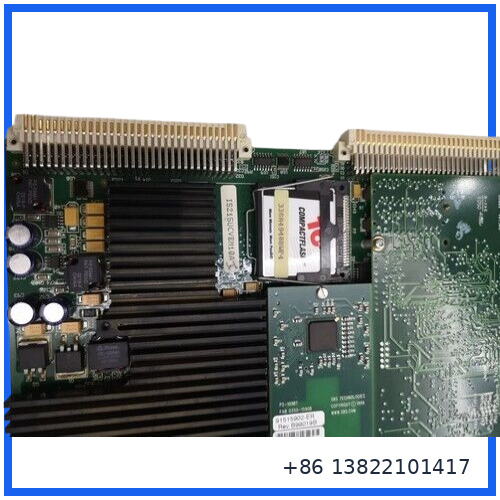
The GE IS215UCVEM10A is a VME controller module associated with the GE Mark VI Speedtronic turbine control platform. It is a processor-based control board used within the Mark VI control architecture to handle control processing, system communication, and data exchange between the controller and other turbine-control hardware.
The module is built around a VMEbus-based architecture and is intended for installation in the Mark VI control rack. Its role is different from a conventional analog or digital I/O card. The controller provides the computing and communication layer required by the larger turbine control system.
The IS215UCVEM10A is also associated with VMIC VME controller hardware. Published references identify the board as a Mark VI Speedtronic VME controller and show multiple communication and service interfaces on the board.
Main Features
- GE Mark VI Speedtronic turbine control module
- VMEbus-based controller architecture
- Processor-based control and data-processing functions
- Designed for industrial turbine-control environments
- Supports communication with associated Mark VI control hardware
- Multiple board-level communication/service interfaces
- Status indication through onboard LEDs
- Rack-mounted industrial control construction
- Suitable for maintenance and replacement of compatible Mark VI systems
- Complete part-number and hardware-revision matching recommended
Technical Specifications
| Parameter | Specification |
|---|---|
| Manufacturer | General Electric |
| Model | IS215UCVEM10A |
| Module Type | VME Controller Module |
| Series | Mark VI Speedtronic |
| Architecture | VME / VMIC-based |
| Primary Function | Control processing and system communication |
| Application | Turbine control |
| Board Type | Processor / controller board |
| Mounting | Mark VI control rack |
| Communication | Board-dependent Ethernet / serial interfaces |
| Status Indication | Onboard diagnostic LEDs |
| Backplane | VMEbus |
| Firmware | System/application dependent |
| Configuration | Mark VI system dependent |
Some secondary sources publish detailed processor, memory and operating-system specifications for this part number, but these descriptions are inconsistent and appear to mix IS215UCVEM10A with other UCVE/VMIVME variants. For that reason, those values should be verified from the physical board label and GE system documentation before being used for a replacement specification.
VME Controller Function
The IS215UCVEM10A acts as a computing and communication element within the Mark VI control architecture.
A typical control path can be understood as:
Field / turbine signals → Mark VI I/O hardware → controller processing → control logic → turbine control outputs
The controller processes information received from the Mark VI system, executes the required application logic, and exchanges operating data with other control-system components.
This makes the module particularly important during troubleshooting. A fault in the controller can affect more than one signal because processor, communication, and system-level functions may depend on the controller.
Communication and Interfaces
The exact interface population should be checked on the actual board before installation.
Depending on the hardware configuration, VME controller boards in this family can provide Ethernet and serial/service interfaces used for:
- Control-system communication
- Engineering access
- Diagnostic functions
- System configuration
- Data exchange with other control hardware
Do not assume that two visually similar UCVE boards have identical communication interfaces. The complete GE part number and hardware revision should be used when selecting a replacement.
Installation & Replacement Guide
1. Confirm the Existing Module
Before removing the original board, record:
- Complete part number
- Hardware revision
- Serial number
- Firmware information
- Board position
- Cable connections
- LED status
- Active system alarms
For this model, matching the complete identification is more important than simply matching the “UCVE” family name.
2. Shut Down According to Site Procedure
Follow the plant’s approved turbine-control maintenance procedure before removing the module.
Where the Mark VI configuration permits online replacement, follow the specific GE maintenance procedure for that installation rather than assuming that all VME boards can be removed while energized.
3. Inspect the Replacement Board
Check the board for:
- Bent connector pins
- Damaged VME contacts
- Cracked PCB areas
- Corrosion
- Burn marks
- Loose components
- Damaged Ethernet/serial connectors
The board should also be protected against electrostatic discharge during handling.
4. Install the Controller
Carefully align the board with the correct rack position and seat it into the VME backplane.
Reconnect the cables according to the original installation record.
5. Restore Configuration
A hardware replacement may require restoration of the appropriate firmware, application configuration, or controller settings.
Do not assume that a replacement board will automatically contain the same system configuration as the original unit.
6. Perform Functional Testing
After installation, verify:
- Controller startup
- Diagnostic LED status
- VME communication
- Ethernet/serial communication where applicable
- I/O communication
- Controller-to-controller communication
- System alarms
- Turbine control application status
Complete the required functional checks before returning the turbine control system to normal operation.
Inspection Before Installation
For surplus or replacement inventory, a simple incoming inspection is worthwhile.
PCB condition:
Check both sides of the board for contamination, corrosion, damaged components, or signs of overheating.
Connectors:
Inspect the VME backplane connector and all external communication connectors carefully.
Battery and storage components:
If the installed board contains battery-backed or removable storage components, check their condition before commissioning.
Revision:
Record every identification marking on the board. GE Mark VI boards can have closely related part numbers with different revisions or functions.
Troubleshooting
Controller does not boot
Check rack seating, backplane connection, system power, processor status indicators, and firmware/application compatibility.
Communication is lost
Check the physical network connection, connector condition, communication configuration, and controller-side diagnostics.
Controller starts but the turbine application does not run
Verify the correct application software and system configuration. A hardware replacement does not necessarily include the configuration of the original controller.
Intermittent controller faults
Inspect the VME connector, rack contacts, cabinet environment and power quality. Loose backplane connections can cause intermittent communication or processor problems.
Replacement board is not recognized
Compare the complete board identification and revision with the original unit. A related UCVE model is not automatically a direct substitute.
Typical Applications
The IS215UCVEM10A is primarily associated with GE Mark VI turbine control environments, including:
- Gas turbine control systems
- Steam turbine control systems
- Combined-cycle power plants
- Generator control systems
- Turbine monitoring and control
- Legacy GE Speedtronic installations
- Industrial power-generation equipment
The Mark VI Speedtronic association and VME-controller classification are consistently reported for this part number.
Maintenance Recommendations
For installed Mark VI equipment:
- Keep the control cabinet clean and dry.
- Inspect VME connectors during scheduled maintenance.
- Check controller diagnostic LEDs.
- Record firmware and hardware revisions.
- Back up controller configuration where supported.
- Check communication cables and connectors.
- Monitor recurring controller alarms.
- Keep a correctly matched spare available for critical turbine systems.
For stored spare boards, use ESD-safe packaging and avoid excessive humidity, condensation, dust, and unnecessary connector handling.
FAQ
Q: What is the IS215UCVEM10A?
A: It is a GE Mark VI Speedtronic VME controller module used for processor-based control and communication functions.
Q: Is it an I/O module?
A: No. Its primary role is controller/processor functionality rather than direct field signal termination.
Q: What system does it belong to?
A: It is associated with the GE Mark VI Speedtronic turbine control family.
Q: Is it the same as every IS215UCVE board?
A: No. UCVE boards can have different hardware configurations and functions. The complete part number and revision should be matched.
Q: Can the board be replaced directly?
A: Physical installation is only one part of the replacement. Firmware, application configuration, communication settings and system compatibility should also be verified.
Related GE Models
- IS215UCVEM01A
- IS215UCVEM06A
- IS215UCVEM09A
- IS215UCVEM10A
- IS215UCVEH2AE
- IS215UCVFH2BB
- VMIVME-7614
- VMIVME-7650
- VMIVME-7807
- IS215ACLEH1B
Product Summary
The GE IS215UCVEM10A is a Mark VI Speedtronic VME controller designed for processor-based control and communication within GE turbine-control systems.
For replacement applications, the most important checks are the complete part number, hardware revision, board configuration, firmware, communication interfaces, and Mark VI system compatibility. Avoid selecting a substitute solely because another UCVE controller looks similar.