Description
📋 Product Overview
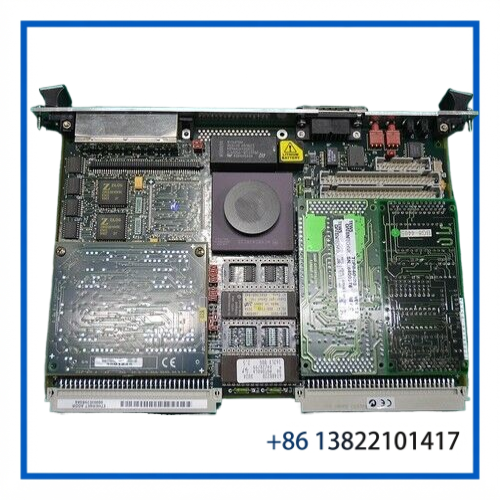
The Motorola MVME162-222 is a legacy 6U VME embedded controller board built around a 25 MHz Motorola 68040 processor. It was designed for industrial computer systems requiring a VMEbus-based CPU, onboard memory, Ethernet communication, and real-time control capabilities.
The MVME162-222 belongs to the MVME162 200-series family. The -222 configuration is particularly identifiable by its 25 MHz 68040 CPU, 4 MB memory configuration, and Ethernet interface. Unlike some other MVME162 versions, the -222 is primarily an Ethernet-oriented configuration rather than a SCSI-equipped model.
It is commonly encountered today as a replacement board for legacy industrial computers, scientific equipment, test systems, semiconductor equipment, and other VME-based platforms where maintaining the original controller architecture is preferable to a complete system redesign.
⚙️ Key Features
- Motorola MVME162-222 embedded controller
- 25 MHz MC68040 processor
- 4 MB onboard DRAM configuration
- VMEbus architecture
- Ethernet interface
- 6U VME form factor
- Onboard monitor/debugger support
- Battery-backed memory and clock functions
- Serial communication capability within the MVME162 family
- Designed for real-time embedded control applications
- Suitable for legacy VME system maintenance and replacement
The MVME162 family supports VMEbus control, local-bus DMA, serial communication, timers, watchdog functions, and onboard firmware/debug facilities. Exact board configuration should be confirmed from the physical unit and its board revision.
📊 Product Datasheet
| Parameter | Specification |
|---|---|
| Brand | Motorola |
| Model | MVME162-222 |
| Product Type | VME Embedded Controller / CPU Board |
| Processor | Motorola MC68040 |
| CPU Frequency | 25 MHz |
| DRAM | 4 MB |
| VME Interface | VMEbus |
| Form Factor | 6U VME |
| Ethernet | Yes |
| SCSI | Not specified for the -222 Ethernet-only configuration |
| IndustryPack | Configuration-dependent; verify actual board |
| Serial Interface | MVME162 family serial interface |
| SRAM | Board/configuration dependent |
| Flash | Onboard monitor/debug memory |
| NVRAM / RTC | Battery-backed |
| Watchdog | Yes |
| Operating System | Application dependent |
| Dimensions | Approx. 6U VME board format |
| Application | Industrial and embedded VME control |
| Condition | Verify actual listing condition |
The exact -222 identification is supported by multiple MVME162 references, which distinguish it from models such as the -220, -221, and -223.
🖥️ Operating Function
The MVME162-222 functions as the CPU and control element of a VME-based embedded computer.
A typical architecture can be represented as:
VME Backplane → MVME162-222 CPU Board → VME / Ethernet / Serial Interfaces → External Equipment
The processor executes the application software while the VMEbus provides access to other boards installed in the chassis. Ethernet can be used for communication with a host computer, networked controller, or equipment-level system.
The board also includes firmware and diagnostic functions intended to support startup, hardware checking, and system-level debugging. This makes it suitable for long-running legacy control systems where the original VME software environment must be maintained.
🔧 Installation & Configuration
Before installing an MVME162-222 replacement board, record the configuration of the original controller.
- Power down the complete VME chassis.
- Disconnect the chassis from the appropriate power source.
- Observe ESD precautions when handling the board.
- Record all jumper, switch, and configuration settings.
- Photograph the original board before removal.
- Verify the replacement is specifically an MVME162-222.
- Inspect the VME edge connectors for contamination or damaged contacts.
- Install the board into the correct VME slot.
- Reconnect front-panel and backplane connections.
- Power up the VME system and observe the startup/diagnostic sequence.
- Verify Ethernet and other required communications.
- Confirm that the application software recognizes the controller.
- Check the equipment for normal operation before returning it to service.
Do not assume that another MVME162 model is a direct replacement simply because the mechanical format is similar. Different MVME162 versions can have different processors, memory configurations, storage interfaces, and I/O options.
🧰 Maintenance Recommendations
For long-term storage or replacement-stock management, the MVME162-222 should be handled as a legacy electronic assembly.
- Store in an ESD-safe bag.
- Keep the board away from moisture and conductive contamination.
- Inspect the VME connector before installation.
- Check battery-backed functions if the board has been stored for an extended period.
- Record the board revision and firmware/monitor version.
- Back up application configuration before removing the existing controller.
- Check the VME power supply and backplane if the replacement board does not boot.
- Verify Ethernet cabling and network configuration separately from the CPU board.
- Avoid repeated insertion and removal of the VME board.
- Keep one fully identified spare if the machine depends on discontinued VME hardware.
A failed CPU board is not always the root cause of a VME system failure. Backplane faults, power-rail problems, communication hardware, and application software can produce similar symptoms.
❓ Frequently Asked Questions
Q: What processor does the MVME162-222 use?
A: The MVME162-222 is associated with a 25 MHz Motorola 68040 processor configuration.
Q: Is the MVME162-222 a VME board?
A: Yes. It is a 6U VME embedded controller designed for VME-based computer systems.
Q: Does the MVME162-222 have Ethernet?
A: Yes. The -222 configuration is identified as an Ethernet-oriented MVME162 version.
Q: Is MVME162-222 the same as MVME162-220?
A: No. They are different configurations. The -220 includes additional interface capabilities, while the -222 is identified as the Ethernet-only configuration in several MVME162 references.
Q: Can I replace another MVME162 model with the -222?
A: Not automatically. The processor, memory, communication interfaces, storage options, firmware, and system requirements should all be compared before substitution.
Q: Is this board suitable for a legacy industrial system?
A: Yes, provided the original system was designed around a compatible MVME162/VME architecture and the required software and I/O configuration are maintained.
Q: Should the board be hot-swapped?
A: No. Unless the specific VME system was explicitly designed and equipped for hot-swap operation, power down the chassis before removing or installing the board.
🔄 Related Motorola MVME162 Models
The following models belong to the same or closely related MVME162 family. They should not be treated as automatic substitutes:
- Motorola MVME162-220
- Motorola MVME162-221
- Motorola MVME162-222
- Motorola MVME162-223
- Motorola MVME162-233
- Motorola MVME162-243
- Motorola MVME162-250
- Motorola MVME162-251
- Motorola MVME162-252
- Motorola MVME162-263
The MVME162 programmer’s documentation lists the -222 among the 200-series MVME162LX controllers, confirming its position within the broader MVME162 platform.
🏭 Application Summary
The Motorola MVME162-222 remains useful as a maintenance and replacement component for older VME-based control platforms.
Its combination of a 25 MHz 68040 processor, onboard memory, VMEbus architecture, and Ethernet connectivity makes it suitable for embedded control and data-processing systems where the existing software and backplane architecture are already established.
For replacement purchasing, the most important points are the exact MVME162-222 model number, board revision, firmware environment, memory configuration, VME backplane compatibility, and required communication interfaces.
Product: Motorola MVME162-222
Type: 6U VME Embedded CPU Controller
Processor: 25 MHz Motorola 68040
Memory: 4 MB configuration
Network: Ethernet
Application: Legacy VME industrial and embedded control systems