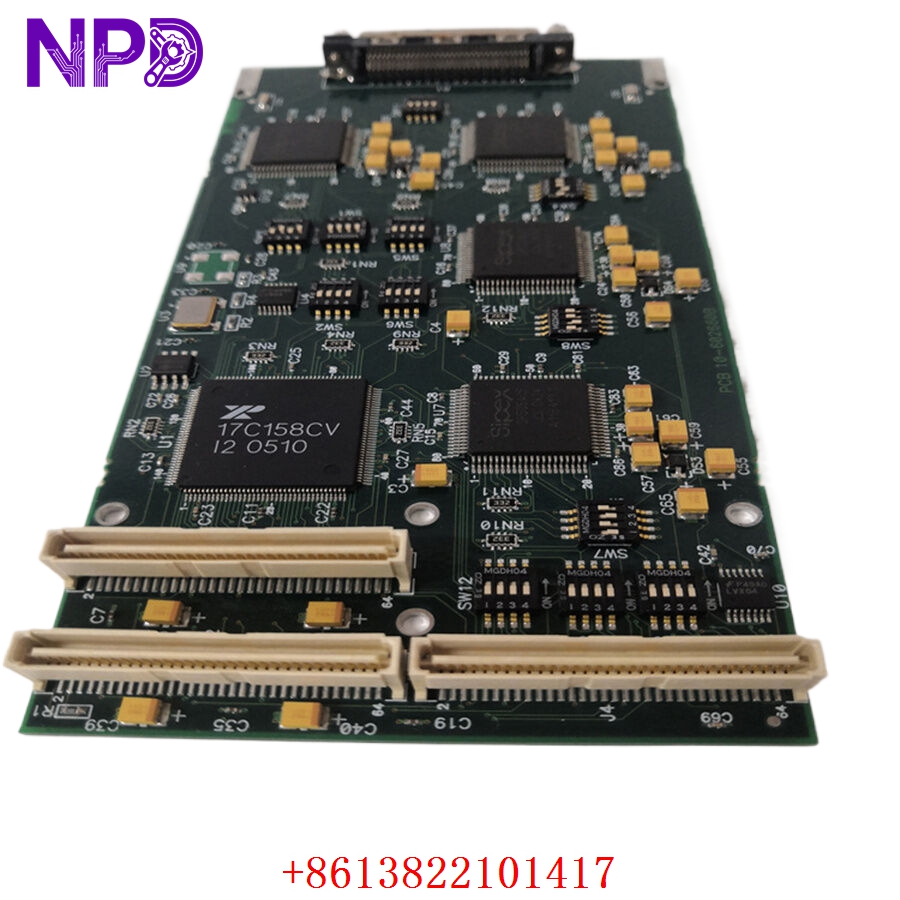

Description
The NORIS MARINE AUTOMATION SA378-601G (SA378/5-C3) is a high-reliability interface and signal processing PCB designed for marine engine monitoring and safety systems. Noris is a global leader in maritime automation, and this board is specifically engineered to handle inputs from temperature, pressure, and speed sensors. It ensures that critical engine data is accurately conditioned and transmitted to the vessel’s central Integrated Automation System (IAS), maintaining compliance with international maritime safety regulations.
Technical Specifications
| Parameter | Description |
| Model | SA378-601G / SA378/5-C3 |
| Manufacturer | NORIS Marine Automation |
| Function | Signal Processing / Sensor Interface |
| Application | Marine Engine/Propulsion Monitoring |
| Signal Input | Pt100, Pressure Transducers, MPU (Speed) |
| Weight | Approximately 0.45 kg |
| Origin | Germany |

Operational Guidelines & Usage
🔹 Startup Sequence
- Ensure the board is properly seated in the Noris automation rack and the safety locking clip is engaged.
- Verify that all terminal block wiring (sensor inputs/data outputs) is secure and free of oxidation.
- Power up the automation cabinet. The board will perform a internal initialization.
- Monitor the status LEDs on the front panel; a green “Status” or “Power” LED confirms the module is active.
- Confirm signal availability in the central monitoring station (HMI).
🔹 Shutdown Sequence
- Notify bridge and engine room staff that the monitoring system for the associated engine/auxiliary is being taken offline.
- Disable the module through the automation software if required.
- Power down the rack unit.
- Use an anti-static wrist strap before handling the module to prevent ESD damage to the sensitive signal-processing ICs.
🔹 Normal Operational Flow
- The SA378 board continuously polls field sensors (e.g., cooling water temp, lube oil pressure).
- It performs signal linearization and A/D conversion to transform raw inputs into standard industrial protocols.
- Data is transmitted across the internal backplane to the main processor.
- If a signal exceeds a defined “Alarm” or “Trip” threshold, the module flags the event instantly for the main controller to process.
🔹 Parameter Configuration
- Configuration is typically performed via the Noris service software, which allows for the mapping of sensor ranges and alarm setpoints.
- Some versions use DIP switches or jumpers for hardware addressing; refer to the physical board layout if software addressing is not applicable.
- Always verify that the configured input range (e.g., 4-20mA or 0-10V) matches the physical sensor connected to the board.
🔹 Mode Switching
- Active/Operational: Standard state for monitoring and data transmission.
- Service/Configuration: Allows technicians to modify input thresholds or test signal paths. Use of this mode should be logged in the ship’s maintenance records.
Common Questions & Answers (Q&A)
💡 Q: How do I troubleshoot an inaccurate sensor reading?
A: First, measure the raw signal at the board’s input terminal using a calibrated multimeter. If the raw signal is correct but the HMI reading is wrong, the calibration factor on the SA378 board needs to be adjusted in the software. If the raw signal itself is incorrect, the issue lies with the field sensor or the cabling.
💡 Q: Is this board susceptible to high-frequency engine vibration?
A: Noris components are type-approved for maritime vibration standards. However, if readings become intermittent, inspect the module’s connection pins. Over time, vibration can cause “fretting corrosion” on the contacts; using a non-residue electronic contact cleaner can resolve these issues.
💡 Q: How can I identify if the board has suffered internal failure?
A: If the status LED is completely dark or flashing in an erratic pattern not described in the manual, it is a sign of internal component failure. Check the power supply pins on the backplane first; if voltage is present, the board itself likely requires replacement.
💡 Q: Can the SA378-601G be used for non-engine monitoring?
A: While designed for engine monitoring, it can be used for any general-purpose marine analog signal processing provided the input types match the module’s specification (e.g., Pt100 sensors).