Description
🔹 Product Overview
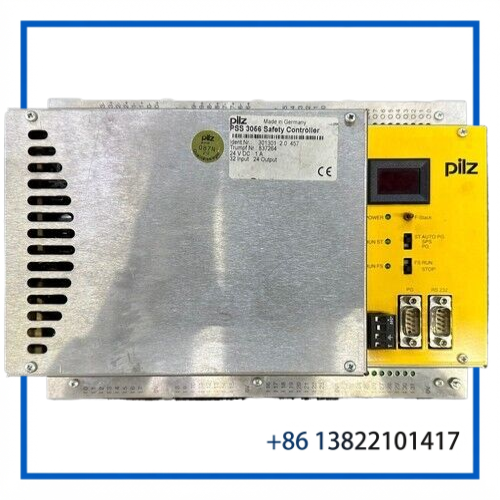
The PILZ PSS 3056 is a legacy programmable safety system designed for safety-related machine control applications. The PSS 3056 family provides integrated digital safety I/O and programming interfaces for monitoring protective devices, evaluating safety signals, and controlling safety-related outputs.
The PSS 3056 series includes several variants, including PSS 3056, PSS 3056-1, PSS 3056-2, and PSS SB 3056. The exact I/O configuration depends on the specific version and application. The standard PSS 3056 provides onboard inputs and outputs, while the PSS SB 3056 version adds SafetyBUS p functionality.
This controller is particularly relevant for maintenance and replacement of older machinery where the original safety-control architecture must be preserved or where a controlled migration strategy is required.
⚙️ Key Features
- PILZ PSS 3056 programmable safety controller
- Designed for safety-related machine control
- Integrated digital input and output interfaces
- Cyclic monitoring of safety-related outputs
- Short-circuit, overload and overtemperature protection on applicable outputs
- RS-485 programming interface
- RS-232 user interface
- Configuration-dependent I/O architecture
- Suitable for legacy machine safety systems
- Applicable to industrial machinery, presses and automated production equipment
- Useful as a maintenance spare for existing PSS installations
📋 Technical Datasheet
| Parameter | Specification |
|---|---|
| Brand | PILZ |
| Model | PSS 3056 |
| Product Series | PSS 3056 Series |
| Product Name | Programmable Safety Controller |
| Product Type | Programmable Safety System |
| System Function | Safety Control / Machine Safety |
| Input Interface | Integrated digital safety inputs |
| Output Interface | Integrated digital outputs, configuration dependent |
| Programming Interface | RS-485 |
| User Interface | RS-232 |
🛡️ Safety Control Function
The PSS 3056 is intended for applications where safety signals must be evaluated and safety-related outputs controlled according to a defined safety program.
The onboard outputs include monitored switching behavior. For the standard PSS 3056 configuration, the installation documentation specifies dual-pole 2 A outputs, with the operating system testing the outputs during each cycle. The outputs are also designed with protection against short circuit, overload and overtemperature.
This architecture allows the controller to monitor devices such as emergency-stop circuits, protective switches, interlocks and other machine-safety signals while controlling safety-related actuators.
🔌 I/O and System Integration
The exact I/O arrangement should always be checked against the installed PSS 3056 variant.
The PSS 3056 family includes different onboard I/O configurations. The standard PSS 3056 has a larger onboard output configuration than the PSS 3056-1 and PSS 3056-2, while the PSS SB 3056 provides SafetyBUS p functionality.
When replacing an existing controller, compare:
- Controller model and suffix
- I/O terminal assignment
- Safety program
- Input device wiring
- Output device wiring
- Feedback circuits
- Programming interface
- Machine-specific configuration
- Firmware and project compatibility
A replacement should not be treated as a generic PLC substitution because safety-controller configuration and machine-specific safety logic are critical to correct operation.
🏭 Typical Applications
The PSS 3056 can be found in legacy safety-control applications such as:
- Presses and press brakes
- Machine tools
- Automated production machinery
- Material-handling equipment
- Industrial processing machinery
- Guard-door monitoring
- Emergency-stop circuits
- Safety interlock systems
- Legacy machine retrofit projects
- Safety-system spare inventory
The PSS 3056 is also associated with older TRUMPF TRUMABEND press-brake systems. PILZ identifies the original PSS 3056-Trumpf controller as a safety controller used on TRUMABEND machines during approximately 1996–2004.
🔧 Installation & Commissioning
Before installation, isolate the machine from all hazardous energy sources and verify that the safety circuit is in a safe state.
Recommended procedure:
- Record the existing controller model and hardware configuration.
- Photograph and document all terminal connections.
- Confirm the exact PSS 3056 variant.
- Compare input and output terminal assignments.
- Check the DC supply and protective grounding.
- Install the controller according to the original cabinet layout.
- Verify all safety-device wiring.
- Load or restore the correct safety application configuration where applicable.
- Perform input and output functional testing.
- Verify every emergency-stop, guard and safety-interlock function before returning the machine to production.
Because this is safety-related equipment, commissioning should be performed by qualified personnel familiar with the machine’s original safety design.
🔍 Troubleshooting
Controller Does Not Start
Check the supply wiring, protective grounding, terminal connections and cabinet power distribution. Inspect for loose terminals or signs of overheating.
Safety Inputs Do Not Change State
Check the corresponding emergency-stop, guard switch, limit switch or other safety device. Verify continuity and correct terminal assignment.
Output Remains Disabled
Check the safety logic, input conditions and feedback circuits. A safety output may remain off when an expected permissive or monitoring condition is not satisfied.
Output Fault or Diagnostic Condition
Inspect the connected load, wiring and contactor coils. The PSS documentation notes that output testing can detect short circuits or open circuits, and unsuitable inductive loads can also affect diagnostics.
Communication or Programming Problem
Check the programming connection and interface configuration. The PSS 3056 programming interface uses RS-485 communication.
🧰 Maintenance Recommendations
For legacy PSS 3056 installations, preventive maintenance should include:
- Inspect terminal blocks for looseness.
- Check cabinet temperature and ventilation.
- Inspect wiring for insulation damage.
- Check safety-device operation regularly.
- Monitor recurring diagnostic faults.
- Keep a tested spare controller available.
- Preserve a backup of the applicable safety project.
- Record controller revisions and configuration changes.
- Avoid unapproved modifications to safety logic.
For machinery that remains in long-term operation, maintaining a spare PSS 3056 can reduce downtime when an aging controller fails.
🔄 Replacement Considerations
The PSS 3056 is now a legacy safety-control platform, so replacement planning is important for machines that must remain operational.
PILZ currently provides a PNOZmulti 2-based conversion kit specifically for TRUMPF TRUMABEND machines that used the PSS 3056-Trumpf controller. The conversion approach uses a PNOZmulti 2 system mounted on a base plate and is intended as a retrofit for the older PSS 3056 application.
For an original-equipment replacement, however, the exact PSS 3056 configuration should be matched before substitution. Model suffix, I/O arrangement, application program and machine wiring should all be verified.
❓ FAQ
What is the PILZ PSS 3056?
It is a programmable safety system used for safety-related machine control and monitoring.
Is the PSS 3056 a standard PLC?
No. It is designed specifically for safety-related control applications and should be evaluated according to the machine’s safety architecture.
Does every PSS 3056 have the same I/O configuration?
No. The PSS 3056 family includes different variants with different onboard I/O and interface configurations.
What communication interface is used for programming?
The PSS 3056 uses an RS-485 programming interface. Certain versions also provide additional interfaces depending on configuration.
Can a PSS 3056 be replaced directly by another PLC?
Not as a simple drop-in replacement. The safety architecture, application program, I/O assignment and validation requirements must be considered.
Is the PSS 3056 suitable as a maintenance spare?
Yes. For existing machinery still using this platform, a verified spare can be useful for minimizing downtime.
🔟 Related PILZ Models
- PILZ PSS 3056-1
- PILZ PSS 3056-2
- PILZ PSS SB 3056
- PILZ PSS 3000 Series
- PILZ PSS 4000 Series
- PILZ PNOZmulti
- PILZ PNOZmulti 2
- PILZ PNOZ m B1
- PILZ PNOZ m EF 16DI
- PILZ PNOZ m EF 8DI4DO
📌 Product Summary
The PILZ PSS 3056 is a legacy programmable safety controller intended for machine-safety applications requiring monitored inputs, safety-related outputs and programmable safety logic. Its integrated I/O and industrial programming interfaces make it a significant component in older PILZ safety architectures.
For replacement projects, the exact PSS 3056 variant and machine-specific I/O configuration should be verified before installation. For long-running legacy machinery, retaining a tested PSS 3056 spare can be an effective way to support maintenance and reduce unexpected production downtime.