Description
📌 Product Introduction
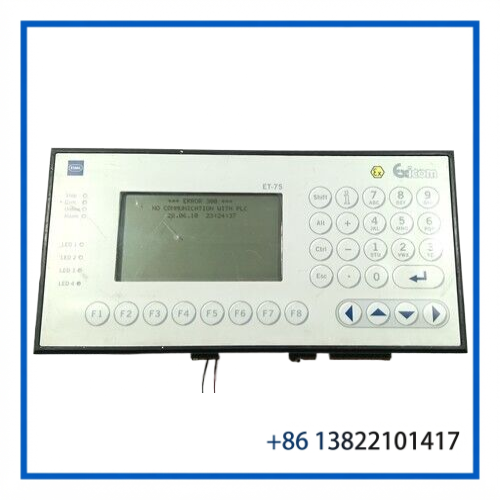
The R. STAHL EXICOM ET-75-RS422 is an intrinsically safe HMI operator interface designed for industrial process control, hazardous-area machinery, and marine automation applications. The ET-75 series provides a local operator interface for displaying process information, entering commands, and communicating with connected control systems.
The ET-75-RS422 version uses a serial RS-422 interface and is designed to work with the EXICOM family of automation equipment. The original ET-75 documentation specifies operation in hazardous areas including Zone 1/2, Division 1/2, and Zone 21/22, making this model suitable for applications where conventional operator terminals cannot be installed.
⚙️ Key Features
- R. STAHL EXICOM ET-75 operator interface
- Model: ET-75-RS422
- Intrinsically safe HMI design
- RS-422 serial communication
- Monochrome transflective LCD
- 240 × 128 pixel display resolution
- LED backlight
- 8 function keys plus alpha/system keys
- 4 + 4 system LEDs
- 128 KB main memory
- 448 KB data memory
- 8 digital inputs
- Designed for hazardous-area installation
- Compatible with SPSPlusWIN project design software
- Suitable for industrial and marine automation systems
📊 Technical Specifications
| Parameter | Value |
|---|---|
| Brand | R. STAHL / EXICOM |
| Model | ET-75 |
| MPN / Type | ET-75-RS422 |
| Product Name | HMI Operator Interface Display Module |
| Series | EXICOM ET-75 |
| Display | Monochrome transflective LCD |
| Display Resolution | 240 × 128 pixels |
| Display Size | 114 × 64 mm |
| Communication | RS-422 serial |
| Keyboard | Polyester membrane, 8 function keys + 23 alpha/system keys |
| Digital Inputs | 8 × 3.3 V / 2 mA |
| Main Memory | 128 KB |
| Data Memory | 448 KB |
| Auxiliary Supply | 8–12.5 V, 180 mA |
| Operating Temperature | -20°C to +70°C; +60°C maximum at T4 |
| Storage Temperature | -30°C to +80°C |
| Front Dimensions | Approx. 290 × 146 mm |
| Panel Cutout | Approx. 275 × 131 × 80 mm |
| Protection / Certification | ATEX / FM hazardous-area versions |
| Weight | Approx. 3.0 kg per original ET-75-RS422 catalog |
| Country of Origin | Germany |
| Condition | Used / Pre-Owned |
The original R. STAHL catalog specifies 3.0 kg for the ET-75-RS422 version and gives the 290 × 146 mm front dimensions and 275 × 131 × 80 mm cutout dimensions.
🖥️ Display & Operator Interface
The ET-75 uses a monochrome transflective LCD with a 240 × 128 pixel resolution and a 114 × 64 mm active display area. The LED backlight is supported through the associated 9143/10 power supply arrangement.
The keyboard uses a polyester membrane construction with more than one million specified operating actions. The interface includes 8 function keys, 23 alpha/system keys, and 4 + 4 system LEDs for operator feedback.
🔌 Communication & System Integration
The ET-75-RS422 is the RS-422 version of the ET-75 operator terminal. The original system architecture uses a 9185/11-45-10 fieldbus isolator for serial data transfer, while related ET-75 configurations can interface through RS-232, RS-422/485, Profibus, MPI, or Ethernet using the appropriate accessories.
For replacement applications, verify:
- RS-422 wiring and polarity
- Associated fieldbus isolator
- Controller communication parameters
- HMI project/software version
- Power supply arrangement
- Hazardous-area certification requirements
- Existing panel cutout and mounting arrangement
The terminal is intended to operate with EXICOM project software and is also documented as compatible with the EXICOM ET-9752 system family.
🏭 Application Areas
The R. STAHL EXICOM ET-75-RS422 can be applied to:
- Hazardous-area process control
- Oil and gas equipment
- Chemical processing systems
- Marine automation
- Offshore machinery
- Industrial production equipment
- Pump and compressor control
- Electrical and generator systems
- Tank and terminal automation
- Machinery monitoring and operator stations
Its hazardous-area design makes correct certification and system matching particularly important when used in classified locations.
🔧 Installation & Integration
- Confirm that the replacement unit is the ET-75-RS422 version rather than another ET-75 communication variant.
- Verify the existing panel dimensions before removing the original HMI.
- Check the RS-422 wiring and associated isolator.
- Confirm the approved power supply arrangement, including the 9143/10 interface where applicable.
- Install the terminal according to the original hazardous-area installation requirements.
- Load or verify the correct HMI project configuration.
- Check communication parameters between the HMI and host controller.
- Test display functions, function keys, system LEDs, and connected digital inputs.
- Verify that all hazardous-area certification requirements remain valid after installation.
Do not modify the certified enclosure, wiring, or electrical interface in a way that could invalidate the equipment’s hazardous-area approval.
🛠️ Maintenance Recommendations
- Keep the LCD surface clean and free from abrasive particles.
- Inspect the membrane keyboard for worn or damaged keys.
- Check the RS-422 connector and wiring for corrosion or loose connections.
- Inspect the front seal and mounting area for contamination or damage.
- Check the display backlight during routine inspections.
- Verify stable auxiliary supply voltage.
- Review HMI communication diagnostics if data updates become intermittent.
- Back up the active HMI project before replacing the terminal.
- Store spare units in a clean, dry environment.
- Preserve the original certification and identification labels on the unit.
❓ FAQ
Q1. What is the R. STAHL EXICOM ET-75-RS422?
It is an intrinsically safe HMI operator terminal from the EXICOM ET-75 series, equipped with an RS-422 serial interface.
Q2. What type of display does it use?
The ET-75 uses a monochrome transflective LCD with 240 × 128 pixel resolution.
Q3. What is the communication interface?
This specific version is the RS-422 model. Other ET-75 variants use different communication options, so the complete suffix should be checked before substitution.
Q4. Is the ET-75 suitable for hazardous areas?
Yes. The ET-75 documentation specifies intrinsically safe versions for hazardous locations including Zone 1/2, Division 1/2, and Zone 21/22.
Q5. What software is used for project design?
The ET-75 documentation identifies SPSPlusWIN for operating-system software and project design.
Q6. What is the operating temperature?
The catalog specifies -20°C to +70°C, with +60°C maximum for the T4 configuration.
Q7. What is the panel cutout size?
The specified cutout is approximately 275 × 131 × 80 mm, with a front dimension of approximately 290 × 146 mm.
Q8. How much does the ET-75-RS422 weigh?
The original catalog lists approximately 3.0 kg for the ET-75-RS422 terminal.
Q9. Can an ET-75-RS422 directly replace another ET-75 model?
Not automatically. Communication interface, isolator, project configuration, power arrangement, certification, and mechanical installation must all be checked before substitution.
Q10. What should be checked before ordering a replacement?
Confirm the complete type designation, especially ET-75-RS422, together with the hardware revision, software configuration, connector arrangement, hazardous-area certification, and panel dimensions.
🔗 Recommended Related R. STAHL / EXICOM Models
- R. STAHL EXICOM ET-75-RS422-RSi
- R. STAHL EXICOM ET-75-RS422-WCR
- R. STAHL EXICOM ET-75-MPI-Pack
- R. STAHL EXICOM ET-75-DP-Pack
- R. STAHL EXICOM ET-75-Pack
- R. STAHL EXICOM ET-9752
- R. STAHL 9143/10 Power Supply
- R. STAHL 9185/11-45-10 Fieldbus Isolator
- R. STAHL 9185/11-46-10 Profibus Isolator
- R. STAHL EXICOM Operator Interface Systems
📝 Product Summary
The R. STAHL EXICOM ET-75-RS422 is a specialized hazardous-area HMI operator interface combining a 240 × 128 monochrome LCD, membrane keyboard, internal memory, digital inputs, and RS-422 serial communication. With its EXICOM architecture and intrinsically safe design, it is suited to industrial, marine, process, and other classified-area automation systems where an HMI replacement must match the existing communication, power, mechanical, and certification requirements.