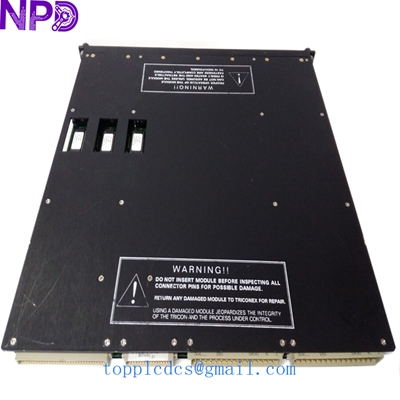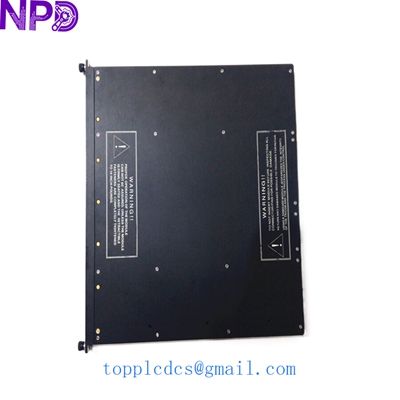
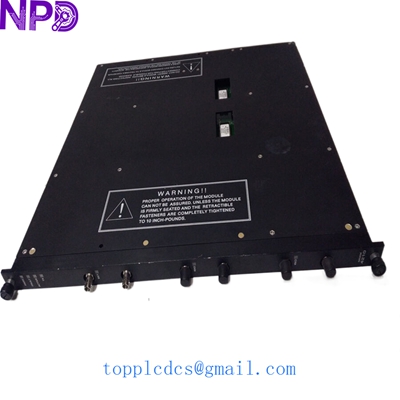
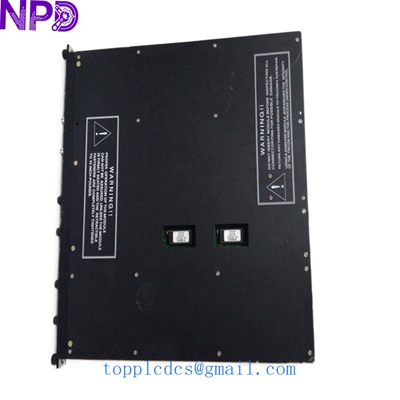

Description
- Model: TRICONEX 3721
- Brand: Schneider Electric (Triconex)
- Series: Tricon Triple Modular Redundant (TMR)
- Core Function: High-density Analog Input for Safety Instrumented Functions (SIF)
- Product Type: TMR Analog Input Module (Non-Isolated)
- Key Specs: 32 Channels | 0–5 VDC Input | TMR Architecture | SIL 3 Rated
- Number of Channels: 32, non-isolated
- Input Type: Differential, 0 to 5 VDC
- Resolution: 12 bits
- Accuracy: < 0.15% of FSR (0° to 60°C)
- TMR Architecture: Three independent sub-channels with hardware voting
- Update Rate: 10 ms (all 32 channels)
- Input Resistance: > 10 MΩ (Power On)
- Diagnostic Fault Coverage: > 99%
- Power Consumption: < 10 Watts
- Safety Rating: Suitable for SIL 3 applications (IEC 61508)
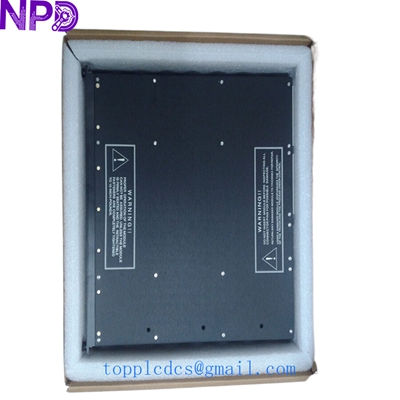
TRICONEX 3721
Application Scenarios & Pain Points
Engineering Pain Points: In a TMR system like Tricon, the 3721 is designed to provide high availability. However, because these are non-isolated modules, the biggest integrator “pitfall” is Common Mode Voltage. If your field sensors are powered by different sources or have ground loops, you will see “Leg Deviation” alarms in the TriStation software. When the three sub-channels (Leg A, B, and C) disagree by more than a calibrated threshold, the module will mark a leg as “Faulty,” even if the field signal is technically “okay.”
Typical Application Scenarios:
- Emergency Shutdown (ESD) Systems Monitoring critical pressure and level transmitters in oil and gas refineries where a failure to trip means a major safety incident.
- Fire and Gas (F&G) Systems Interfacing with 0-5V gas detectors or flame sensors where 24/7 uptime is legally mandated.
- Burner Management Systems (BMS) Managing air-to-fuel ratios and furnace pressures in large industrial boilers.
- Nuclear Power Plant Control Used in non-safety-critical but highly reliable control loops within reactor secondary systems.
The “Phantom Leg Fault” Case Study
Background: A chemical plant in the Middle East reported that their Triconex 3721 was reporting a “Leg C Deviation” fault every time the site’s heavy lightning protection system grounded out during storms.
Problem: The 3721 is a 0-5 VDC module. Most field transmitters are 4-20 mA. The plant used 250 Ω precision resistors at the external termination panel to convert the signal. Because the module is non-isolated, the “floating ground” during the storms was shifting the reference voltage for Leg C just enough to trigger a diagnostic mismatch.
Solution: We didn’t replace the module. Instead, we installed high-quality signal isolators between the field and the Triconex termination assembly.
Result: The “Phantom Faults” disappeared. This highlights that for the 3721, signal conditioning is as important as the card itself. If you don’t manage your grounds, the TMR diagnostics will be “too smart for their own good” and trip on noise.
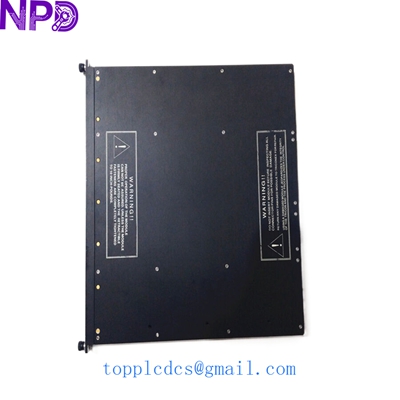
TRICONEX 3721
Compatible Replacement Models
| Original Model | Related/Replacement | Compatibility | Note |
| 3721 | 3721R | ✅ Direct Replace | “R” signifies Remote; identical function |
| 3721 | 3700 | ❌ Incompatible | 3700 is a 0-10V module; scaling is different |
| 3721 | 3720 | ⚠️ Software Compatible | 3720 is the 16-channel version; requires I/O re-mapping |
Integrator’s Tip: When replacing a 3721, always check the “Elco” connector on the backplane for bent pins. The high-density 56-pin connectors on Tricon racks are notoriously sensitive. If you force the module in, you’ll snap a pin and be looking at a much more expensive rack replacement.
Troubleshooting Quick Reference
| Symptom | Possible Cause | Related Part | Check Method |
| “PASS” Light is Off | Internal Logic Failure | ✅ 3721 | Check TriStation Diagnostic Monitor for “Fatal Error” |
| “FAULT” Light (Solid Red) | Module Self-Test Fail | ✅ 3721 | Replace module; internal RAM/Flash corruption |
| “ACTIVE” Light Off | Not Configured | ❌ System | Verify the slot is defined in the hardware configuration |
| Channel “Glitching” | Resistor Board Fault | ❌ Termination | Check the 250Ω resistor on the External Term Panel |
Field Note: …I’ve seen guys spend hours debugging a 3721 card when the problem was actually the External Termination Header (ETH). These cards are nearly bulletproof; if you have a single channel failure, it’s 90% likely to be the field wiring or the resistor block. If you have a “Leg Fault,” that’s when you start looking at the card’s internal A/D converters.
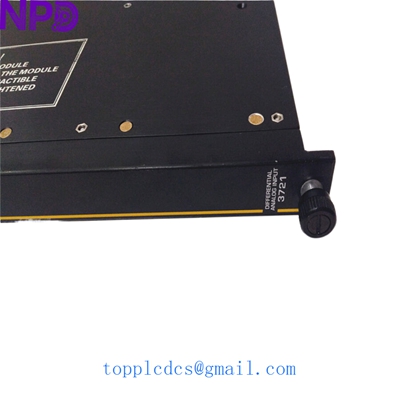
TRICONEX 3721
Strategic Quality Assurance (Our SOP)
- TMR Slot Test: The module is placed in a live Tricon rack. We verify that all three “Legs” (A, B, C) synchronize within 100ms.
- High-Density Channel Sweep: Using a precision voltage calibrator, we inject 1.25V, 2.5V, and 5.0V into all 32 channels.
- Redundancy Voting Test: We simulate a failure on one sub-channel to ensure the TMR “voting” logic continues to provide the correct output to the controller.
- Firmware Verification: We record the firmware version (e.g., v9.6) to ensure it matches the user’s specific system version.
Other Parts in Stock:
- Triconex 3625 (Digital Output)
- Triconex 3503E (Digital Input)
- newplcdcs
- ABB 3BSE018161R1
- Honeywell CC-PAIH01
- Bently Nevada 3500/22M
- Emerson KJ3203X1-BA1
- Siemens 6DD1682-0CH0