
Description
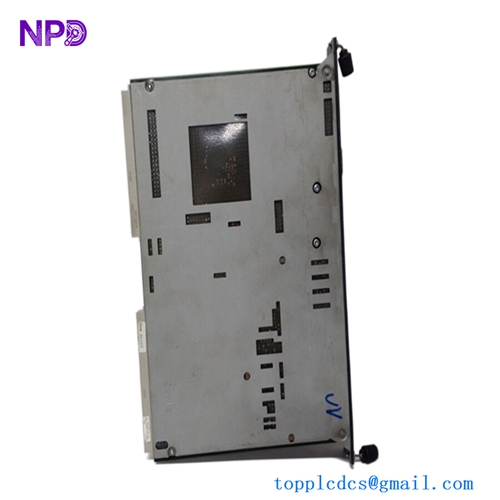
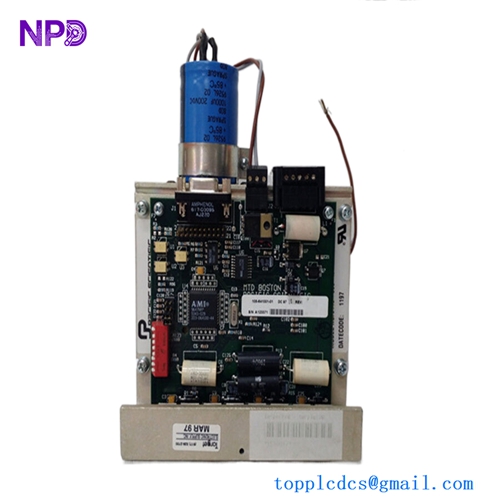
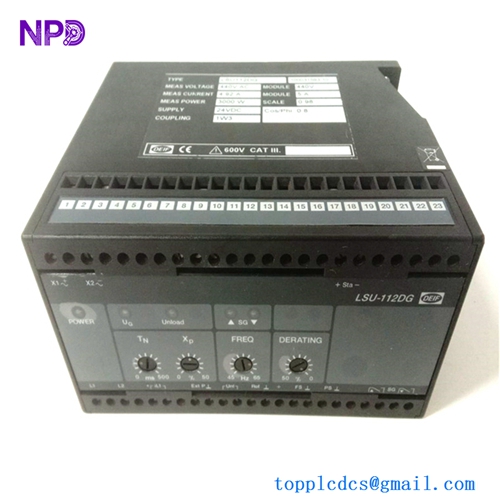
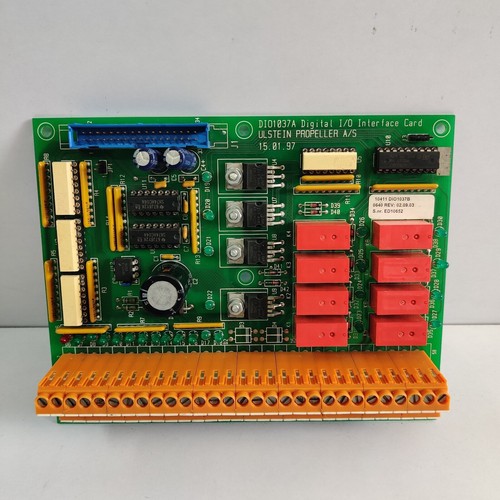
The Ulstein Propeller DIO1037A is a specialized Digital I/O Interface Card designed for marine propulsion control systems. As a critical link in the Ulstein (now part of Kongsberg Maritime) control ecosystem, this board manages the digital handshake between the propulsion control system and external field devices. It is responsible for processing discrete signals—such as start/stop commands, safety interlocks, and status feedback—ensuring reliable control of heavy-duty marine thrusters and propeller pitch systems.
📋 Technical Specifications
🔹 Part Number: DIO1037A 🔹 System Series: Ulstein / Kongsberg Marine Propulsion Control 🔹 Component Type: Digital Input/Output (I/O) Interface Card 🔹 Function: Discrete Signal Processing and Relay Logic 🔹 Operating Environment: Maritime Control Cabinets 🔹 Weight: Approximately 0.45 kg 🔹 Origin: Norway
🚀 Application Fields
⚡ Marine Propulsion and Thruster Control ⚓ Vessel Positioning and Maneuvering Systems ⚙️ Safety Interlock and Alarm Monitoring 🌊 Offshore Dynamic Positioning (DP) Interfaces
🛠️ Product Instructions
The DIO1037A is intended for rack mounting within an Ulstein-specific control cabinet. During installation, ensure the cabinet power is isolated to prevent accidental shorts. Use an anti-static wrist strap to protect the CMOS components. Slide the card into the backplane guides until the edge connector is fully seated. Ensure the retaining clips or screws are secure, as the high-vibration environment of a vessel’s engine room can cause loose cards to generate intermittent faults.
⚙️ Communication & Configuration Steps
⚙️ Address Mapping: The board’s discrete inputs and outputs are mapped to specific registers within the propulsion control processor. Configuration is typically updated via the Ulstein engineering interface or by setting address-defining jumpers on the card if the system is older legacy hardware. ⚙️ Station Number: The station ID identifies the card on the control bus. This is critical for systems with multiple I/O cards; ensure the address matches the configuration map defined during the vessel’s commissioning. ⚙️ Baud Rate: Communication speed is predefined by the Ulstein proprietary control bus. Ensure the bus is correctly terminated at the last card in the chain to maintain signal integrity.
🔋 Power-up Debugging Process
✅ Step 1: Verify the 24V DC power rail stability. ✅ Step 2: Observe the status LEDs on the front panel; a green “Power” LED and a blinking “Active” LED indicate the card is communicating with the main controller. ✅ Step 3: Use a multimeter to verify voltage presence on discrete inputs when field switches are activated. ✅ Step 4: Navigate the propulsion control panel interface to perform a “forced” test on outputs to verify relay switching.
📋 First-time Operation Checklist
✔️ Confirm the revision of the DIO1037A matches the existing hardware generation in the rack. ✔️ Inspect terminal block connections for signs of oxidation—a common occurrence in salt-mist environments. ✔️ Verify that all safety-critical inputs (e.g., Emergency Stop) are wired as “Fail-Safe” (Normally Closed). ✔️ Conduct a system-wide diagnostic check to ensure the propulsion control computer detects the card as “Online.”
❓ Frequently Asked Questions (Q&A)
❓ Q: What does it mean if an I/O channel LED is flickering? 💡 A: A flickering LED usually indicates a “chattering” signal, often caused by a loose field connection, a failing limit switch, or electrical noise from an unshielded cable running parallel to a motor power line.
❓ Q: Can I replace this card while the thrusters are active? 💡 A: No. Replacing an I/O card while the propulsion system is active will cause a loss of critical feedback and likely trigger a “System Trip.” Always perform this during a scheduled maintenance period or in a safe, static condition.
❓ Q: How does the DIO1037A protect the CPU from field voltage spikes? 💡 A: The card utilizes optical isolation for all input channels. This creates an electrical barrier between the high-voltage field side (24V/110V) and the sensitive, low-voltage control side (5V/3.3V) of the card’s processor.