Description
🔹 Product Overview
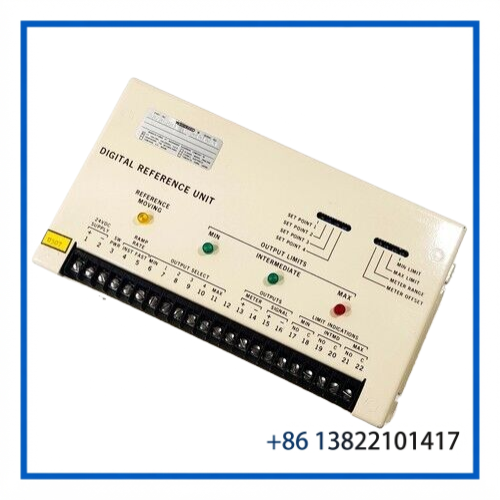
The WOODWARD 8272-221 REV.B is a Digital Reference Unit designed to generate a controlled reference signal for Woodward speed, load, and process-control applications. The 8272-221 is the direct-acting 0–6 V output version of the Digital Reference Unit family.
The unit provides selectable reference inputs and adjustable ramp functions, allowing an operator or control system to command changes in the reference signal at controlled rates. It can be used in applications where a precise electronic reference is required for an associated governor or control system.
The 8272-221 operates from a 24 VDC supply and uses screw-clamp terminals. It is a legacy Woodward component, making verified replacement units useful for maintaining installed generator, engine, turbine, and industrial control systems.
🔹 Key Features
- Woodward Digital Reference Unit
- Model 8272-221
- Revision B configuration
- Direct-acting 0–6 V reference output
- 24 VDC operating supply
- Selectable reference inputs
- Adjustable ramp-rate functions
- Minimum, intermediate, and maximum output limits
- Front-accessible adjustment controls
- Screw-clamp terminal connections
- Suitable for speed, load, and process-control applications
- Designed for legacy Woodward control-system maintenance
🔹 Technical Datasheet
| Parameter | Specification |
|---|---|
| Brand | WOODWARD |
| Model | 8272-221 |
| Revision | REV.B |
| Product Name | Digital Reference Unit |
| Product Type | Electronic Reference / Signal Generation Unit |
| Power Supply | 24 VDC |
| Reference Output | Direct Acting, 0–6 V |
| Control Function | Selectable Reference with Adjustable Ramp |
| Connections | Screw-Clamp Terminals |
| Application | Engine, Generator, Turbine and Industrial Control Systems |
🔹 Reference Signal Function
The Digital Reference Unit converts selected reference commands into a controlled analog output for an attached control system. The 8272-221 uses a direct-acting 0–6 V output, making it suitable for control systems requiring this reference range.
The unit provides multiple selectable reference levels and adjustable ramp rates. This allows the reference to change at a controlled rate instead of making an abrupt step change.
Typical applications include:
Operator / External Reference → 8272-221 → 0–6 V Reference → Woodward Speed or Load Control
🔹 Ramp and Set-Point Control
The 8272-221 includes adjustable reference set points and ramp-rate functions. The reference can be configured around low, intermediate, and high operating levels.
Ramp selection allows the rate of reference movement to be adjusted for the application. The manual describes slow, medium, fast, and instantaneous reference changes, with adjustment provided through the unit’s internal controls.
This function is useful when controlling generator loading, engine speed changes, or other processes where the rate of change of the reference must be controlled.
🔹 System Integration
A typical application can be arranged as:
Reference Selection → 8272-221 Digital Reference Unit → 0–6 V Signal → Governor / Speed / Load Control → Prime Mover
The unit can also provide meter-output functionality for monitoring the reference level. The associated control system should be checked to confirm its expected reference polarity, voltage range, and signal common.
Do not substitute the 8272-468, because that model uses an inverse-acting 6–0 V output rather than the direct-acting output of the 8272-221.
🔹 Installation & Commissioning
- Confirm the unit identification as 8272-221 REV.B.
- Verify that the receiving control system requires a direct-acting 0–6 V reference.
- Confirm the 24 VDC supply and system circuit common.
- Inspect screw terminals and wiring before energizing.
- Verify reference-input wiring and selected input configuration.
- Check low, intermediate, and high set-point adjustments.
- Verify the selected ramp-rate setting.
- Measure the reference output with suitable test equipment.
- Confirm the associated governor or control responds correctly.
- Test minimum, intermediate, and maximum reference commands.
- Verify ramp behavior before placing the prime mover into normal service.
🔹 Troubleshooting Guide
No output signal:
Check the 24 VDC supply, system common, input selection, terminal wiring, and internal protection/fuse conditions where applicable.
Output does not reach the expected voltage:
Verify the set-point adjustments, reference input, output connections, and measurement equipment.
Reference changes in the wrong direction:
Check whether the receiving control expects direct-acting or inverse-acting operation and verify signal polarity.
Reference changes too quickly:
Inspect the selected ramp-rate setting and associated adjustment potentiometers.
Reference does not change when the input is selected:
Check the input-selection circuit, external command wiring, and change-detection operation.
Intermittent operation:
Inspect terminal tightness, connectors, power quality, internal adjustment components, and PCB condition.
🔹 Maintenance
The 8272-221 is a legacy electronic control device, so maintenance should focus on stable power, clean connections, correct calibration, and proper environmental conditions.
During scheduled maintenance:
- Inspect screw terminals.
- Check the 24 VDC supply.
- Verify output voltage.
- Check reference set points.
- Test ramp-rate operation.
- Inspect indicators and adjustment controls.
- Compare actual output with the control-system requirements.
- Record calibrated settings for future replacement.
When removing the unit from a cabinet, follow appropriate ESD precautions because the control contains electronic circuit boards.
🔹 Replacement Considerations
Before replacing an existing unit, verify the following:
- 8272-221 part number
- Revision level
- 24 VDC supply requirement
- Direct-acting 0–6 V output
- Reference input arrangement
- Terminal configuration
- Ramp-rate requirements
- Set-point configuration
- Receiving governor or control model
- Existing plant wiring
The 8272-221 and 8272-468 are not interchangeable solely by model-family identification because their output actions differ.
🔹 Frequently Asked Questions
Q1: What is the Woodward 8272-221?
It is a Digital Reference Unit used to generate a controlled reference signal for compatible Woodward control systems.
Q2: What is the output of the 8272-221?
The 8272-221 is the direct-acting 0–6 V output version.
Q3: What power supply does it use?
The 8272-221 is identified as a 24 VDC Digital Reference Unit.
Q4: What is the difference between 8272-221 and 8272-468?
The 8272-221 provides a direct-acting 0–6 V output, while the 8272-468 provides an inverse-acting 6–0 V output.
Q5: Can it be used with a generator control system?
Yes. Digital Reference Units can be used with speed or load controls and other compatible engine, generator, turbine, and process-control systems.
Q6: Does it provide adjustable ramp rates?
Yes. The unit provides selectable ramp functions with adjustable ramp-rate settings.
Q7: Is the 8272-221 a current-generation Woodward product?
It is a legacy/discontinued product, so it is particularly relevant to maintenance and replacement of existing installations.
Q8: What should be checked before replacement?
Confirm the complete model, revision, supply voltage, output type, signal polarity, terminal wiring, and receiving control requirements.
🔹 10 Related Woodward Models
- Woodward 8272-468 Digital Reference Unit
- Woodward 8272-682 Digital Reference Unit
- Woodward 8272-683 Digital Reference Unit
- Woodward 8272-684 Digital Reference Unit
- Woodward 8272-685 Digital Reference Unit
- Woodward 2301A Load Sharing Control
- Woodward 2301A Speed Control
- Woodward 9905-xxxx Electronic Control Series
- Woodward 505 Digital Governor
- Woodward 9907 Speed Control Series
🔹 Product Summary
The WOODWARD 8272-221 REV.B Digital Reference Unit is a legacy electronic reference-control device providing a direct-acting 0–6 V output from a 24 VDC-powered unit. Its selectable inputs, adjustable set points, and controlled ramp functions make it suitable for compatible engine, generator, turbine, and industrial control applications.
For replacement projects, verify the output type and signal polarity carefully, especially when distinguishing the 8272-221 from the inverse-acting 8272-468.