
Description
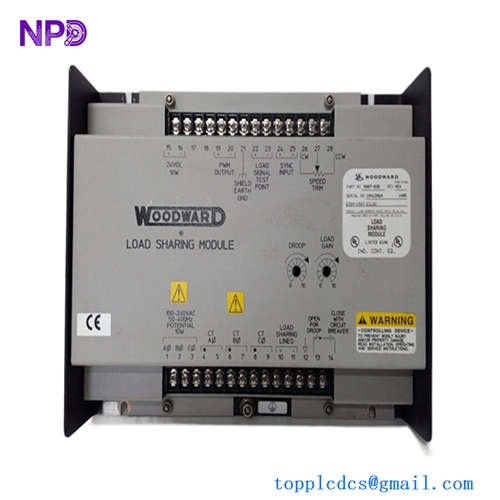
- The Woodward 8272-611 is an analog control module from the legacy 2301A series, specifically configured for low-voltage industrial power systems. This unit is designed to govern the speed of diesel or gas engines, as well as steam and gas turbines. It provides essential load sharing capabilities, allowing multiple generator sets to be operated in parallel while evenly balancing the kilowatt load proportionally across the system.
Product Specifications
- Model Number: 8272-611
- Manufacturer: Woodward
- Control Type: Analog Speed Control & Load Sharing
- Input Voltage: 18–40 VDC (Low Voltage Version)
- Power Consumption: 5 Watts maximum
- Speed Sensor Input: Magnetic Pickup (MPU) signal (1.0 to 30 Vrms)
- Actuator Output: 0–200 mA (Standard current loop for Woodward actuators)
- Load Sharing Line: ±2.5 VDC differential bus connection
- Operating Temperature: -40°C to +70°C
- Dimensions: 203mm x 113mm x 58mm
- Weight: 0.85 kg (1.87 lbs)
- Country of Origin: USA
Application Fields
The 8272-611 is heavily utilized in rugged, traditional power infrastructure setups where digital complexity is not required:
- Standby generator networks for critical industrial facilities.
- Prime power generation in marine vessels and offshore drilling platforms.
- Multi-engine parallel load systems in remote processing plants.
- Mechanical drive turbine systems requiring basic speed regulation.
Usage Instructions
Mount the Woodward 8272-611 securely inside a control panel away from high-temperature exhaust paths. Wiring must separate the high-current actuator lines from the sensitive, low-signal MPU speed cables. Connect twisted-pair shielded cables for the speed sensor to prevent electromagnetic interference from causing speed instability. Adjust the front-accessible potentiometers for “Gain” and “Stability” during initial engine commissioning to eliminate engine hunting. For proper load sharing, make sure all parallel controls share a common load-sharing line loop and that the “Load Gain” potentiometer is calibrated under a steady, known electrical load.
Frequently Asked Questions (Q&A)
Q: What is the main difference between the 8272-611 and a high-voltage version? A: The 8272-611 operates on an 18–40 VDC low-voltage power supply supply line. High-voltage models in the 2301A family are designed to accept 90–150 VDC or 85–250 VAC line inputs directly.
Q: Can this module interface directly with a modern PLC or SCADA system? A: Because it is a purely analog module, it does not feature digital serial or Ethernet protocols like Modbus. However, you can monitor its operation through standard analog inputs (like the actuator loop or load lines) routed to an external PLC analog input card.
Q: Why is the engine frequency dropping when a large load is applied? A: If the module is configured for “Droop” mode, a drop in frequency proportional to the load is normal behavior. If you require a constant frequency under any load, you must switch the system into “Isochronous” mode by closing the Isochronous/Droop terminal contacts.
Related Model Recommendations
- Woodward 8271-756 (2301A Load Sharing Module)
- Woodward 8273-501 (2301A Speed Control Only)
- Woodward 9907-018 (2301A High Voltage Chassis)
- Woodward 9907-173 (2301D Digital Control Upgrade)
- Woodward 8272-466 (2301A Standard Configuration)