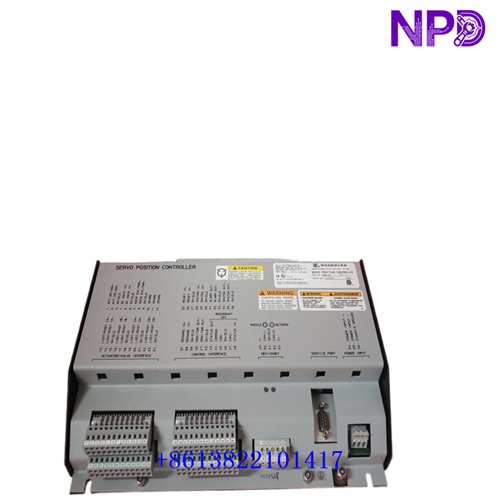

Description
⚙️ Product Specifications (Datasheet)
| Parameter | Value |
| Model / Part Number | 723PLUS Power Generation Series (P/N: 8280-415) |
| Device Type | Digital Microprocessor-Based Speed & Load Controller |
| Application Category | Power Generation (Generator Sets & Paralleling Systems) |
| Power Supply Voltage | High Voltage Version (90 to 150 VDC or 88 to 132 VAC @ 40 W max) |
| Load Sharing Type | Integral Analog Load Share Line Compatibility |
| Analog Outputs | 3 Dedicated Configurable Analog Outputs (Terminals 15/16, 17/18, 21/22) |
| Operating Temperature | -40°C to +70°C (-40°F to +158°F) |
| Housing Material | Heavy-Duty Sheet Metal Enclosure |
| Speed Sensor Inputs | 2 Independent Channels (Magnetic Pickups / MPU or Proximity Sensors) |
| Communication Ports | Dual RS-422 / RS-485 Serial Ports (Modbus RTU / ASCII) |
🚀 Standard Operating Procedure
- 🛠️ Pre-Start Loop Inspection: Confirm power input wiring matches High Voltage limits (88–132 VAC / 90–150 VDC). Verify signal integrity for analog outputs on terminals 15/16, 17/18, and 21/22, MPU sensors, and analog load-share lines.
- ⚡ Power On Sequence: Turn on the main power feed circuit breaker. Confirm front panel diagnostic LEDs illuminate and the internal 32-bit CPU completes initialization without active fault alarms.
- 🕹️ Control Mode Selection: Set initial operating mode (Isochronous, Droop, or Parallel Load Share) via terminal contacts or Modbus commands.
- 🏎️ Generator Set Start: Initiate the prime mover start routine. The 8280-415 tracks engine speed via dual speed channels and ramps fuel delivery to reach rated speed.
- 🔄 Synchronizing & Analog Load Sharing: Once paralleled to the bus, the integrated analog load-share circuitry continuously balances proportional kW load across connected generator sets.
- 📊 Analog Output Monitoring: Track 4–20 mA or 0–5 V signal outputs from terminals 15/16, 17/18, and 21/22 to send real-time operational telemetry (e.g., speed, fuel demand, load %) to remote panel meters or plant DCS.
- 🛑 Controlled Generator Stop: Issue a stop command to initiate a controlled unload sequence, open the generator breaker, and allow the prime mover to complete its cool-down cycle.
⚙️ Parameter Configuration Guide
- 💻 Connect a PC running Woodward Watch Window software or attach a Handheld Programmer (HHP) to the serial service port.
- 🔑 Log in using the authorized security level password to unlock programming and tuning parameters.
- 📑 Navigate to setup menus including Speed Dynamics, Analog Output Calibration (Terminals 15/16, 17/18, 21/22), Load Share Line Gain, and Breaker Interlocks.
- ✏️ Select and assign specific output functions to the three analog outputs (e.g., map Terminal 15/16 to Engine Speed, Terminal 17/18 to Actuator Demand %, and Terminal 21/22 to Generator Load kW).
- 💾 Select “Save Values” to store all updated settings into non-volatile EEPROM memory before closing the software session.
🔄 Manual / Automatic Mode Switching
- 🖐️ To Select Manual Mode: Actuate the designated local/manual contact switch or override setpoints using Watch Window software. Manual mode grants operators direct authority over local speed setpoints and valve limiters.
- 🤖 To Select Auto Mode: Toggle control input contacts back to Automatic mode. The controller automatically maintains speed loops, tracks remote speed/load references, and balances power distribution across parallel load-share lines.
❓ Frequently Asked Questions (Q&A)
- ❓ Q: How are the three analog outputs on terminals 15/16, 17/18, and 21/22 configured?
💡 A: Each analog output can be independently scaled and configured using Woodward Watch Window software to output standard 4–20 mA or 0–1 mA signals representing parameters like speed feedback, fuel demand, or kW load.
- ❓ Q: What is the main benefit of integral analog load sharing on power generation models?
💡 A: The analog load-share circuitry connects directly to a shared analog line between multiple generators, allowing instant real-power (kW) balancing without needing complex external supervisory controls.
- ❓ Q: What power input supply does model 8280-415 require?
💡 A: Model 8280-415 is a High-Voltage unit requiring an input voltage source of 88 to 132 VAC (47–63 Hz) or 90 to 150 VDC.