Description
Product Description
The WOODWARD ProAct mA 8400-015 is a digital speed control designed for engine and actuator control applications. Woodward identifies 8400-015 specifically as the ProAct mA Control with 0–200 mA actuator output. The controller works as part of a ProAct system and connects to an intermediate ProAct Driver, which then interfaces with the ProAct actuator. Woodward specifically notes that the 8400-015 does not require the same actuator replacement approach as newer speed controls because the actuator is matched to the ProAct Driver rather than directly to the 8400-015 speed control.
The ProAct mA control uses an external 18–32 VDC supply, with 24 VDC nominal operation, and supports magnetic pickup speed sensing. The system can also provide remote speed-setting and auxiliary inputs for load-sharing applications. Woodward documentation describes the controller as a board-based assembly housed in an aluminum enclosure, with external connections through terminal blocks and a 9-pin D-sub connector.
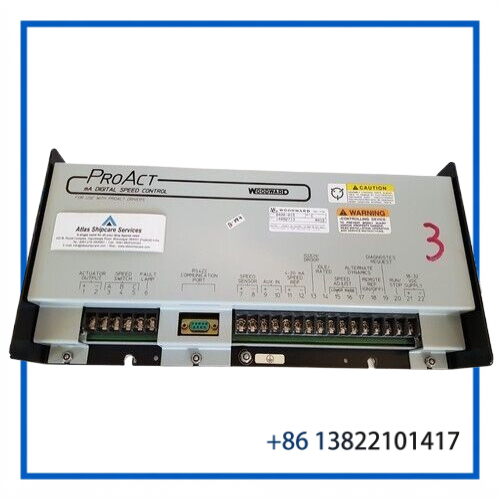
8400-015
The supplied listing identifies the unit as 8400-015 REV.C and used. The exact revision, wiring configuration, actuator/driver combination, and programmed settings should be checked against the existing engine control system before replacement.
Product Parameters
| Parameter | Specification |
|---|---|
| Brand | WOODWARD |
| Product Family | ProAct |
| Model | 8400-015 |
| Product Type | ProAct mA Digital Speed Control |
| Control Function | Engine / actuator speed control |
| Actuator Output | 0–200 mA |
| Speed Input | Magnetic Pickup (MPU) |
| Supply Voltage | 18–32 VDC |
| Nominal Supply | 24 VDC |
| Remote Speed Input | 4–20 mA |
| Controller Construction | PCB assembly in shielded enclosure |
| External Connections | Terminal blocks and 9-pin D-sub |
| Associated Driver | ProAct Driver |
| Associated Actuator | ProAct I / II / III / IV depending on system configuration |
| Manual | Woodward Manual 04177 |
| Revision | REV.C per supplied listing |
| Condition | Used; verify actual condition |
| Application | Industrial engine and power-generation control |
| Discontinued / Legacy Status | Legacy product; replacement strategy should be checked against the existing ProAct system |
FAQ
Q: What is the WOODWARD 8400-015?
A: It is a ProAct mA digital speed control. Woodward identifies 8400-015 as the ProAct mA control with a 0–200 mA actuator output.
Q: What type of actuator does the 8400-015 control?
A: The 8400-015 works through an intermediate ProAct Driver. The driver connects to the actuator, so actuator compatibility should be determined from the ProAct Driver and complete system configuration.
Q: What is the power supply requirement?
A: Woodward documentation specifies an 18–32 VDC supply, with 24 VDC as the nominal supply voltage.
Q: What is the actuator output?
A: The 8400-015 is the ProAct mA version with a 0–200 mA actuator control output.
Q: Can the 8400-015 be replaced directly by another ProAct speed control?
A: Replacement should be checked carefully. Woodward’s application note specifically identifies 8400-015 as a special case and states that it does not need to be changed in the referenced actuator update; the actuator is matched to the ProAct Driver.
Q: What should be checked before installation?
A: Verify the 8400-015 part number and revision, supply voltage, MPU signal, 0–200 mA output wiring, ProAct Driver model, actuator model, and programmed engine-control settings.
Recommended Related WOODWARD Models
- 8400-010 | ProAct Model II Speed Control
- 8400-055 | ProAct Model II Fuel Limit Control
- 8400-059 | ProAct Speed Control
- 8400-061 | ProAct Fuel Limit / Speed Control
- 9905-462 | ProAct Model I Speed Control
- 9905-463 | ProAct Model II Speed Control
- 9905-792 | ProAct Plus 4–20 mA Fuel Limiter
- 9907-1289 | ProAct Model I Speed Control
- 9907-1290 | ProAct Model II Speed Control
- 8400-706 | ProAct I/II Driver
Woodward’s ProAct documentation lists 8400-010, 8400-015, 8400-055, 9905-462, 9905-463, and 9905-792 among the legacy ProAct speed/fuel-control products, while its replacement guidance also identifies the corresponding newer control and driver configurations.