
Description
Product Specifications
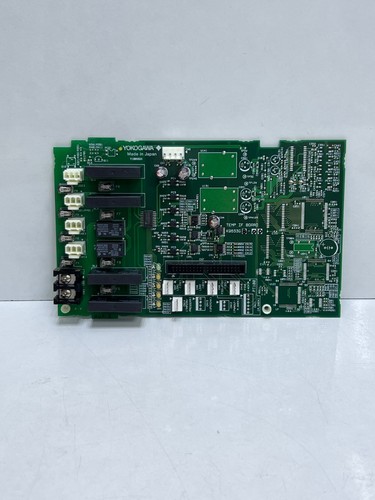
| Attribute | Specification |
|---|---|
| Model Number | K9633GB-00 |
| Product Type | Temperature Interface (IF) Board |
| System Compatibility | Yokogawa CENTUM CS / CS 3000 / VP Systems |
| Input Signal Type | Thermocouple (TC) / RTD (Resistance Temperature Detector) |
| Circuit Configuration | Analog Signal Conversion & Conditioning |
| Dimensions | 130 mm x 130 mm x 20 mm |
| Weight | 0.32 kg |
| Origin | Japan |
| Mounting | Plug-in PCB for Field Control Unit (FCU) |
Application Fields
The Yokogawa K9633GB-00 is a high-performance interface module designed to bridge field temperature sensors with the Distributed Control System (DCS). It is widely used in:
- Refining and Petrochemicals: Precise monitoring of reactor and furnace temperatures.
- Power Plants: Measuring steam and boiler feed water temperatures.
- Food & Beverage: Temperature control for pasteurization and sterilization processes.
- Pharmaceuticals: Maintaining strict thermal environments in fermentation and synthesis.
- Metal & Mining: Monitoring high-temperature smelting and casting operations.
Product Instructions
- Installation: Slide the K9633GB-00 into the designated slot within the Yokogawa I/O rack. Ensure the card is fully seated in the backplane to establish a reliable electrical connection.
- Calibration: While the board is factory-calibrated, system-level calibration should be performed during commissioning to account for lead-wire resistance in RTD applications or cold-junction compensation in thermocouples.
- Wiring: Ensure the field sensor wires are connected to the appropriate terminal block. Use shielded twisted-pair cables to minimize electromagnetic interference (EMI) on the low-voltage temperature signals.
- Signal Integrity: Avoid routing temperature sensor cables near high-voltage power lines. The K9633GB-00 features onboard filtering, but external cable management is essential for maximum accuracy.
Product Q&A
Q1: Can the K9633GB-00 handle both Thermocouples and RTDs simultaneously? A1: This depends on the specific hardware configuration and the terminal board it is paired with. Generally, these boards are configured for a specific input type across the channels, though some Yokogawa modules support mixed-signal inputs via software configuration.
Q2: What is the most common cause of a “Burnout” alarm on this board? A2: A “Burnout” or “Open Circuit” alarm typically indicates a physical break in the field wiring or a failed sensor. Check the continuity of the thermocouple or RTD element at the terminal block.
Q3: Is the K9633GB-00 interchangeable with newer Yokogawa temperature modules? A3: The K9633GB-00 is part of a specific generation of Yokogawa hardware. While newer systems like CENTUM VP may support it via legacy I/O nodes, it is important to verify the specific I/O bus and software version for compatibility.
Related Product Models
- YOKOGAWA K9633GA
- YOKOGAWA K9633GC
- YOKOGAWA SAI143
- YOKOGAWA SAV144
- YOKOGAWA SAT145