
Description
Product Description
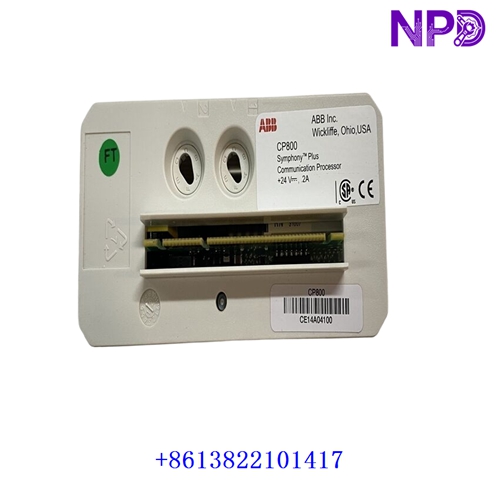
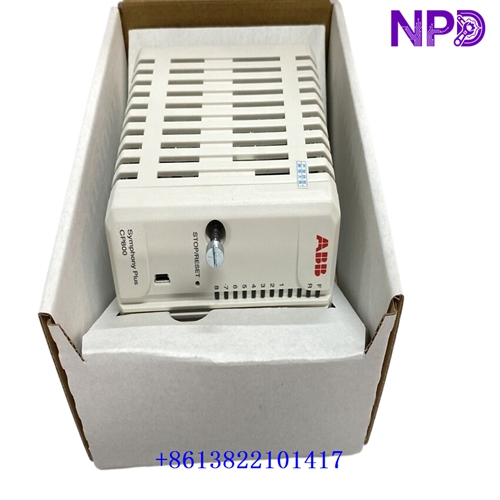
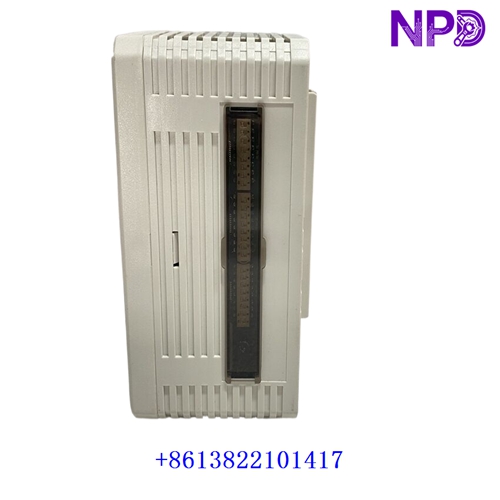
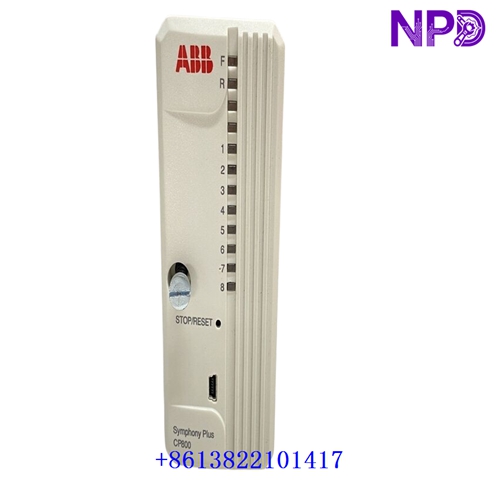
The ABB CP800 is a communication processor module designed for the HPC800 Harmony Process Controller within the ABB Symphony Plus distributed control system. Its primary function is to provide communication between the HC800 control processor and the PN800 Ethernet-based plant network. It supports data exchange between controller resources, network-connected devices, and other system components, making it an important part of the HPC800 control architecture. The CP800 uses a 32-bit processor operating at 256 MHz and provides 64 MB of RAM and 4 MB of ROM. It supports 10/100 Mbps communication over PN800 and 4 Mbps communication over the CW800 control network. The module is mounted on the MB810 mounting base and works with the associated communication termination units and bus terminators. Typical applications include power generation, industrial process control, plant-wide automation, and distributed control system communication. For replacement projects, verify firmware compatibility, network configuration, hardware revision, and the associated HC800 processor before installation.
CP800
Product Datasheet
| Parameter | Specification |
|---|---|
| Brand | ABB |
| Model | CP800 |
| Product ID | CP800 |
| Series | Symphony Plus / Harmony HPC800 |
| Product Name | Communication Processor Module |
| Product Type | Controller Communication Module |
| Main Function | Provides PN800 plant network communication for HPC800 |
| Associated Controller | HC800 Harmony Control Processor |
| Processor | 32-bit processor |
| Processor Speed | 256 MHz |
| Memory | 64 MB RAM |
| ROM | 4 MB |
| PN800 Communication Rate | 10/100 Mbps |
| CW800 Communication Rate | 4 Mbps |
| Plant Network | PN800 Ethernet-based network |
| Control Network | CW800 |
| System Capacity | Supports up to 3,937 addressable PN800 nodes, according to the HPC800 documentation |
| Power Supply | +24 V DC |
| Power Consumption | 5 W |
| Current Consumption | 200 mA at 24 V DC |
| Mounting Base | MB810 |
| Installation | Keyed connection to MB810 base; DIN-rail mounting |
| Operating Temperature | 0 to +55 °C |
| Storage Temperature | −40 to +85 °C |
| Relative Humidity | 20–95%, non-condensing, subject to temperature limits |
| Air Quality | ISA S71.04 G1 standard |
| Dimensions | 243.84 × 170.18 × 73.66 mm (supplier-listed package dimensions; verify actual module envelope) |
| Weight | Approximately 0.99 kg (supplier-listed value) |
| Country of Origin | Not verified; confirm the individual unit label |
| Product Status | Symphony Plus HPC800 system component |
| Condition | Confirm against the actual item’s inspection and sales description |
| Discontinued | Current manufacturer lifecycle status not verified |
First-Time Operation Inspection Checklist
- 🔍 Part number verification: Confirm the CP800 model and inspect the product label, serial number, and hardware revision.
- 🧰 Physical inspection: Check the enclosure, connector contacts, locking mechanism, and mounting interface for damage.
- 🔌 Power verification: Confirm a regulated +24 V DC supply with the correct polarity and sufficient capacity.
- 🧩 Base compatibility: Verify that the MB810 mounting base is installed and that the module is correctly keyed and seated.
- 🖥️ Controller compatibility: Confirm that the associated HC800 processor and CP800 hardware revisions are compatible.
- 🌐 Network inspection: Check PN800 Ethernet connections, network addressing, and communication paths.
- 🔄 Control network verification: Confirm CW800 communication and the correct network address settings.
- 💡 Status inspection: Review the module’s Fault LED and operation/diagnostic LEDs during startup.
- 📋 Configuration backup: Save existing controller and communication configuration before replacing the module.
- 🧪 Communication test: Verify data exchange between HC800, PN800, and connected plant network devices.
Daily Maintenance
- 🔎 Check the CP800 Fault LED and diagnostic indicators.
- 🌐 Monitor PN800 and CW800 communication status.
- 🔌 Inspect the 24 V DC supply for voltage instability and loose connections.
- 🌡️ Maintain cabinet temperature within the specified operating range.
- 🧹 Keep the module and mounting base free from dust and conductive contamination.
- 📊 Review communication diagnostics and network error records.
- 📝 Record hardware revisions, firmware versions, communication faults, and maintenance activities.
- 💾 Maintain backups of controller configuration and network settings.
- 🛠️ Inspect mounting-base connections and terminal assemblies during scheduled shutdowns.
Troubleshooting and Frequently Asked Questions
Q1: What is the main function of the ABB CP800?
The CP800 provides communication between the HC800 control processor and the PN800 Ethernet-based plant network within the HPC800 controller architecture.
Q2: Is the CP800 a standalone controller?
No. It is a communication processor module. It works with the HC800 control processor and the associated HPC800 mounting and communication components.
Q3: What is the difference between HC800 and CP800?
The HC800 executes control functions and process-control applications. The CP800 handles communication between the HPC800 controller and the PN800 plant network.
Q4: What power supply does the CP800 require?
The documented requirement is +24 V DC at approximately 200 mA, with a nominal power consumption of 5 W.
Q5: Which communication networks does the CP800 support?
The documented interfaces include PN800 at 10/100 Mbps and CW800 at 4 Mbps. Verify the actual network topology and application configuration before connecting the module.
Q6: Why does the CP800 show a red Fault LED?
Possible causes include an internal module fault, firmware problems, incorrect network addressing, or communication configuration errors. Read the operation and diagnostic LED pattern and follow the ABB troubleshooting procedure.
Q7: Can the CP800 be replaced without changing the HC800?
A module replacement may be possible, but compatibility must be verified. Check the hardware and firmware revisions of both primary and redundant controller components, as well as the existing network configuration.
Q8: Is the CP800 used in redundant HPC800 systems?
Yes. The HPC800K02 configuration includes two HC800 modules and two CP800 modules. Redundant installations require matching configuration and compatible revision levels.
Q9: What should be checked if PN800 communication is interrupted?
Inspect the Ethernet connection, network addressing, communication configuration, module status, and associated network infrastructure. Also check the CW800 communication path where relevant.
Q10: Which mounting base is used with the CP800?
The CP800 is designed for the MB810 mounting base. Confirm the base, communication termination units, and bus terminators before installation.
Safety Precautions
- ⚠️ Follow the plant’s lockout/tagout procedure before removing or installing the module.
- ⚡ Verify the +24 V DC supply and polarity before energizing.
- 🧤 Use ESD protection when handling the electronic module.
- 🔧 Do not force the CP800 into an incompatible mounting base.
- 🌐 Confirm network settings and communication addresses before connecting the module to the plant network.
- 📘 Verify firmware and hardware revision compatibility before replacing a module in a redundant controller.
- 🚫 Do not remove or reset the module without checking the effect on controller communication and plant operation.
- 🧪 Perform communication and diagnostic tests before returning the system to normal operation.
- 🏭 Follow ABB installation and maintenance documentation for the complete HPC800 assembly.
Recommended ABB Related Models
The following modules and components belong to the ABB Symphony Plus and HPC800 controller architecture. They are useful for spare-parts identification and system maintenance, but are not all direct replacements for the CP800.
- HC800 – Harmony Control Processor
- HPC800K01 – Non-Redundant HPC800 Controller Kit
- HPC800K02 – Redundant HPC800 Controller Kit
- MB810 – HPC800 Module Mounting Base
- CTB810 – Communication Termination Board, Left
- CTB811 – Communication Termination Board, Right
- TER800 – HNet Bus Terminator
- PNI800 – PN800 Network Interface Module
- SPC800 – Symphony Plus Controller
- SPBRC410 – Symphony Plus Bridge Controller
- SD Series Controller – Symphony Plus Controller Family
- Harmony INFI 90 – Distributed Control System Family
- INNIS21 – Network Interface Module
- INICT12 – Computer Interface Module
- INNPM12 – Network Processing Module