
Description
Product Description
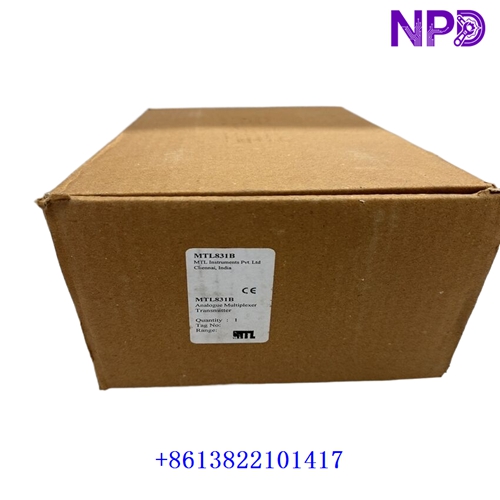
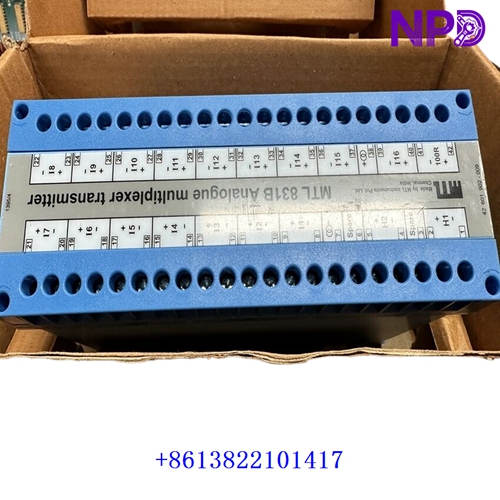
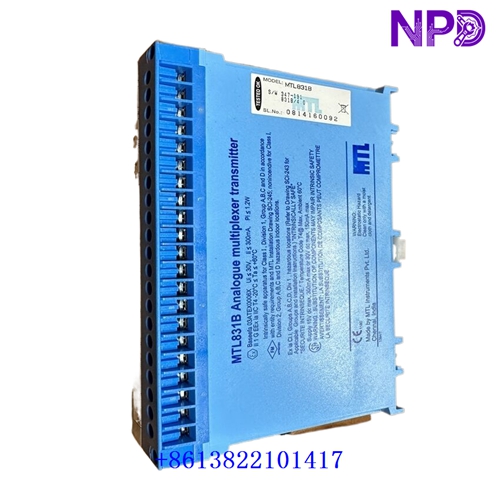
The MTL831B is an intrinsically safe analog multiplexer transmitter from the MTL800 series, designed to acquire multiple temperature and millivolt signals in hazardous industrial areas and transmit the measurement data to a receiver in a safe area.
The transmitter supports up to 16 thermocouple (THC) or millivolt input channels, or up to 15 RTD input channels. It accepts 2-wire, 3-wire, and 4-wire RTD configurations. Thermocouple and RTD inputs can also be mixed on the same transmitter, subject to the selected channel configuration.
The MTL831B communicates through two data highway connections, providing a redundant transmission arrangement. These connections carry both communication signals and operating power from the receiver, eliminating the need for a separate hazardous-area power supply at the transmitter.
Designed for applications requiring remote temperature measurement, the MTL831B can be installed in suitable hazardous-area locations, including Zone 0, when the complete installation complies with the applicable intrinsic-safety certification and system requirements.
MTL831B
Product Datasheet
- Brand: MTL Instruments
- Manufacturer: MTL / Eaton
- Model: MTL831B
- Product Name: IS Analog Multiplexer Transmitter
- Product Series: MTL800
- Product Type: Intrinsically Safe Analog Input Transmitter
- Thermocouple / Millivolt Inputs: Up to 16 channels
- RTD Inputs: Up to 15 channels
- RTD Wiring: 2-wire, 3-wire, or 4-wire
- Mixed Input Capability: Thermocouple and RTD inputs
- Millivolt Measuring Ranges: ±10 mV, ±25 mV, or ±60 mV, autoranging
- RTD Measuring Range: -200 to +850 °C for Pt100
- RTD Excitation Current: 100 µA
- Data Highway: Dual redundant
- Communication and Power: Transmitted through the data highway
- Typical Response Time: Approximately 1 second per transmitter
- Operating Temperature: -20 to +60 °C
- Storage Temperature: -40 to +80 °C
- Intrinsic Safety Classification: Zone 0, IIC, T4, subject to the applicable certification and installation conditions
- Mounting: DIN rail or flat-surface mounting
- Weight: Approximately 1.3 kg
- Power Supply: Loop-powered through the data highway from the receiver
- Country of Origin: Not independently verified
- Product Status: Legacy model; MTL831C is identified as its newer system-generation successor
Technical Features & Specifications
- Multi-Channel Signal Acquisition: Supports up to 16 thermocouple or millivolt inputs, or up to 15 RTD inputs.
- Flexible Sensor Configuration: Supports 2-wire, 3-wire, and 4-wire RTDs, with thermocouple and RTD inputs configurable on the same transmitter.
- Millivolt Measurement: Provides selectable ±10 mV, ±25 mV, and ±60 mV ranges with automatic ranging.
- Temperature Measurement: Supports Pt100 RTD measurement from -200 to +850 °C.
- Measurement Accuracy: Thermocouple, RTD, and millivolt measurement accuracy is specified as less than 0.1% of measuring range at 20 °C, with additional sensor-dependent temperature effects.
- Dual Data Highways: Provides two redundant data highway connections. Either or both can be used according to the system design.
- Integrated Power Transmission: Receives operating power through the data highway from the safe-area receiver.
- Intrinsic Safety: Designed for installation in hazardous areas, including Zone 0, subject to approved system configuration.
- Multi-Transmitter Operation: Supports one or two transmitters in the applicable receiver arrangement.
- Remote Signal Transmission: Transfers hazardous-area measurement signals to the safe area through a twisted-pair data highway.
- DIN-Rail Mounting: Supports installation in an industrial field enclosure or suitable control panel.
Application Scenarios & Pain Points
- Oil and Gas Facilities: Collects temperature measurements from hazardous-area process equipment, pipeline installations, and production facilities.
- Chemical Processing: Acquires thermocouple and RTD signals from reactors, storage tanks, and process vessels.
- Refineries: Consolidates multiple temperature measurement points for transmission to a central control system.
- Power Generation: Supports remote temperature monitoring of auxiliary equipment and process systems.
- Tank Farms: Provides centralized acquisition of temperature signals from distributed field instruments.
- Hazardous-Area Instrumentation: Reduces the need for individual signal cables running from each field sensor to the safe-area control room.
First-Time Installation Checklist
- Confirm the transmitter label identifies the MTL831B.
- Inspect the housing, terminals, connectors, and mounting clips for damage.
- Verify the hazardous-area classification and installation location.
- Confirm compatibility with the MTL838B-MBF receiver and MTL3052 isolator arrangement.
- Check the applicable intrinsic-safety entity parameters and certification documentation.
- Select the correct input mode for each channel: thermocouple, millivolt, or RTD.
- Verify RTD wiring configuration: 2-wire, 3-wire, or 4-wire.
- Check thermocouple type, polarity, and extension-cable compatibility.
- Connect the redundant data highways according to the system wiring diagram.
- Verify transmitter addressing and internal configuration switch settings.
- Confirm the receiver recognizes the transmitter and reports valid channel data.
- Perform temperature simulation and signal validation before putting the system into service.
Daily Maintenance
- Review temperature readings and diagnostic status through the associated receiver.
- Check for abnormal or fluctuating sensor measurements.
- Inspect field sensor wiring and terminal connections.
- Check data highway connections for mechanical damage or loose wiring.
- Verify the condition of the associated MTL3052 isolator and MTL838B-MBF receiver.
- Inspect the enclosure for moisture, dust, corrosion, or other environmental damage.
- Check the transmitter’s operating temperature against the specified limits.
- Maintain records of sensor configuration, transmitter addressing, and maintenance activities.
Troubleshooting & Frequently Asked Questions
Q1: What is the MTL831B?
The MTL831B is an intrinsically safe analog multiplexer transmitter designed to collect thermocouple, millivolt, and RTD signals from hazardous-area instruments.
Q2: How many input channels does it support?
It supports up to 16 thermocouple or millivolt inputs, or up to 15 RTD inputs. The actual channel capacity depends on the selected sensor configuration.
Q3: Can thermocouple and RTD inputs be mixed?
Yes. The MTL831B supports mixed thermocouple and RTD configurations. Individual channel input modes must be configured using the appropriate internal switches.
Q4: Does the MTL831B require a separate 24 V DC power supply?
No separate hazardous-area power supply is required. The transmitter receives power through the data highway from the associated receiver.
Q5: Which receiver is compatible with the MTL831B?
The MTL838B-MBF is the associated receiver. It converts the transmitter’s data into serial Modbus output for connection to a suitable control or monitoring system.
Q6: What is the purpose of the MTL3052?
The MTL3052 is a digital isolator used in the data highway arrangement when the MTL831B is installed in a hazardous area. The installation must follow the approved system configuration.
Q7: What should be checked if the receiver cannot detect the transmitter?
Check data highway wiring, transmitter addressing, receiver configuration, isolator connections, cable resistance, and the associated power supply path.
Q8: Can the MTL831B be replaced directly by the MTL831C?
No. Eaton identifies the MTL831C as part of a newer system-generation replacement solution. Replacing an MTL831B installation requires evaluating the complete transmitter, isolator, receiver, and configuration-software arrangement.
Safety Precautions
- Installation and maintenance must be performed by personnel qualified in hazardous-area instrumentation.
- Follow applicable IEC/EN 60079 installation and maintenance requirements and local regulations.
- Verify the intrinsic-safety certification and entity parameters for the complete transmitter, isolator, and field-circuit arrangement.
- Do not connect unauthorized power sources to the transmitter.
- Confirm sensor cable capacitance and inductance limits before installation.
- Do not modify internal configuration switches while the equipment is energized unless the approved procedure permits it.
- Verify thermocouple polarity and RTD wiring before commissioning.
- Use approved enclosures when the installation environment requires additional ingress protection.
- Do not substitute an MTL831C or another transmitter without checking the complete system compatibility requirements.
Recommended Related Models & Components
The following products are associated with the MTL800 series and its transmitter/receiver architecture. They are related components, not all direct replacements for the MTL831B.
- MTL838B-MBF – Associated Modbus Receiver
- MTL3052 – Digital Data Highway Isolator
- MTL831C – Newer-generation Analog Multiplexer Transmitter
- MTL838C – Newer-generation Receiver
- MTL5553 – Newer-generation Digital Isolator
- MTL821B – MTL800 Series Multiplexer Transmitter for switched inputs
- MTL830 Series – Analog Multiplexer System Family
- MTL800 Series – Remote Analog Multiplexer System
- ENC8 – MTL Field Enclosure
- ENC8-SS – Stainless Steel Field Enclosure
- ENC83 – MTL Field Enclosure
- ENC83-SS – Stainless Steel Field Enclosure
- PCL45USB – MTL Configuration Interface
- PCS45 – MTL Configuration Software
- MTL838B-MBF Receiver Configuration – Associated receiver setup and configuration documentation