Description
🛡️ Product Overview
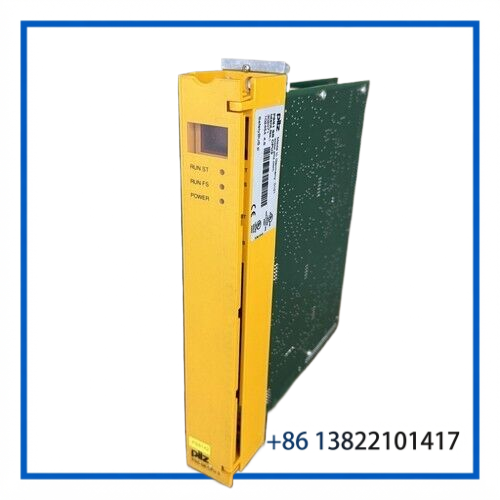
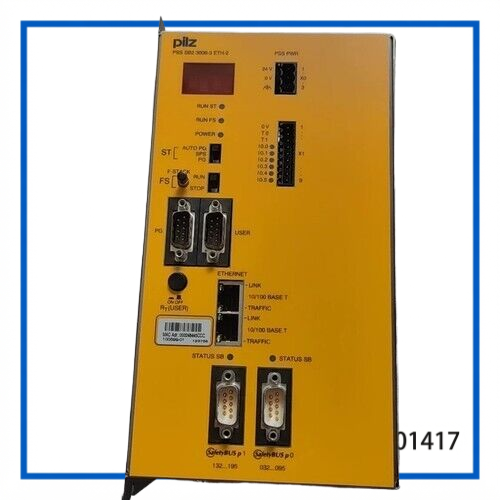
The PILZ PSS SB2 3006-3 ETH-2 is a decentralized safety controller designed for Pilz SafetyBUS p safety-control systems. The manufacturer identifies this unit with Product ID 301640 and classifies its application as standard/failsafe.
This compact PSS unit integrates digital safety inputs, test-pulse outputs, SafetyBUS p communication, and an Ethernet interface in one industrial control device. It is suitable for legacy machine-safety systems where the installed architecture depends on the PSS/SafetyBUS p platform.
The unit operates from a 24 V DC supply and provides 6 digital inputs, 2 test-pulse outputs, 2 SafetyBUS p interfaces, and 1 Ethernet interface.
Pilz currently identifies Product ID 301640 as no longer available, making correctly identified surplus or replacement stock particularly relevant for maintenance of existing installations.
📋 Product Datasheet
| Parameter | Specification |
|---|---|
| Brand | PILZ |
| Model | PSS SB2 3006-3 ETH-2 |
| Product ID | 301640 |
| Product Series | PSS / SafetyBUS p |
| Product Name | SafetyBUS p Safety Controller |
| Product Type | Decentralized Safety Control |
| Application | Standard / Failsafe |
| Supply Voltage | 24 V DC |
| Digital Inputs | 6 |
| Test Pulse Outputs | 2 |
| SafetyBUS p Interfaces | 2 |
| Ethernet Interfaces | 1 |
⚙️ Key Features
- Pilz PSS third-generation safety-control platform
- Decentralized safety control architecture
- SafetyBUS p communication
- 6 integrated digital inputs
- 2 test-pulse outputs
- 2 SafetyBUS p interfaces
- 1 integrated Ethernet interface
- 24 V DC supply
- Potentially isolated digital inputs
- Suitable for standard and failsafe applications
- Designed for industrial machine-safety systems
🔌 Communication & System Integration
The PSS SB2 3006-3 ETH-2 is designed to operate within a SafetyBUS p architecture rather than functioning as a generic standalone PLC.
The SafetyBUS p connections use 9-pin D-Sub male connectors. The integrated Ethernet interface provides connectivity to Ethernet-based devices and configuration/service environments.
Pilz documentation for the ETH-2 interface specifies Ethernet cabling based on at least Category 5 standards and supports 10Base-T or 100Base-TX. The documentation also describes an internal autosensing switch for process-data exchange between Ethernet participants.
When replacing an installed unit, verify:
- SafetyBUS p network architecture
- Connected PSS modules
- Safety program configuration
- Ethernet configuration
- Input/output wiring
- Connector type and pin assignment
- Existing PSS software/project compatibility
A visually similar PSS module should not be assumed to be a direct substitute.
🏭 Industrial Applications
Typical applications for this type of Pilz safety controller include:
- Machine safety control
- Production machinery
- Automated manufacturing equipment
- Conveyor and material-handling systems
- Safety interlocking
- Emergency-stop systems
- Guard monitoring
- Industrial safety networks
- Legacy SafetyBUS p installations
- Machinery modernization and maintenance
The device is particularly relevant when maintaining an existing PSS/SafetyBUS p installation where replacing the complete safety architecture would require substantial engineering changes.
🛠️ Installation & Maintenance
Before Installation
- Confirm the model marking PSS SB2 3006-3 ETH-2.
- Verify Product ID 301640.
- Record the existing PSS hardware configuration.
- Back up the applicable safety-control project.
- Document SafetyBUS p connections.
- Document Ethernet connections and network settings.
- Inspect the replacement unit for storage or shipping damage.
During Installation
- Disconnect power according to the machine’s approved safety procedure.
- Verify the 24 V DC supply before energizing.
- Reconnect SafetyBUS p wiring according to the original configuration.
- Check the D-Sub connectors for damage or contamination.
- Reconnect Ethernet only after verifying the network configuration.
- Confirm that all safety-related wiring matches the approved machine documentation.
Maintenance
For legacy PSS installations, keep records of:
- Product ID
- Hardware revision
- Safety project version
- Network configuration
- Connected SafetyBUS p nodes
- Replacement-unit test results
- Installation date
- Operating environment
🔍 Troubleshooting
The controller does not start
Check the 24 V DC supply, polarity, protective devices, terminal connections, and connector seating.
SafetyBUS p communication fails
Inspect both SafetyBUS p connections and verify the network configuration. Check the associated PSS devices and safety-system diagnostics before replacing the controller.
Ethernet communication is unavailable
Check the Ethernet cable, RJ45 connection, network configuration, and connected Ethernet equipment. Pilz documentation specifies 10Base-T/100Base-TX-compatible Ethernet infrastructure for the ETH-2 interface.
Digital inputs do not respond correctly
Verify the 24 V DC input signals, field wiring, sensor condition, and the corresponding safety-program configuration.
Test-pulse diagnostics fail
Check the connected safety sensors, wiring, input configuration, and test-pulse connections.
Replacement unit cannot be commissioned
Because this is a legacy safety-control component, verify the complete hardware configuration and safety-program compatibility rather than treating the unit as a generic PLC replacement.
✅ First-Operation Checklist
- Model confirmed: PSS SB2 3006-3 ETH-2
- Product ID confirmed: 301640
- 24 V DC supply verified
- SafetyBUS p network documented
- D-Sub connectors inspected
- Ethernet connection verified
- Safety program backup completed
- Input wiring checked
- Test-pulse wiring checked
- Safety diagnostics completed
- Ethernet communication tested
- SafetyBUS p communication tested
- Machine safety functions tested under controlled conditions
❓ FAQ
What is the PILZ PSS SB2 3006-3 ETH-2?
It is a decentralized safety-control unit for Pilz PSS/SafetyBUS p systems. Pilz identifies it by Product ID 301640.
Is it a standard PLC?
It should not be treated as a generic PLC. It is specifically designed for standard/failsafe applications within the Pilz PSS safety-control architecture.
How many digital inputs does it have?
The manufacturer specifies 6 digital inputs.
How many test-pulse outputs are available?
The unit provides 2 test-pulse outputs.
How many SafetyBUS p interfaces are included?
The PSS SB2 3006-3 ETH-2 has 2 SafetyBUS p interfaces using 9-pin D-Sub male connectors.
Does it have Ethernet?
Yes. The unit includes one Ethernet interface.
What is the supply voltage?
The specified supply voltage is 24 V DC.
Is this model still manufactured?
Pilz currently marks Product ID 301640 as no longer available. This makes verified spare stock useful for maintaining existing installations.
Can another PSS module automatically replace it?
No. A replacement should be selected based on the complete SafetyBUS p architecture, hardware configuration, safety program, communication interfaces, and field wiring.
🔧 Related PILZ Models / Series
- PSS SB 3006-3 ETH-2
- PSS SB2 3006-3 DP-S
- PSS SB2 3006-3 IBS-S
- PSS SB2 3006-3 CN-A
- PSS SB2 3006-3 ETH-2 DP-S
- PSS SB2 3006-3 ETH-2 IBS-S
- PSS SB2 3006-3 DN-S
- PSS SB CPU3 ETH-2
- PSS SB 3047-3 ETH-2
- PSS SB 3075-3 ETH-2
These are related PSS/SafetyBUS p products or variants documented by Pilz; they should not be considered automatic drop-in replacements for Product ID 301640.
📦 Spare-Parts & Lifecycle Planning
Because 301640 is now listed by Pilz as no longer available, lifecycle planning is particularly important for installations that still depend on this hardware.
Recommended practices include:
- Keep at least one verified spare for production-critical systems.
- Record the exact Product ID 301640.
- Maintain a backup of the installed safety project.
- Record SafetyBUS p topology and connected nodes.
- Store Ethernet configuration information with the spare.
- Test replacement units before placing them into long-term storage.
- Use ABC classification for critical safety-control components.
- Maintain buffer stock where equipment downtime has high production impact.
- Verify hardware revision and condition before installation.
- Consider last-time-buy planning for other obsolete PSS/SafetyBUS p components.
For safety-related equipment, replacement and commissioning should always be performed by appropriately qualified personnel using the machine’s approved safety documentation.