Description
🔹 Product Overview
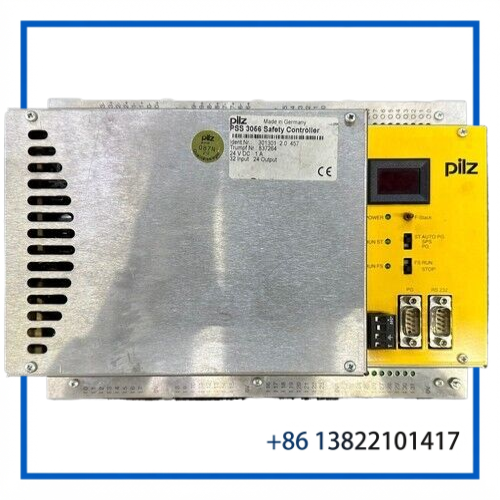
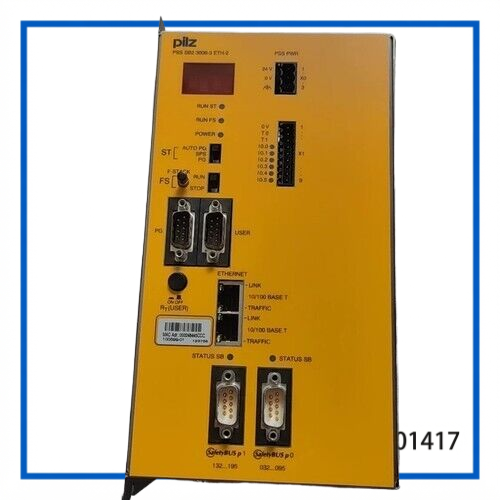
The PILZ PSS1 SB CPU3 302071 is a central processing unit for the PILZ PSS 3100 modular safety PLC platform, designed for standard and failsafe control applications with an integrated SafetyBUS p interface. It is identified as PSS1 SB CPU3, order number 302071.
The module combines safety and control processing within a PSSmodular architecture and is intended to work with compatible PSS1 power supplies, module racks, I/O modules, and SafetyBUS p components. The documented application range is standard/failsafe, with a SIL CL value of SIL3 in the referenced technical data.
This is a legacy PILZ PSS 3100-series component, so replacement work should be based on the exact order number, hardware version, existing rack configuration, safety project, and installed peripheral modules.
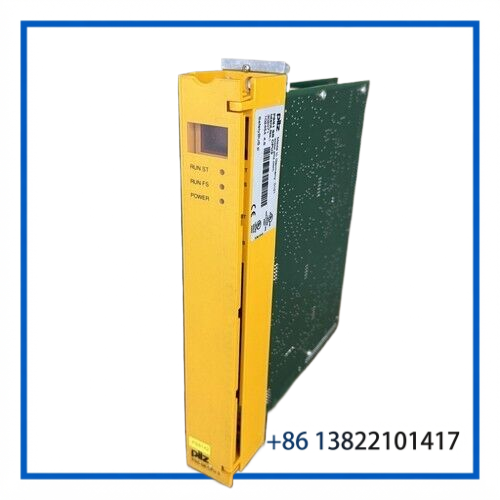
🔹 Product Datasheet
| Parameter | Specification |
|---|---|
| Brand | PILZ |
| Model | PSS1 SB CPU3 |
| Order Number | 302071 |
| Series | PSS 3100 / PSSmodular |
| Product Name | Safety PLC Central Processing Unit |
| Safety Network | SafetyBUS p |
| Application Range | Standard / Failsafe |
| Safety Classification | SIL CL 3 |
| Dimensions | Approx. 41 × 265 × 218 mm |
| Weight | Approx. 665 g net / 1.019 kg gross |
The PSSmodular documentation lists 302071 specifically as the PSS1 SB CPU3 within the PSS 3100 central processing units with SafetyBUS p.
🔹 Key Features
- PSS 3100-series central processing unit
- Standard and failsafe control capability
- Integrated SafetyBUS p functionality
- Designed for modular PSS architecture
- SIL CL 3 application capability according to referenced documentation
- Suitable for industrial safety and machine-control systems
- Compatible with the appropriate PSS1 rack, power supply, I/O and communication modules
- Legacy-system replacement option where the original CPU is still required
🔹 SafetyBUS p & System Integration
The PSS1 SB CPU3 is intended for systems using PILZ SafetyBUS p. The SafetyBUS p interface allows the CPU to participate in a distributed safety-control architecture with compatible safety components.
For replacement projects, the CPU should not be evaluated independently from the complete system. Verify:
- Existing PSS1 module rack
- PSS1 power supply
- SafetyBUS p network structure
- Connected I/O modules
- Safety project and configuration
- CPU hardware/version information
- Existing communication interfaces
- Field wiring and connector arrangement
- Required safety functions and validation documentation
The related PSS1 SB CPU3 ETH-2, order number 302081, is a separate model with Ethernet functionality and should not be treated as a direct substitute without confirming the system configuration.
🔹 Industrial Applications
The PSS1 SB CPU3 can be found in legacy safety-control installations such as:
- Machine safety systems
- Production and assembly machinery
- Material-handling equipment
- Industrial automation lines
- Safety interlocking systems
- Distributed safety-control architectures
- Factory automation equipment
- Existing PSSmodular installations requiring CPU replacement
🔹 Installation & Maintenance
Before installation, confirm that the replacement unit is exactly PSS1 SB CPU3 / 302071 and that its hardware version is suitable for the existing PSS 3100 system.
Recommended procedure:
- Record the existing CPU order number and hardware/version information.
- Document rack position and all connected PSS1 modules.
- Back up the existing safety-control project and configuration.
- Isolate system power according to the machine safety procedure.
- Inspect connectors, rack contacts, terminals and SafetyBUS p wiring.
- Install the CPU into the compatible PSS1 modular rack.
- Restore the approved configuration.
- Check SafetyBUS p communication and diagnostic indications.
- Verify all safety inputs and outputs.
- Perform the required safety validation before returning the machine to production.
For a safety PLC, configuration backup and functional validation should be treated as part of the replacement process rather than simply replacing the hardware.
🔹 Troubleshooting
CPU does not start:
Check the compatible PSS1 power supply, rack connections, supply wiring and module seating.
SafetyBUS p communication fault:
Inspect the SafetyBUS p cable, connectors, network topology, connected nodes and configuration.
Configuration mismatch:
Confirm that the installed CPU model, hardware version and project configuration correspond to the original system.
I/O functions are incorrect:
Check module positions, I/O configuration, wiring and the safety program before changing field wiring.
Replacement CPU will not operate correctly:
Compare the complete hardware configuration rather than replacing the CPU alone. Differences in rack, I/O, communication or safety configuration may affect system operation.
🔹 First-Operation Checklist
☑ Verify PSS1 SB CPU3 / 302071
☑ Check CPU hardware/version information
☑ Confirm compatible PSS1 rack and power supply
☑ Inspect SafetyBUS p connections
☑ Confirm all installed I/O modules
☑ Back up and verify the safety project
☑ Check diagnostic indicators
☑ Test safety communication
☑ Test individual safety functions
☑ Complete documented safety validation before production operation
🔹 FAQ
What is PILZ PSS1 SB CPU3 302071?
It is a PSS 3100-series central processing unit designed for standard and failsafe control applications with SafetyBUS p functionality.
Is 302071 the same as PSS1 CPU3 302064?
No. 302064 is the PSS1 CPU3, while 302071 is the PSS1 SB CPU3 with SafetyBUS p functionality.
Is PSS1 SB CPU3 a safety PLC?
Yes. It is a central processing unit for the PSSmodular safety PLC architecture and is documented for standard/failsafe applications.
Can 302081 replace 302071?
Not automatically. PSS1 SB CPU3 ETH-2 302081 is a different model. Compatibility must be confirmed against the complete system architecture and required interfaces.
Is this module suitable for an existing PSS 3100 system?
It is specifically listed as a PSS 3100 central processing unit with SafetyBUS p, but the complete rack, power supply, I/O, configuration and safety project should be checked before installation.
🔹 Related PILZ Models
- PILZ PSS1 CPU3 — 302064
- PILZ PSS1 SB CPU3 ETH-2 — 302081
- PILZ PSS1 PS 24 — 302051
- PILZ PSS1 BMP 5/2 — 302006
- PILZ PSS1 BMPS 3/1 — 302007
- PILZ PSS1 BMPS 3/3 — 302008
- PILZ PSS1 DI 2 — 302101
- PILZ PSS1 DIF — 302105
- PILZ PSS1 DO S — 302111
- PILZ PSS1 ETH-2 — 302160
These components belong to the broader PSS 3100/PSSmodular product family; exact compatibility should always be checked against the original system configuration.
🔹 Spare-Parts & Lifecycle Planning
For legacy PSSmodular installations, maintaining a spare CPU can reduce downtime when an unexpected hardware failure occurs. A practical inventory strategy is to classify the 302071 CPU, power supply, rack, SafetyBUS p components and critical I/O modules separately according to failure impact.
For critical machines, maintain:
- One tested CPU spare where justified
- Backup copies of approved safety configurations
- Records of CPU hardware/version information
- Spare SafetyBUS p cables and connectors
- A list of installed PSS1 I/O modules
- Replacement verification procedures
- Last-time-buy or migration planning for aging systems
Because exact hardware compatibility matters in safety applications, the order number 302071 should be matched before purchasing or installing a replacement.