
Description
Product Description
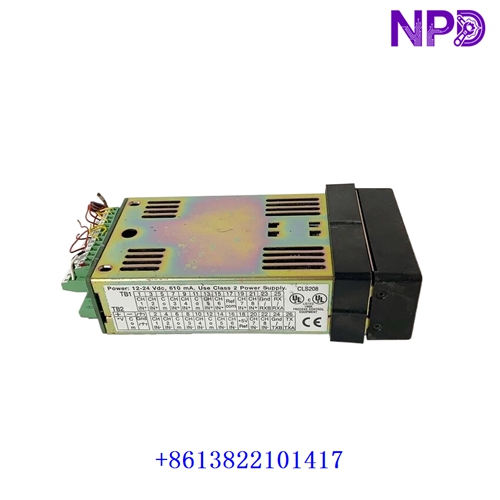
The Watlow Anafaze CLS208 is an eight-loop temperature and process controller in the CLS200 series. It is designed for applications that require independent monitoring and PID control of multiple heating or cooling zones from one compact panel-mounted instrument.
The CLS208 accepts a range of process sensors, including thermocouples, RTDs, linear voltage and current transmitters, and pulse inputs. Its control functions include PID regulation, auto-tuning, sensor-failure detection, and configurable process and deviation alarms.
Depending on the firmware option, the controller can also provide ramp-and-soak sequencing, cascade control, ratio control, differential control, remote analog setpoint, and process-variable retransmission.
The controller includes built-in serial communications for configuration, monitoring, and data acquisition. EIA/TIA-232 and EIA/TIA-485 interfaces are available, with Modbus RTU and an ANSI X3.28-compatible protocol.
The CLS208 is suitable for industrial heating systems, plastics processing equipment, thermal production lines, and other multi-zone process applications.
CLS208
Product Datasheet
| Parameter | Specification |
|---|---|
| Brand | Watlow Anafaze |
| Model | CLS208 |
| Series | CLS200 |
| Product Type | Multi-Loop Temperature and Process Controller |
| Number of Control Loops | 8 |
| Control Method | PID |
| Display | 32-character vacuum fluorescent display |
| Operator Interface | 8-key keypad with menu-guided operation |
| Analog Inputs | 8 differential inputs |
| Sensor Types | Thermocouples, RTDs, linear voltage/current, pulse |
| Thermocouple Types | B, E, J, K, R, S, T |
| RTD Support | 2-wire or 3-wire platinum, 100 Ω at 0 °C |
| Linear Input Ranges | 0–20 mA, 4–20 mA, 0–5 V DC, 0–10 V DC |
| Control Functions | PID, auto-tune, alarms |
| Optional Firmware | Ramp and soak; enhanced control features; custom |
| Digital I/O | Depends on terminal-board configuration |
| Serial Interfaces | EIA/TIA-232 or EIA/TIA-485 |
| Communication Protocols | Modbus RTU; ANSI X3.28-compatible protocol |
| Selectable Baud Rates | 2,400, 9,600, or 19,200 |
| Power Requirement | 15–24 V DC ±3 V DC |
| Maximum Current | 1 A |
| Panel Format | 1/8 DIN |
| Product Status | Confirm with manufacturer or supplier |
| Country of Origin | Confirm from nameplate |
Technical Features & Specifications
1. Eight Independent Control Loops
The CLS208 provides eight differential analog inputs for multi-zone temperature and process control. Each loop can be configured for its assigned sensor, setpoint, control behavior, and alarm requirements.
This arrangement reduces the need for multiple individual temperature controllers in applications with several heating zones.
2. Multiple Sensor Input Options
The controller supports a range of temperature and process input types:
- Thermocouples: Types B, E, J, K, R, S, and T
- RTD: 2-wire or 3-wire platinum, 100 Ω at 0 °C
- Linear current: 0–20 mA and 4–20 mA
- Linear voltage: 0–5 V DC and 0–10 V DC
- Pulse input: TTL-level square wave up to 2 kHz
RTD support and certain linear input configurations require the appropriate hardware options and scaling resistors. Verify the installed input configuration before connecting field sensors.
3. PID Control and Auto-Tuning
The CLS208 supports closed-loop PID control and automatic tuning. Operators can configure setpoints and control parameters through the front-panel keypad.
Control outputs can be configured for on-off time proportioning or distributed zero-crossing operation, depending on the output arrangement and application.
4. Firmware Options
The CLS200 family offers several firmware configurations:
- Standard firmware: PID control, auto-tune, alarms, job memory, and sensor-failure detection.
- Ramp-and-soak firmware: Adds programmed temperature ramping and soak sequencing.
- Enhanced firmware: Adds cascade, ratio, and differential control, remote analog setpoint, and process-variable retransmission.
- Custom firmware: Application-specific functions supplied by Watlow.
The installed firmware option should be checked before purchasing a replacement. Two CLS208 units may have different control capabilities.
5. Digital Inputs and Outputs
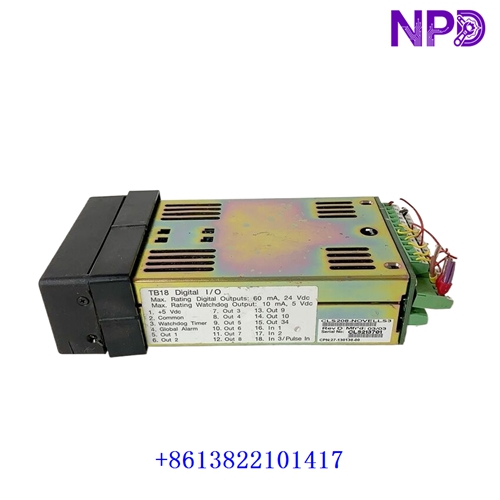
Digital I/O availability depends on the selected termination option.
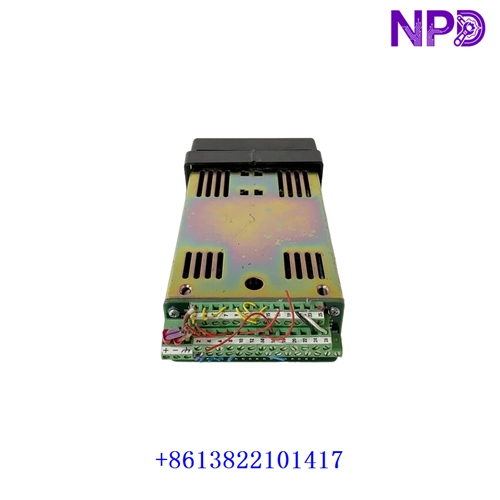
The mass-termination configuration provides access through a 50-pin SCSI connector and compatible TB50 terminal board. The TB18 screw-terminal option is available for CLS208 and limits the accessible digital I/O.
The controller supports digital inputs for functions such as job selection and ramp-and-soak triggering. Digital outputs can be assigned to control and alarm functions.
6. Serial Communication
The controller supports EIA/TIA-232 or EIA/TIA-485 communication, with selectable baud rates of 2,400, 9,600, and 19,200.
Supported communication protocols include Modbus RTU and an ANSI X3.28-compatible protocol. Check the communication interface, wiring, address, protocol, and jumper settings before connecting the CLS208 to a PLC, computer, or supervisory system.
7. Alarm and Diagnostic Functions
The CLS208 provides independent process and deviation alarms for each channel. Alarm behavior can include programmable deadband, delay, and startup suppression.
Sensor-failure detection helps identify open, shorted, or reversed thermocouple connections. A global alarm output and watchdog output are also provided.
Application Scenarios & Pain Points
- Plastics processing: Independent temperature regulation across multiple barrel and heating zones.
- Extrusion equipment: Multi-zone temperature control and optional ramp-and-soak sequencing.
- Industrial ovens: Monitoring and regulation of several heating sections.
- Thermal processing lines: Maintaining configured temperature profiles during production.
- Packaging machinery: Temperature control for sealing and heating stations.
- Manufacturing equipment: Integration of multiple temperature loops into a compact controller.
First-Time Installation Checklist
- Verify the complete model and ordering code on the controller nameplate.
- Confirm that the installed unit is the eight-loop CLS208 version.
- Identify the firmware option: Standard, Ramp and Soak, Enhanced, or Custom.
- Confirm the terminal arrangement: SCSI connector, TB18, or TB50.
- Check the installed power-supply arrangement and required DC voltage.
- Verify thermocouple, RTD, current, voltage, and pulse input configurations.
- Check scaling resistors where required for RTD or linear inputs.
- Confirm control-output assignments and external power interfaces.
- Verify serial communication type, cable wiring, baud rate, and protocol.
- Back up existing control parameters, alarm settings, and job configurations.
- Test all eight input channels and their associated control outputs.
- Verify alarm operation and independent over-temperature shutdown devices before production.
Daily Maintenance
- Check the display for abnormal readings, alarm indications, and channel status.
- Compare process values with independent temperature measurements when required.
- Inspect sensor wiring and terminal connections for looseness or corrosion.
- Check thermocouple polarity and RTD wiring arrangements.
- Review control outputs for unexpected switching or sustained full-power operation.
- Monitor communication stability and investigate repeated data errors.
- Keep the controller and its enclosure free from dust, moisture, and conductive contaminants.
- Maintain backups of configuration parameters and stored job settings.
- Verify independent safety shutdown devices according to the plant maintenance schedule.
Troubleshooting & Frequently Asked Questions
Q1: What is the Watlow Anafaze CLS208?
It is an eight-loop temperature and process controller from the CLS200 series, designed for multi-zone PID control and process monitoring.
Q2: How many temperature zones can it control?
The CLS208 provides eight control loops. The actual number of active heating or cooling zones depends on the installed output configuration and application wiring.
Q3: Which thermocouples are supported?
The CLS200 specification lists Types B, E, J, K, R, S, and T.
Q4: Does the CLS208 support RTD sensors?
Yes. The eight-loop CLS208 supports 2-wire and 3-wire platinum RTDs rated at 100 Ω at 0 °C. The required scaling resistors and input configuration must be verified.
Q5: Does it support Modbus?
Yes. The CLS200 supports Modbus RTU through its EIA/TIA-232 or EIA/TIA-485 serial interface.
Q6: What is the power requirement?
The specified controller supply is 15–24 V DC ±3 V DC, with a maximum current of 1 A. Confirm the supply arrangement and wiring against the actual unit and installation manual.
Q7: What is the difference between CLS208 and CLS204?
CLS208 is the eight-loop version, while CLS204 is the four-loop version. Their channel counts and some input and terminal configurations differ.
Q8: Can a CLS208 with standard firmware replace one with enhanced firmware?
Not necessarily. Enhanced firmware provides additional control functions, including cascade, ratio, differential, and remote analog setpoint capabilities. Confirm the original application requirements before substitution.
Q9: Why does the controller show an incorrect temperature?
Possible causes include incorrect sensor type selection, reversed thermocouple wiring, damaged sensor leads, improper RTD connections, incorrect scaling resistors, or electrical interference.
Q10: What should be checked before ordering a replacement?
Confirm the complete ordering code, firmware type, terminal-board option, power-supply arrangement, serial communication settings, and installed sensor configuration.
Safety Precautions
- Disconnect process power before installation, wiring, or maintenance.
- Use a suitable Class 2 power supply where required by the installation and applicable UL requirements.
- Follow local electrical codes for wiring, fuses, and circuit protection.
- Separate low-level sensor wiring from high-voltage and high-current power cables.
- Provide proper grounding and shielding to reduce electrical interference.
- Use ESD protection when handling internal electronic components.
- Set safe operating limits before initiating auto-tuning; the controller may drive the output to 100% during this process.
- Do not rely solely on controller alarms or output override functions for emergency shutdown.
- Install independent, approved over-temperature and safety shutdown devices where hazardous conditions could result from controller failure.
Recommended Related Models & Components
The following are related Watlow CLS200 controllers, termination hardware, and accessories. They are not all direct replacements for the CLS208.
- Watlow CLS204 – Four-Loop Controller
- Watlow CLS216 – Sixteen-Loop Controller
- Watlow TB18 – Screw-Terminal Digital I/O Option
- Watlow TB50 – 50-Pin Digital I/O Terminal Board
- Watlow DAC – Digital-to-Analog Converter
- Watlow SDAC – Serial Digital-to-Analog Converter
- Watlow CLS200 SCSI Cable – Controller-to-TB50 Connection
- Watlow CLS200 Serial Communication Cable – RS-232/RS-485 Connection
- Watlow CLS200 Power Supply Adapter – Compatible DC Supply Option
- Watlow Type J Thermocouple – Temperature Sensor
- Watlow Type K Thermocouple – Temperature Sensor
- Watlow Type T Thermocouple – Temperature Sensor
- Watlow Platinum RTD – 100 Ω Temperature Sensor
- Watlow 4–20 mA Temperature Transmitter – Linear Process Input
- Watlow CLS200 Configuration and Communication Accessories
Confirm exact part numbers, connector styles, and firmware requirements when sourcing accessories or replacement equipment.