
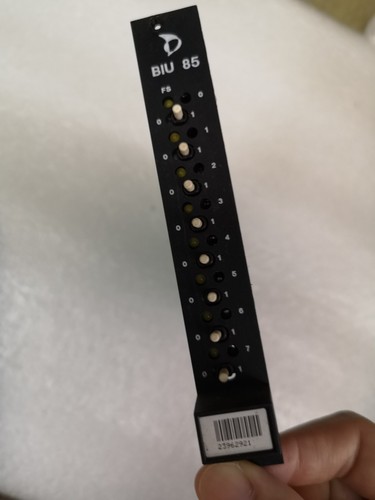
The Valmet Metso Automation A413144 is a specialized BIU 8-5 Binary Input Unit (Board) designed for use within legacy Valmet/Metso Distributed Control Systems (DCS) and marine automation platforms (such as Damatic Classic or Damatic XD / DNA architectures). This module functions as a rugged digital interface, capturing binary field signals—such as limit switch statuses, valve positions, relay contacts, and alarm indicators—and translating them into isolated logic-level data for the system’s central processing units. Engineered for extreme reliability, the A413144 is a staple in both heavy-scale land-based processing facilities and marine vessel alarm/monitoring systems where continuous uptime is essential.
Technical Specifications
The following parameters outline the technical composition of the A413144 interface board:
- Part/Model Number: A413144
- Type Designation: BIU 8-5 (Binary Input Unit)
- Manufacturer: Valmet Automation (formerly Metso Automation)
- Signal Type: Binary / Digital Inputs
- Channel Configuration: Grouped isolated binary channels (typically 8 channels based on series designation)
- Input Voltage Range: Standard industrial 24V DC wet/dry contact sensing (configuration dependent)
- Isolation: Galvanic opto-isolation between field inputs and backplane logic
- Dimensions: Standard Eurocard size for rack installation (approx. 234mm x 160mm)
- Weight: 0.58 kg
Application Fields
The A413144 board is heavily relied upon in both maritime and specialized process control networks:
- Marine & Shipbuilding: Integrated into centralized machinery space monitoring, ship alarm systems, and bilge/tank level switch interfaces.
- Pulp & Paper Mills: Managing discrete status monitoring for conveyor systems, safety interlocks, and valve feedback sequences.
- Power Generation: Routing binary plant trip conditions, circuit breaker positions, and auxiliary equipment run/stop feedbacks.
- Chemical Treatment: Handling remote digital inputs from process fields where galvanic isolation against ground loops is required.
Product Instructions and Handling
The A413144 is a slide-in rack module that interfaces with the system via a dedicated backplane connector. Before inserting or extracting the board, verify the local node instructions; while many legacy Metso racks support hot-swapping under specific parameters, it is safest to ensure the channel loops are stable to prevent accidental system trips. Field wiring lands on external terminal assemblies connected via multi-pin ribbon cables to the front or rear of the rack. Due to the proximity of high-frequency filtering capacitors and micro-logic circuits on the PCB, use strict ESD (Electrostatic Discharge) safety practices, including a grounded wrist strap when removing the board from its anti-static packaging. Inspect the gold-plated edge fingers for contamination or oxidation before reseating.
Questions and Answers
Q: What is the main distinction of the BIU 8-5 designation? A: The designation represents a “Binary Input Unit” within this specific generation of Valmet hardware, featuring a specific configuration of input thresholds, filtering times, and channel densities tailored to standard process logic.
Q: Does the board provide interrogation voltage to the field contacts? A: Depending on the carrier rack jumper or wiring configuration, the system can provide internal 24V DC loop power to clear dry contacts, or it can be configured to accept externally powered signals.
Q: How do the diagnostic indicators on the front plate assist in troubleshooting? A: Onboard LEDs reflect the real-time state of each individual binary channel. If a field switch closes but the corresponding LED remains unlit, it points directly to an open circuit in the field wiring or a failure in that specific channel’s opto-isolator.
Product Related News: Extending the Lifecycle of Proven Systems
In the contemporary industrial sector, the longevity of legacy platforms like Damatic is a primary focus for maintenance managers. Valmet and Metso systems installed in the late 1990s and 2000s continue to drive highly profitable operations globally. Because a full DCS upgrade can incur massive capital expenditure and lengthy shutdowns, sourcing high-quality, original spare components like the A413144 BIU board is a vital lifecycle extension strategy. Recent engineering practices emphasize treating these sub-assemblies with component-level maintenance—such as replacing aging electrolytic capacitors—to ensure they continue to meet original factory specifications. Keeping active spares on hand ensures that critical alarm loops and safety interlocks remain functional, guaranteeing operational continuity in challenging industrial environments.


