
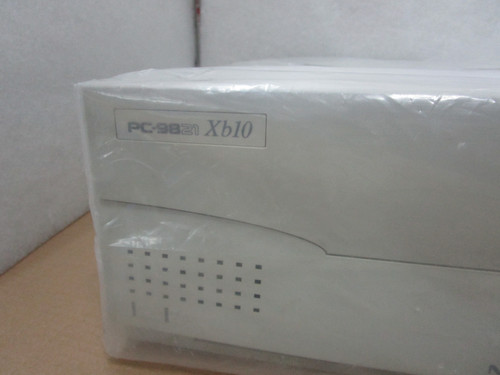
The NEC PC-9821Xb10 is a specialized industrial-grade personal computer belonging to the legendary PC-9800 series, specifically the “98CANBE” family. Unlike consumer models of the era, the Xb10 was engineered for reliability in factory automation, laboratory environments, and dedicated control systems. It utilizes NEC’s proprietary 16/32-bit architecture, which was the dominant computing standard in Japan for decades. The Xb10 model is particularly valued for its balance of performance and legacy compatibility, featuring a Pentium processor while maintaining the C-Bus (C-Bus) expansion slots necessary for interfacing with specialized industrial I/O, motor controllers, and communication boards.
Technical Specifications
The following parameters define the technical profile of the NEC PC-9821Xb10:
- Model Number: PC-9821Xb10
- Manufacturer: NEC (Nippon Electric Company)
- Processor: Intel Pentium (typically 100 MHz)
- Memory: Standard 8MB or 16MB RAM (expandable via proprietary SIMMs)
- Storage: Integrated 3.5-inch Floppy Disk Drive (FDD) and 850MB to 1.2GB IDE Hard Disk Drive (HDD)
- Graphics: 640×400 (standard PC-98 mode) and high-resolution modes via Cirrus Logic or proprietary NEC chipsets
- Expansion Slots: 2 to 3 C-Bus (98-series proprietary) slots for industrial cards
- Operating System: Supports MS-DOS 6.22, Windows 3.1, and Windows 95 (NEC versions)
- Power Supply: 100V AC (Japanese standard)
- Weight: Approximately 7.5 kg
Application Fields
The PC-9821Xb10 remains a vital asset in several specialized industrial sectors:
- Semiconductor Manufacturing: Controlling legacy wafer probers and wire bonders that require C-Bus interface cards.
- Automotive Production: Managing PLC programming terminals and assembly line monitoring systems.
- Medical Equipment: Running diagnostic software for older imaging and laboratory analysis devices.
- CNC Machining: Interfacing with precision milling and lathe controllers that rely on PC-98 timing and bus architecture.
Product Instructions and Handling
The PC-9821Xb10 operates on the Japanese 100V AC standard. If using this unit in regions with 220V/240V power, a high-quality step-down transformer is mandatory to avoid destroying the internal power supply. The unit utilizes a specialized 15-pin (2-row) VGA connector for video output; a standard modern VGA monitor may require a sync-converter or a multi-sync monitor capable of 24.8 kHz horizontal frequency. When installing expansion cards, ensure the C-Bus pins are clean and the system is powered off. Due to the age of these units, the internal CMOS battery (typically a Ni-Cd or Lithium rechargeable) should be checked for leakage, as it can cause terminal damage to the motherboard if left unattended.
Questions and Answers
Q: Can I use a standard Windows 95 installation disk on the Xb10? A: No. The PC-9821 uses a different architecture than IBM-PC compatibles. You must use the “NEC PC-9800 series” specific version of MS-DOS or Windows.
Q: What is a “C-Bus” and why is it important for this model? A: C-Bus is NEC’s proprietary expansion bus. Most industrial equipment from the 1980s and 90s in Japan used this bus for high-speed I/O. The Xb10 is used today primarily because it provides a reliable environment to host these legacy C-Bus cards.
Q: How do I access the BIOS on the PC-9821Xb10? A: To enter the system configuration menu, hold the “HELP” key (or sometimes the “ESC” or “GRPH” + “S” keys depending on the model) while turning on the power.
Product Related News: The Longevity of the PC-98 Standard
While the PC-98 series was officially discontinued years ago, the demand for units like the PC-9821Xb10 in the industrial secondary market remains remarkably high. Many multi-million dollar production lines in East Asia are still governed by these machines. In 2026, the focus has shifted toward “Solid State Migration,” where the aging mechanical HDDs of the Xb10 are replaced with industrial-grade CF or SD card adapters (using IDE-to-CF converters). This significantly improves reliability and reduces boot times. By maintaining original NEC hardware, facilities can avoid the astronomical costs of rewriting legacy industrial software or replacing entire manufacturing suites, proving that the robust design of the PC-9821 series continues to provide value decades after its release.


