
🔹 Product Introduction
The NORIS Marine Systems N3000-ISC-202-01 is an ISC controller module used within the NORIS N3000 marine automation and distributed I/O system. The N3000-ISC functions as an independently operating slave unit under an N3000 master unit and is designed for shipboard monitoring, control, and I/O expansion. The ISC unit supports a range of binary and analog signals through plug-in I/O modules and communicates within the CAN-based N3000 architecture. The standard ISC configuration includes a slave processor board, four potential-free relay outputs, four digital inputs, and provision for up to six additional plug-in I/O modules.
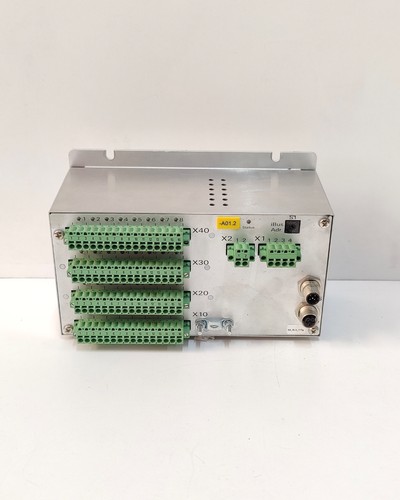
NORIS N3000-ISC-202-01
📋 Product Datasheet
| Parameter | Value |
|---|---|
| Brand | NORIS Marine Systems |
| Model | N3000-ISC-202-01 |
| Series | N3000 |
| Product Name | ISC Controller Module / Slave I/O Controller |
| Place of Manufacture | Germany |
| Product Status | Legacy / Used; verify physical condition and revision |
| Dimensions | Application-dependent; verify against the installed N3000 unit |
| Weight | Not specified in the available technical information |
| Original Country of Origin | Germany |
| Power | 18–32 V DC, nominal 24 V DC |
The N3000-ISC uses a 24 V DC nominal supply and includes connections for internal bus communication, sensor/actuator signals, and CAN-based system architecture. The unit can accommodate up to six plug-in modules, providing additional configurable channels.
🔧 Troubleshooting & Common Issues
• If the module does not power up, check the 18–32 V DC supply, upstream protection, terminal connections, and redundant supply wiring.
• A green status LED indicates that the I/O box is ready. A flashing green/yellow indication can indicate an insulation fault, while red indicates boot mode or an inoperable fault condition.
• If CAN communication is unavailable, inspect CAN wiring, termination, node addressing, and the associated master unit.
• Check the rotary CAN address switch if the module is not recognized by the N3000 network.
• If individual I/O channels fail, inspect the corresponding plug-in card, field wiring, sensor, actuator, and channel configuration.
• If analog values are incorrect, verify the configured signal range and the associated analog I/O module.
⚠️ Safety Precautions
• Isolate the 24 V DC supply before removing or installing the module.
• Follow the vessel’s electrical safety and lockout/tagout procedures.
• Use appropriate ESD protection when handling electronic circuit boards.
• Verify CANbus wiring and node addressing before energizing the system.
• Do not change field wiring while the associated control system is energized unless the approved maintenance procedure permits it.
• Confirm that the replacement module has the same model and hardware revision as the original installation.
• Perform controlled I/O and communication tests before returning the marine automation system to service.
📰 Product-Related News & Industry Context
The NORIS N3000 architecture is designed for marine automation applications and uses master and slave I/O units. NORIS documentation describes the N3000-ISC as an independently operating slave unit subordinate to an N3000-IMC master unit. Each ISC can accommodate up to six additional plug-in I/O modules, allowing the system to expand its available measurement and control channels.
The N3000 platform supports universal analog input, universal analog output, and universal digital input/output modules. Published documentation also describes functions such as sensor fault and wire-break monitoring, insulation and earth-fault monitoring, and configurable alarm limits for analog channels.
❓ Q&A
Q: What is the NORIS N3000-ISC-202-01?
A: It is an ISC controller/slave I/O module belonging to the NORIS N3000 marine automation system.
Q: What does ISC mean in the N3000 system?
A: N3000-ISC is the independently operating slave version of the N3000 I/O box, operating under an N3000 master unit.
Q: What is the nominal operating voltage?
A: The N3000-ISC uses 24 V DC nominal power and accepts an operating range of 18–32 V DC.
Q: How many plug-in I/O modules can it accommodate?
A: Up to six additional plug-in modules can be integrated into an N3000-ISC I/O box.
Q: What standard I/O functions are included?
A: The standard ISC configuration includes four potential-free relay outputs and four digital inputs, with some digital channels capable of frequency-input applications.
Q: How is the CAN node address configured?
A: The N3000-ISC uses a rotary switch for setting the CANbus node address.
Q: What should I verify before purchasing a replacement?
A: Verify the complete N3000-ISC-202-01 part number, hardware revision, supply voltage, connector arrangement, CAN configuration, and installed I/O modules.
Q: Is the N3000-ISC-202-01 discontinued?
A: It should be treated as legacy equipment for replacement planning. The available documentation concerns earlier N3000 generations, so current production status should be confirmed with the equipment documentation or manufacturer.
⭐ Recommended NORIS Models
- NORIS N3000-IMC — Master I/O Controller
- NORIS N3000-ISC — Slave I/O Controller
- NORIS N3000-ISC-I — Slave I/O Cabinet
- NORIS N3000-IMP — Master Panel
- NORIS N3000-DSP — Display Module
- NORIS N3000-IO — I/O Expansion Module
- NORIS N3000 Universal Analog Input Module
- NORIS N3000 Universal Analog Output Module
- NORIS N3000 Universal Digital I/O Module
- NORIS N3000 Display Panel Module


