
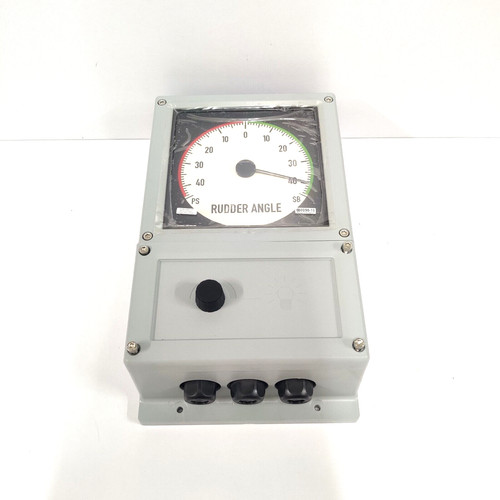
The DEIF Bridge Indicator Rudder Angle BRW-2 is a high-precision marine instrument designed to provide helmsmen and navigation officers with clear, real-time feedback on vessel rudder positioning. Built to withstand demanding maritime environments, this advanced indicator combines reliable analog or digital signal processing with exceptional readability. Its robust housing and precise movement mechanics make it an essential navigation tool for safe steering control across commercial ships, yachts, and offshore vessels.
Product Datasheet & Technical Parameters
- 💡 Operating Voltage: 24 V DC nominal vessel power supply framework
- ⚖️ Weight: Approximately 1.2 kg to 1.6 kg depending on housing dimensions
- 🌍 Origin: Denmark / Authorized European Marine Manufacturing Plants
- ⚡ Power Consumption: Low operational draw optimized for standard bridge electrical networks
- 🔧 Mounting Type: Flush panel console mounting with secure vibration-damping brackets
- ⏱️ Response Time: Instantaneous pointer deflection under 50 milliseconds for real-time tracking
- 🛡️ Protection Rating: IP44 internal console mounting / IP56 weather-resistant enclosure options available
- 💧 Operating Humidity: Up to 95% non-condensing relative humidity tolerance in marine climates
- 🔄 Input Signal: Compatible with standard rudder feedback transmitter loops (PWM, current, or voltage)
- 🌡️ Operating Temperature: Thermal range from -15°C to +55°C for standard bridge and wheelhouse environments
Application Fields
- Commercial cargo ship and container vessel wheelhouse steering control
- Passenger ferry and cruise ship navigation bridge instrumentation
- Offshore supply vessel and tugboat maneuvering consoles
- Mega yacht and luxury vessel custom helm installations
- Naval auxiliary vessel integrated bridge navigation systems
Product Precautions
- Ensure the vessel DC power supply is completely switched off before disconnecting or securing internal plug-in wiring terminals.
- Handle the internal moving-coil mechanism and pointer assembly with extreme care to prevent calibration drift or mechanical damage.
- Verify that the front-panel glass and sealing gasket remain free of chemical solvents or sharp impacts to preserve the weather-sealing integrity.
Parameter Settings & Modification Methods
- Adjust zero-point and span calibration potentiometers carefully during initial sea trials to align the pointer precisely with actual rudder blade positions.
- Configure signal damping filters via internal jumpers or software menus to prevent pointer jitter caused by heavy sea swells.
- Verify all alignment settings against physical rudder angle markings before signing off on bridge navigation equipment inspections.
Manual/Automatic Mode Switching
- Transition the steering display reference between autopilot and manual helm control sources only when coordinated with the officer of the watch.
- Verify that feedback transmitter loops remain uninterrupted during mode changes to ensure continuous angle data transmission.
- Confirm that indicator illumination and dimming controls respond correctly across day and night bridge lighting states.
Emergency Shutdown Operations
- Switch off the bridge instrumentation circuit breaker immediately if electrical short circuits or burning odors originate from the console.
- Disconnect the primary 24 V DC supply fuse to isolate the indicator unit during emergency electrical maintenance.
- Inspect all internal wiring harnesses and signal loops for damage before restoring power after an emergency shutdown.
Frequently Asked Questions (Q&A)
- Q: What causes the rudder angle pointer to stick or read incorrectly? A: Pointer deviation is typically caused by incorrect feedback potentiometer calibration, loose wiring terminals, or mechanical binding in the external rudder feedback linkage.
- Q: Can the indicator illumination be dimmed for night navigation? A: Yes, the BRW-2 features integrated dimming inputs compatible with standard bridge master lighting control networks.
Industry News & Updates
Modern marine bridge instrumentation increasingly transitions toward integrated digital displays and standardized NMEA 2000 communication networks. These advancements allow rudder angle indicators to share high-accuracy positioning data directly with electronic chart systems and autopilot computers, enhancing overall voyage safety and streamlining bridge wiring layouts.
Recommended Related Series Models
- DEIF Rudder Angle Transmitter RAT-2
- DEIF Illuminated Indicator UI-3
- DEIF Rate of Turn Indicator ROT-2
- DEIF Master Indicator MI-4
- DEIF Repeater Indicator RI-3
- DEIF Synchronizer Synchroscope SQ-3
- DEIF Power Management Display PMD-100
- DEIF Engine Speed Indicator ESI-2
- DEIF Pitch Indicator PI-2
- DEIF Bridge Alarm Unit BAU-1


