
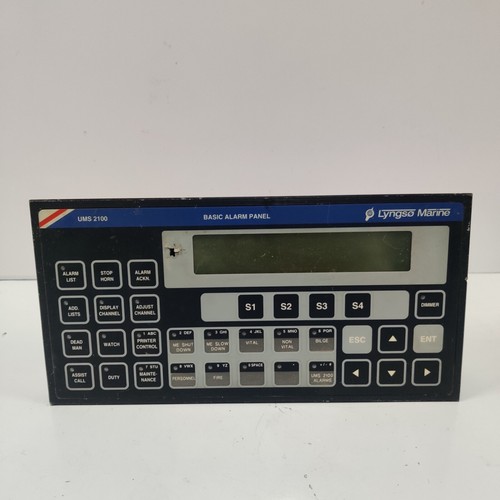
The Lyngso Marine UMS 2100 Basic Alarm Panel P/N 271.148.556/B is a vital component engineered for marine automation and centralized shipboard machinery supervision. Designed to monitor critical alarm points across propulsion, electrical, and auxiliary systems, this reliable operator panel provides crew members with immediate optical and acoustic notification of abnormal operating states. Its durable maritime-grade construction ensures continuous, dependable performance in harsh engine room environments.
Product Datasheet & Technical Parameters
- 💡 Operating Voltage: 24 V DC nominal vessel power supply framework
- ⚖️ Weight: Approximately 1.8 kg to 2.4 kg depending on backplane configuration
- 🌍 Origin: Denmark / Authorized European Marine Manufacturing Plants
- ⚡ Power Consumption: Low operational draw optimized for emergency battery backup circuits
- 🔧 Mounting Type: Flush console cutout mounting with secure vibration-damping brackets
- ⏱️ Response Time: Rapid alarm signal detection and processing under 50 milliseconds
- 🛡️ Protection Rating: IP22 internal housing / IP54 front-panel moisture and dust defense
- 💧 Operating Humidity: Up to 95% non-condensing relative humidity tolerance in marine climates
- 🔄 Communication Port: Dual RS-485 serial bus lines for redundant ship network connectivity
- 🌡️ Operating Temperature: Thermal range from 0°C to +55°C for standard bridge and engine control rooms
Application Fields
- Commercial cargo ship and tanker machinery space alarm monitoring
- Marine diesel engine safety and status indication systems
- Passenger vessel unstaffed machinery space (UMS) supervision
- Offshore drilling rig auxiliary plant monitoring networks
- Naval auxiliary vessel integrated control and alarm installations
Product Precautions
- Ensure the vessel DC power supply is completely switched off before disconnecting or securing internal plug-in wiring terminals.
- Handle internal printed circuit boards with appropriate electrostatic discharge (ESD) protection to safeguard delicate microprocessors.
- Verify that the front-panel membrane and gasket remain free of chemical solvents or sharp impacts to preserve the weather-sealing integrity.
Parameter Settings & Modification Methods
- Access programming configurations through the authorized service mode using the dedicated front-panel tactile keypad or maintenance software.
- Assign individual alarm channel priorities, time delays, and group linkages according to classification society safety rules.
- Save all modified system parameters to internal non-volatile memory before exiting the configuration utility.
Manual/Automatic Mode Switching
- Transition the alarm monitoring network between operational and test modes only when authorized by the chief engineer on duty.
- Verify that bridge and engine room watch handover procedures are complete before altering system routing states.
- Confirm that all bypassed alarm channels are manually restored to active status immediately following routine maintenance work.
Emergency Shutdown Operations
- Utilize dedicated hardwired emergency circuits to bypass panel logic when immediate machinery trip actions are required.
- Disconnect the primary 24 V DC supply fuse or breaker to isolate the alarm unit during critical electrical faults.
- Inspect the central alarm printer and serial data loops for anomalies before restoring power after an emergency shutdown.
Frequently Asked Questions (Q&A)
- Q: What causes the panel to display a communication loss warning? A: Communication faults typically stem from broken RS-485 data cables, loose terminal connections, or node address conflicts on the serial loop.
- Q: How are individual lamp indicators tested on the front panel? A: Pressing the dedicated “Lamp Test” button on the keypad activates all optical indicators and acoustic buzzers simultaneously to verify functionality.
Industry News & Updates
Modern marine alarm and monitoring systems increasingly incorporate advanced software diagnostics and Ethernet-based backbone protocols. These enhancements allow shipboard automation networks to interface seamlessly with remote shore-based support centers, providing real-time machinery health analysis and reducing regulatory compliance downtime for global fleets.
Recommended Related Series Models
- Lyngso Marine UMS 2100 Alarm Extension Unit
- Lyngso Marine Central Processing Unit CPU 2100
- Lyngso Marine Operator Display Terminal ODT 4200
- Lyngso Marine Analogue Input Module AIM 2100
- Lyngso Marine Digital Output Module DOM 2100
- Lyngso Marine Power Supply Unit PSU 2100
- Lyngso Marine Alarm Printer Unit APU 2100
- Lyngso Marine Bridge Navigation Watch Alarm System BNWAS
- Lyngso Marine Safety System Terminal SMT 2100
- Lyngso Marine Serial Communication Interface SCI 2100


