
The Moore Model 353 Process Automation Controller (specifically part number prefix 353A2FNNNNNNA4) is an advanced, microprocessor-based stand-alone industrial controller designed for a wide range of process applications. Whether deployed as a simple single-loop controller or as a multi-loop controller capable of handling complete control, logic, and sequencing functions for continuous or batch processes, this robust instrument ensures high reliability and precision in demanding industrial environments.
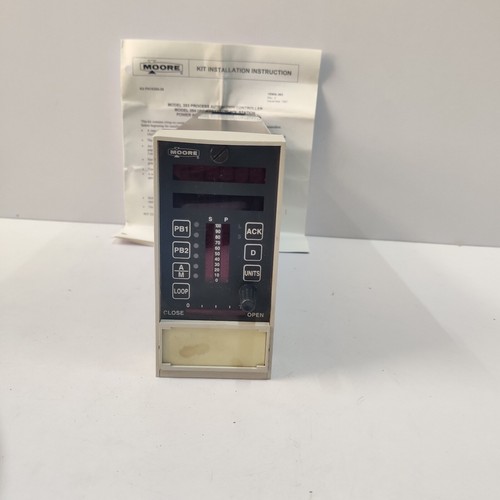
Technical Parameters & Datasheet Overview
- Product Series: Moore / Siemens Model 353 Process Automation Controller (Design Level A)
- Power Supply: AC Powered (typically 120/240V AC, 47–63 Hz)
- Display Assembly: High-visibility local analog and digital multi-variable operator display panels with flip-down ID door
- I/O Architecture: Local I/O expander support with standard internal termination case configuration
- Communication Options: Ethernet network communication enabled for direct plant integration
- Approximate Dimensions: Short case design tailored for standard 12-inch deep cabinets (approx. 3.0 in x 6.0 in x 1.0 in panel footprint / standard modular housing)
- Approximate Weight: Approx. 3.8 lbs (1.8 kg)
- Country of Origin: United States
- Environmental Integrity: Coated circuit boards ensuring robust performance across wide industrial temperature ranges
Applications
- Continuous Process Control: Manages complex single-loop or cascade configurations in chemical, oil and gas, and power generation plants.
- Unit Batch Processing: Executes combined sequencing, logic, and analog control routines for localized industrial batch operations.
- Legacy System Migration: Serves as a direct, scalable modernization upgrade for older pneumatic or early electronic control instrumentation panels.
Usage Precautions
- Qualified Instrumentation Personnel: Installation, configuration, and electrical wiring must be handled by certified technicians trained in industrial control loops and safety protocols.
- Power Isolation: Always disconnect main AC power sources before servicing terminal blocks, replacing internal options, or opening panel housings.
- Environmental Constraints: Ensure cabinet operating temperatures and humidity remain within standard industrial thresholds to protect coated electronics and display components.
Parameter Settings & Configuration Methods
- Front Faceplate Push-Buttons: Full configuration capability is accessible directly via local faceplate buttons hidden behind the flip-down ID door, allowing fast field modifications without extra tools.
- Factory Configured Options (FCOs): Built-in libraries store common control strategies (such as single-loop with tracking setpoint) selectable via simple menu entries.
- Visual Configuration Software: Utilizes graphic function block or ladder logic programming environments via configuration utilities for customized applications.
Manual / Automatic Mode Switching
- Faceplate Control Keys: Operators can switch between manual adjustments and automatic supervisory control directly using dedicated loop and function pushbuttons on the front interface.
- Bumpless Transfer: Internal control logic ensures smooth, bumpless transitions when switching between manual and automatic operational modes.
- User-Defined Interlocks: Custom key bindings can be assigned for specific local overrides or start/stop routines.
Emergency Trip Operations
- Failsafe Output Configuration: Configurable fallback states ensure field outputs move to predefined safe positions if communication or CPU integrity is compromised.
- Watchdog Supervision: Internal hardware and software monitoring routines instantly trigger error handling or trip routines upon detecting critical system anomalies.
Frequently Asked Questions (Q&A)
Q: Can the Model 353 controller be networked into a wider plant system?
A: Yes, equipped with optional Ethernet network communication and standard serial protocols, it integrates smoothly into broader plant supervisory and control networks.
Q: Are configuration settings preserved during a power loss?
A: Yes, non-volatile internal memory securely stores all tuning parameters, configuration databases, and operational states during power cycles.
Q: Is specialized software required to change basic control strategies?
A: Basic configurations and pre-stored FCOs can be accessed and modified directly through the front faceplate pushbuttons, though software tools are available for advanced custom logic design.
Industry News & Updates
Industrial process automation controllers continue to evolve with deeper integration into Ethernet/IP networks, enhanced cybersecurity measures, and advanced diagnostic logging. Maintaining established control loops with proven modular platforms like the Moore 353 series allows processing facilities to maximize reliability, preserve validated control strategies, and minimize costly migration downtime.
For reliable automation parts, spare components, and specialized industrial hardware, visit New PLC DCS to explore extensive inventory options.
Related Series & Alternative Models
- Moore Model 352 Classic Controller Series
- Siemens / Moore Model 353 Design Level B Controllers
- Moore 353 RetroPAK Migration Controllers
- Siemens SIMATIC S7 Industrial Automation Systems
- Moore Process Automation Controller Ethernet I/O Expansion Modules
- ABB Bailey Infi 90 Process Control Units
- Siemens PCS 7 Distributed Control Systems
- Honeywell TDC 3000 Control Modules
- Emerson DeltaV Controller Nodes
- Yokogawa CENTUM VP Field Control Units


