
Description
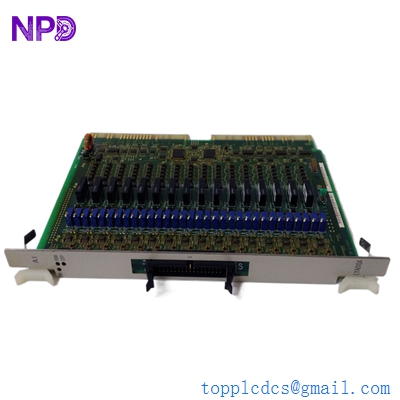
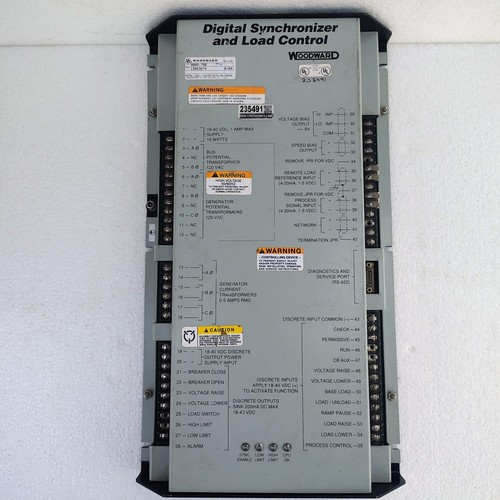
The Woodward 9905-796 is a microprocessor-based Digital Synchronizer and Load Control (DSLC) unit designed for three-phase AC generators driven by diesel or gas engines, steam turbines, or gas turbines. The DSLC functions as an all-in-one synchronizer, load sensor, dead-bus closer, and load controller. It integrates sophisticated generator control functions into a single package, enabling automatic synchronization, phase matching, voltage matching, and real-time active/reactive power load sharing across multiple paralleled generator sets or utility grids.
⚙️ Technical Parameters & Specifications
- Model Number: 9905-796
- Device Line: DSLC (Digital Synchronizer and Load Control)
- Power Supply Input: 18–32 VDC (Nominal 24 VDC)
- Generator Voltage Sensing: 120 or 240 VAC RMS (Three-Phase, 50/60 Hz nominal)
- Generator Current Sensing: 5 A or 1 A RMS CT inputs
- Dimensions: 284 mm x 175 mm x 112 mm
- Weight: 2.45 kg
- Country of Origin: USA
🚀 Application Areas
- Multi-Generator Power Plants: Managing automatic load-sharing loops for islanded generator networks.
- Utility Grid Paralleling: Controlling peak-shaving, base-loading, and export/import power limits when tied to a main utility grid.
- Co-generation & IPP Facilities: Providing precise power regulation and soft-loading transitions for industrial power plants.
- Marine Power Management Systems: Ensuring stable generator synchronization and automatic dead-bus closure on commercial and military vessel grids.
📖 Product Usage Instructions
The Woodward DSLC should be flush-mounted into a control cabinet panel doors or an inner swing rack. Ensure it is protected from direct oil mist, moisture, and excessive ambient heat. Because the unit directly interfaces with high-voltage Three-Phase Potential Transformers (PTs) and Current Transformers (CTs), ensure all CT secondaries are short-circuited before disconnecting the DSLC terminal plugs to prevent dangerous high-voltage inductive arcing. Use twisted, shielded cables for all speed and voltage bias outputs running to the governor and Automatic Voltage Regulator (AVR).
🌐 Communication Configuration Steps
- IP Address / Fieldbus Network: The DSLC 9905-796 utilizes a dedicated, high-speed Echelon LonWorks network ring for inter-unit communication and precise load sharing between paralleled modules. It does not use standard Ethernet IP addresses natively; instead, each unit is identified by a unique LonWorks Neuron ID.
- Station Number / Unit ID: Define the unique unit address within the multi-engine lineup (e.g., Generator 1, Generator 2) using Woodward’s Watch Window service software. This enables deterministic data exchanging for proportional active/reactive load sharing.
- Baud Rate / Network Speed: The underlying LonWorks network operates at a hardcoded, deterministic speed of 1.25 Mbps, eliminating the need for manual field baud rate tuning and ensuring instant system synchronization adjustments.
⚡ Power-Up & Commissioning Flow
- PT/CT Polarities Check: Verify that the phase rotation (A−B−C) of the generator bus matches the utility bus exactly, and ensure CT terminal polarities are facing the correct load direction.
- Control Power Activation: Apply the 24 VDC auxiliary power to the unit. The front panel green “CPU OK” or status LED should illuminate steadily.
- Parameter Calibration: Connect a PC running Woodward Watch Window software to the serial port. Calibrate the rated generator voltage, frequency, CT ratios, and scaling factors according to the generator nameplate data.
- Dynamic Loop Tuning: Run the generator off-line. Initiate manual synchronizing commands to verify that the DSLC’s speed bias output correctly shifts the engine governor speed up and down, and that the voltage bias output successfully commands the AVR.
✅ Initial Operation Checklist
- Is the DSLC casing properly grounded to the primary cabinet ground plane with a short, heavy-duty strap?
- Have the Current Transformer (CT) shorting pins been removed from the terminal block prior to engine startup?
- Does the DSLC display correct, balanced RMS voltages and currents matching an independent digital multimeter?
- Has the synchronization window (phase angle, voltage differential, and slip frequency) been matched to the utility authority’s grid-code requirements?
❓ Common Questions (Q&A)
Q: What does a “Lon Error” or “Network Fault” indicate on the DSLC panel?
A: This points to a communication failure on the Echelon LonWorks network loop connecting the parallel units. Check for a broken twisted-pair communication wire, a missing termination resistor (105 Ω), or a duplicate unit ID assignment within the software configuration.
Q: Can this module operate without a separate engine governor or AVR?
A: No. The DSLC acts as an supervisory controller. It does not directly drive the fuel actuator or generator field windings. Instead, it sends precise correction signals (±3 VDC, ±5 VDC, or 4–20 mA current loops) to an external engine governor (like a Woodward 2301A) and an external AVR to adjust speed and voltage.
Q: How do I clear a latched “Sync Timeout” alarm on the controller?
A: A synchronization timeout occurs if the DSLC cannot bring the generator within the matching phase window before its internal safety timer expires. Verify that the governor’s speed stability parameters are tuned correctly and that the slip frequency window isn’t set too narrow. Once resolved, toggle the synchronized command input or press the system reset parameter via the Watch Window terminal to clear the alarm state.