
Description
Product Description
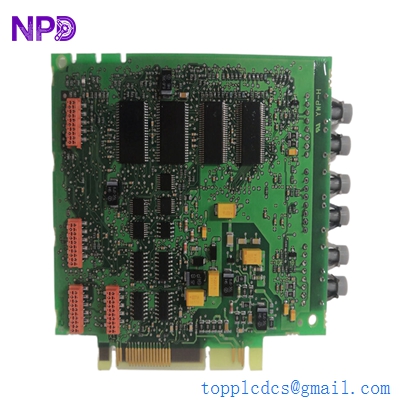
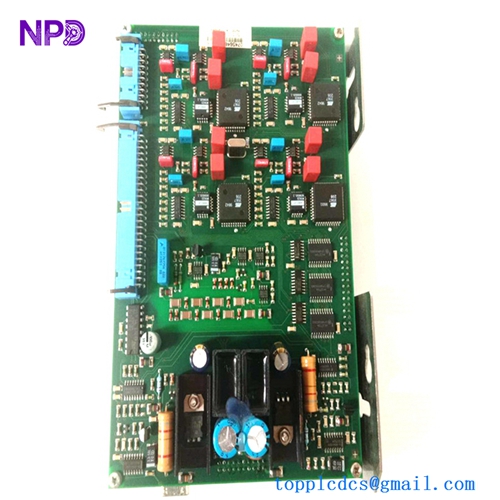
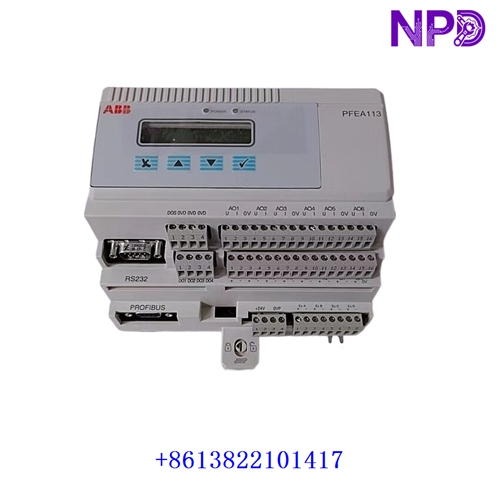
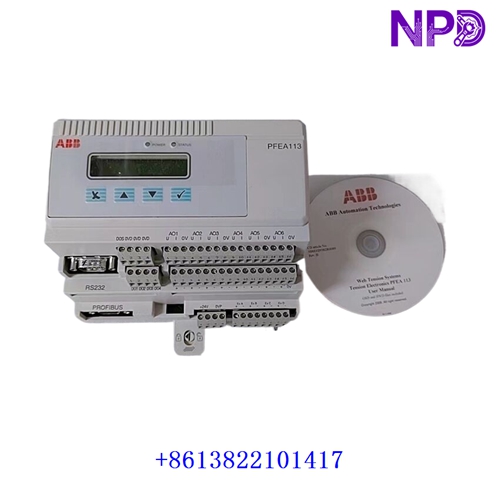
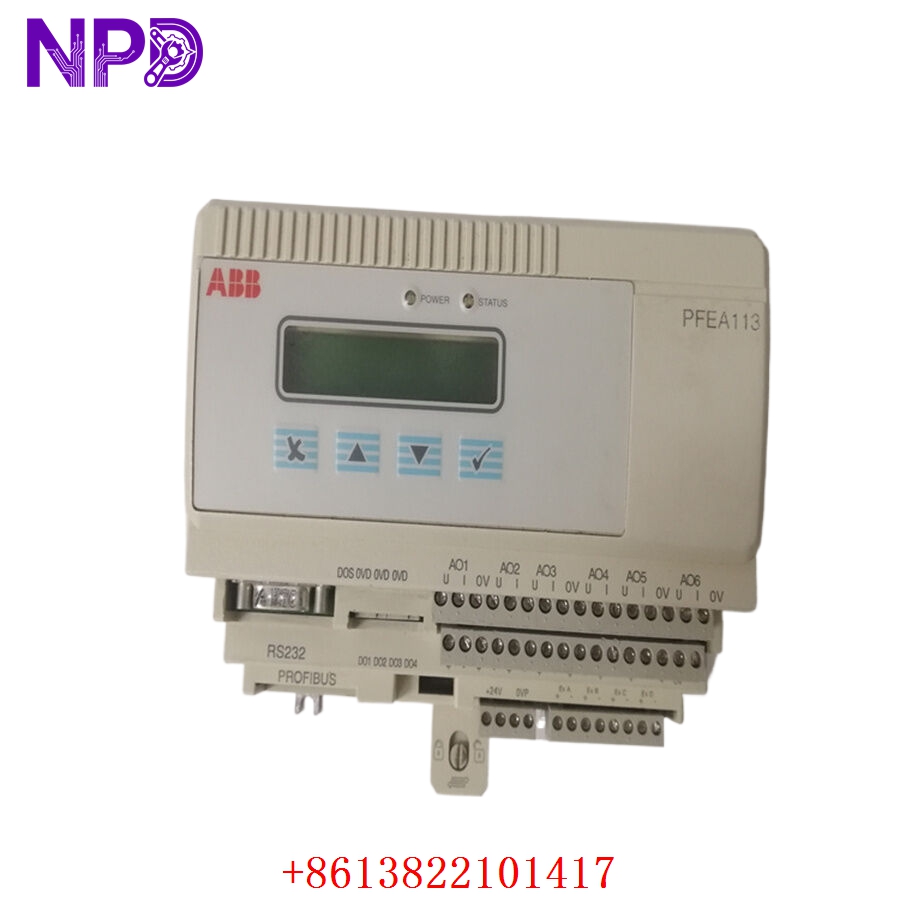
The ABB PFEA113-20 (3BSE028144R0020) is a tension electronics module designed for industrial web tension measurement and control. It processes signals from up to four compatible ABB Pressductor load cells and provides tension-related measurement signals to a machine control system.
Used in applications such as paper converting, printing, packaging, film production, and textile processing, the PFEA113 helps maintain consistent material tension during unwinding, processing, and rewinding. Its signal-processing functions include adjustable filtering, scaling, zero adjustment, and gain configuration.
The module provides six configurable analog outputs, two analog inputs, one digital input, and four digital outputs. It also supports PROFIBUS DP communication, allowing measured tension values and diagnostic information to be exchanged with a PLC or other compatible control system.
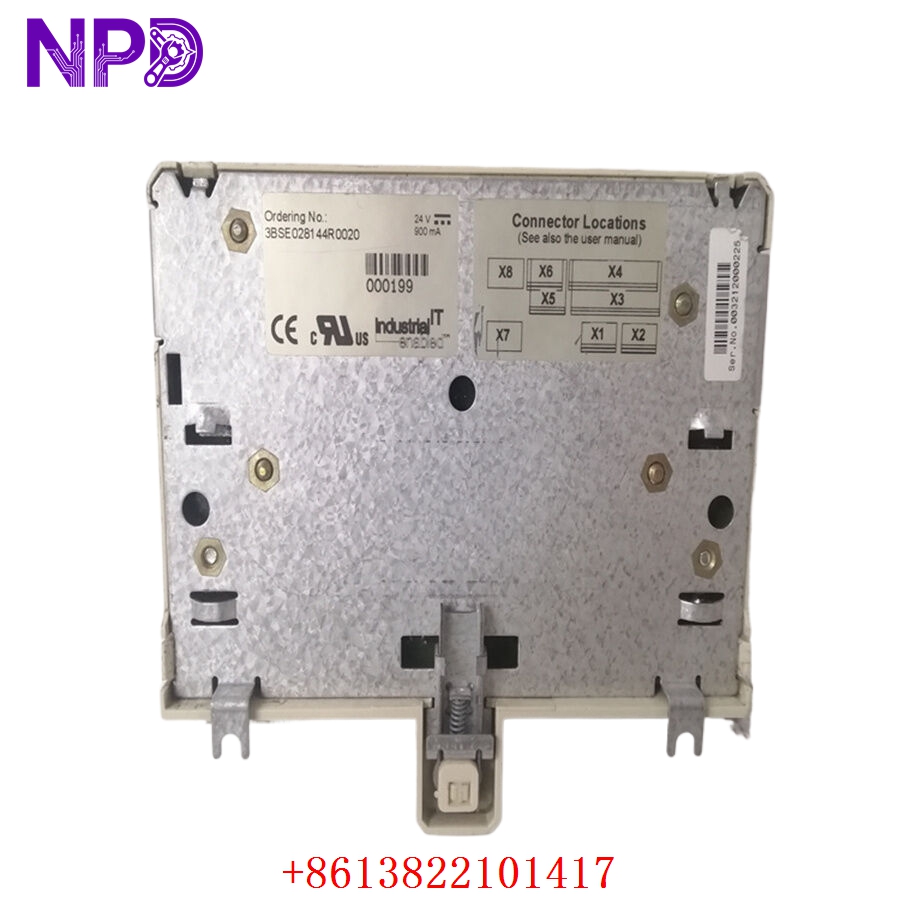
The PFEA113-20 is particularly useful in systems where multiple load cells are required to monitor web tension across a machine. Before installation, confirm the exact enclosure version, supply arrangement, load-cell wiring, and PROFIBUS configuration against the unit label and ABB documentation.
3BSE028144R0020 PFEA113-20
Product Datasheet
- Brand: ABB
- Model: PFEA113-20
- Order Number: 3BSE028144R0020
- Product Name: Web Tension Electronics Module
- Product Family: ABB Pressductor Tension Electronics
- Product Type: Tension Measurement and Control Electronics
- Load Cell Inputs: 4
- Compatible Sensor Families: ABB PFCL, PFTL, and PFRL (verify individual sensor compatibility)
- Load Cell Excitation: 0.5 A RMS at 330 Hz
- Maximum Load: 4 load cells with up to 10 Ω cable resistance
- Analog Inputs: 2
- Digital Inputs: 1
- Analog Outputs: 6, configurable voltage or current
- Digital Outputs: 4
- Voltage Output Range: -5 to +11 V
- Current Output Range: 0 to 21 mA
- Maximum Voltage Output Load: 5 mA
- Maximum Current Output Load: 550 Ω
- Communication: PROFIBUS DP Slave, up to 12 Mbit/s
- IP20 Supply: 24 V DC (18–36 V)
- IP20 Power Requirement: 12 W according to ABB technical data
- Operating Temperature: +5 to +55 °C
- Protection Class: IP20 or IP65, depending on ordered enclosure version
- Display: Multilingual 2 × 16-character display with configuration keys
- Mounting: DIN rail for IP20 version; wall-mounted enclosure for IP65 version
- Country of Origin: Sweden is listed by suppliers; verify the unit label
- Dimensions: Depend on enclosure version; verify against the applicable mechanical drawing
- Weight: Supplier-listed values vary; confirm the actual shipping weight
- Product Status: Verify current lifecycle and availability with ABB
- Condition: Confirm the actual supplied unit
Technical Features & Specifications
Four-Channel Load Cell Measurement
The PFEA113 supports up to four compatible load cells, identified individually as channels A, B, C, and D. Its regulated excitation supply operates at 0.5 A RMS and 330 Hz. The four-channel arrangement supports tension measurement in machines where multiple sensing points are required.
Configurable Analog Outputs
Six analog outputs can be configured for voltage or current signals. The available ranges are -5 to +11 V and 0 to 21 mA, with scaling functions for adapting measurement signals to downstream controllers, indicators, or recording equipment.
Each output has selectable filtering to adjust the response to changing tension and mechanical disturbances.
Analog and Digital I/O
The module provides two analog inputs for signal connection between multiple PFEA113 units, one digital input for functions such as remote zero or gain scheduling, and four digital outputs for status indication and level detection.
PROFIBUS DP Communication
The integrated PROFIBUS DP Slave interface supports communication speeds up to 12 Mbit/s. It allows the module to exchange tension values and status information with a compatible PROFIBUS DP Master.
ABB identifies the PFEA113 GSD file as ABB_0717.GSD. The selected PLC hardware configuration and GSD revision should be checked before commissioning.
Adjustable Signal Filtering
Selectable step-response settings are 5, 15, 30, 75, 250, 750, and 1,500 ms. Shorter settings provide faster response, while longer settings can reduce the effect of mechanical vibration and fluctuating signals. Select the filter based on the machine’s dynamic requirements.
Display and Diagnostic Functions
The multilingual display and configuration keys allow operators to review tension signals, configure parameters, and check operating status. The module also provides self-diagnostic status indication and supports maximum-load and zero-offset memory functions.
Application Scenarios & Pain Points
- Paper and board converting: Monitors web tension during unwinding, coating, slitting, and rewinding.
- Printing machinery: Helps maintain consistent tension as material passes through printing and drying sections.
- Packaging machinery: Supports tension measurement for flexible films, paper, and other packaging materials.
- Plastic film production: Provides multi-point tension measurement for web handling and winding operations.
- Textile machinery: Supports tension monitoring in continuous fabric processing.
- Rewinding and unwinding systems: Supplies measurement signals for coordinated drive and tension-control systems.
Typical operating challenges include fluctuating load-cell signals, mechanical vibration, uneven tension distribution, incorrect sensor wiring, and communication faults. The PFEA113 addresses signal-processing and interface requirements, but correct mechanical installation, sensor calibration, and control-loop tuning remain essential.
First-Time Installation Checklist
- Verify the complete model and order number: PFEA113-20, 3BSE028144R0020.
- Confirm whether the supplied unit is the IP20 or IP65 version.
- Check the applicable supply voltage and power requirements for the enclosure version.
- Verify the four load cells are compatible and correctly connected to channels A, B, C, and D.
- Check load-cell cable resistance, shielding, grounding, and routing.
- Confirm that the load-cell excitation wiring matches the ABB connection diagram.
- Configure analog input and output ranges, scaling, and filtering.
- Set the PROFIBUS station address and verify the master configuration.
- Install the correct ABB_0717.GSD file in the PLC engineering environment.
- Test zero adjustment, gain, channel response, analog outputs, and digital status signals.
- Verify the measured tension against an independent reference instrument before production operation.
- Save the final parameter configuration and commissioning records.
Daily Maintenance
- Check the display and diagnostic indicators for abnormal operating status.
- Inspect load-cell cables, junction boxes, terminals, and shielding.
- Monitor tension readings for unexpected drift or channel imbalance.
- Check PROFIBUS communication diagnostics and PLC status information.
- Inspect cabinet ventilation and ambient temperature.
- Review analog output values and confirm that scaling remains consistent with the control system.
- Back up configuration parameters after approved changes.
- Check mechanical sensor mounting and load-cell connections during scheduled maintenance.
Troubleshooting & Frequently Asked Questions
Q1: What is the main function of the ABB PFEA113-20?
It processes signals from compatible load cells to measure web tension and provides analog and PROFIBUS DP signals to the machine control system.
Q2: How many load cells can it support?
The PFEA113 supports up to four load cells, with 0.5 A RMS excitation at 330 Hz. Check the combined load and cable resistance against ABB’s limits.
Q3: Does it support PROFIBUS communication?
Yes. It operates as a PROFIBUS DP Slave at speeds up to 12 Mbit/s. The PLC or other network controller must be configured as the compatible master.
Q4: What analog outputs are available?
It provides six configurable analog outputs. The published output ranges are -5 to +11 V and 0 to 21 mA.
Q5: Why does the tension reading fluctuate?
Possible causes include mechanical vibration, incorrect load-cell mounting, cable interference, grounding problems, or unsuitable filter settings. Check the sensor installation before increasing the filter time.
Q6: Can the PFEA113 connect to a PLC without PROFIBUS?
Yes, its analog outputs can be used with compatible analog input channels on a PLC or other control device. Verify signal type, range, grounding, and scaling.
Q7: What is the difference between PFEA112 and PFEA113?
The PFEA113 supports four load cells and provides additional I/O functions, including six analog outputs, two analog inputs, one digital input, and four digital outputs. PFEA112 is a different configuration with different channel and interface capabilities.
Q8: Can PFEA113-20 replace another PFEA113 version?
Not automatically. Compare the complete order number, enclosure type, power arrangement, wiring, and application configuration before replacement.
Safety Precautions
- Disconnect power before wiring or servicing the module.
- Use the correct supply arrangement for the IP20 or IP65 version.
- Follow ABB wiring diagrams for load-cell excitation and signal connections.
- Maintain cable shielding and grounding according to the installation documentation.
- Do not exceed the specified load-cell excitation capacity.
- Verify analog signal ranges before connecting to PLC input channels.
- Check PROFIBUS termination and cable installation before energizing the network.
- Perform zero and gain calibration under controlled mechanical conditions.
- Do not bypass machine safety interlocks during testing.
Recommended Related Models & Components
The following ABB products are related to tension measurement and web-handling systems. They are not all direct replacements for PFEA113-20.
- ABB PFEA111 – Tension Electronics
- ABB PFEA112 – Tension Electronics with PROFIBUS DP
- ABB PFEA122 – Tension Electronics with Ethernet-based communication
- ABB PFEA113 – Four-channel Tension Electronics
- ABB PFCL 301E – Pressductor Load Cell
- ABB PFTL 301E – Pressductor PillowBlock Load Cell
- ABB PFTL 101A – Pressductor Load Cell
- ABB PFRL 101 – Pressductor Load Cell
- ABB PFXL 141 – Load Cell Junction Box
- ABB PFXC 141 – Load Cell Connection Component
- ABB NGP110 – Fieldbus Power Conditioner
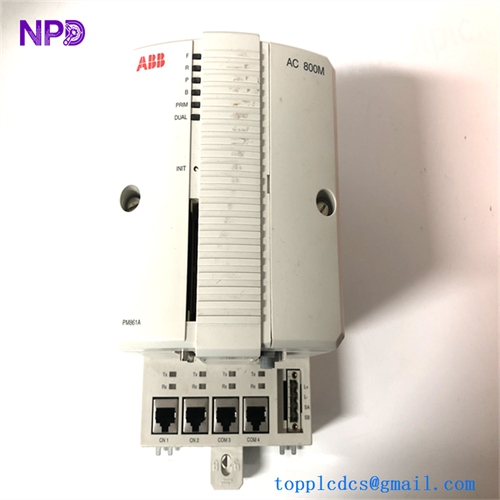
- ABB AC 800M – Process Controller Family
- ABB PM861A – AC 800M Controller
- ABB CI854A – PROFIBUS DP Communication Interface
- ABB CI801 – PROFIBUS Remote I/O Interface