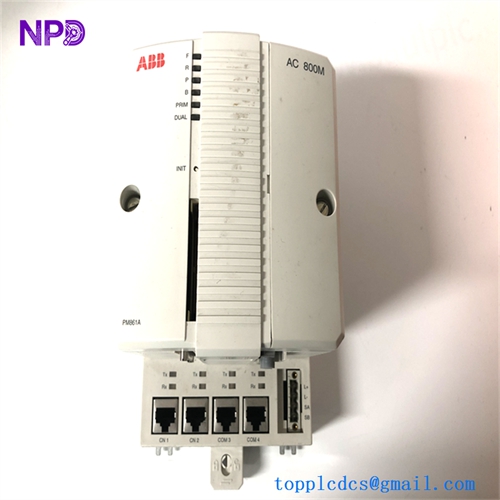
Description
The ABB TE1605341 (Revision VER02, associated with Assembly 1605340-05) is a high-reliability Pulse Driver / Gate Interface Board used in ABB’s industrial power conversion systems. This board is a critical component in the control chain, responsible for amplifying low-level control signals into high-energy pulses capable of triggering power semiconductors like Thyristors (SCRs) or GTOs.
Product Parameters (Datasheet)
- Model Number: TE1605341
- Revision: VER02
- Assembly Number: 1605340-05
- Function: Pulse amplification and galvanic isolation for gate triggering
- Output Channels: Typically 6 or 12 pulse channels (depending on configuration)
- Input Voltage: 15V DC / 24V DC (Internal system power)
- Isolation Voltage: High-dielectric isolation to protect control electronics from high-voltage DC/AC buses.
- Compatibility: Integrated into UNITROL excitation systems and high-power SFC (Static Frequency Converters).
- Connectors: Multi-pin ribbon cable headers and high-current screw terminals for pulse outputs.
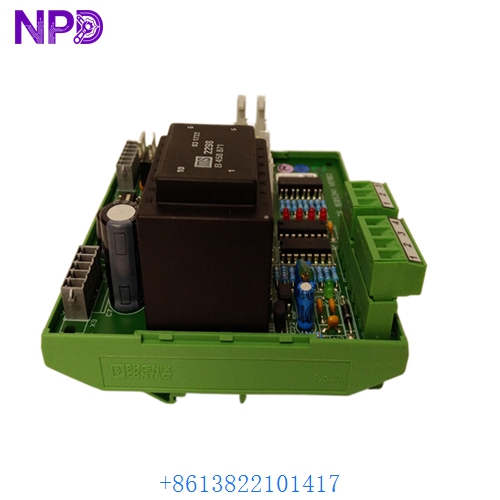
ABB TE1605341 VER02 1605340-05
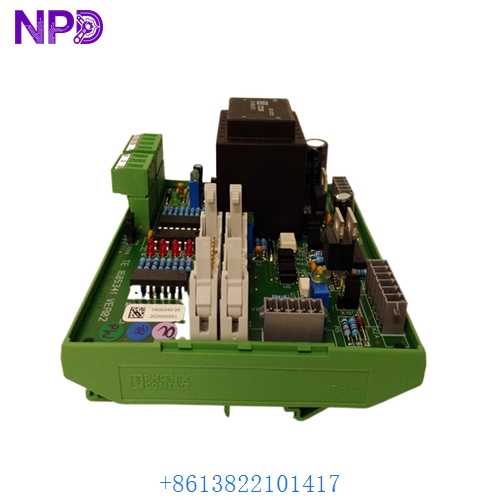
ABB TE1605341 VER02 1605340-05
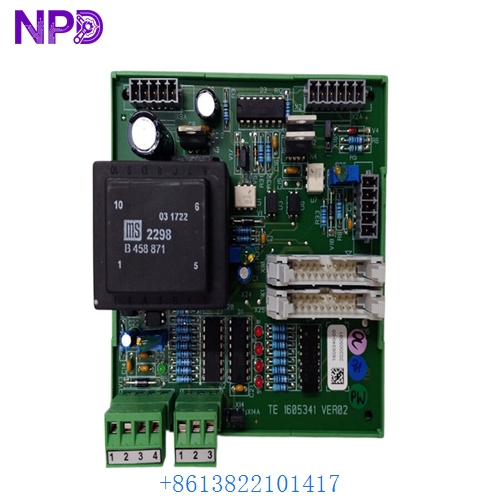
ABB TE1605341 VER02 1605340-05
Country of Origin
This module is engineered and manufactured by ABB Switzerland Ltd. in Turgi, the global center for ABB’s power electronics division.
Application Fields
The TE1605341 is utilized in systems where precise timing of power switching is mandatory:
- Large Excitation Systems: Found in UNITROL 5000/6000 for regulating the output of synchronous generators.
- Static Frequency Converters (SFC): Used in railway power supplies to convert grid frequency for locomotive traction.
- Load Commutated Inverters (LCI): Integrated into MEGADRIVE-LCI systems for starting and controlling massive industrial motors.
- HVDC Valves: Managing the firing pulses for valve modules in high-voltage DC transmission.
- Aluminum Smelting: Controlling high-current rectifiers in electrochemical processes.
Product Usage Instructions
- ESD Protection: This board contains sensitive CMOS and driver components. Use a grounded ESD wrist strap before removing the board from its protective packaging.
- Mounting: Install the board into the designated subrack or mounting plate. Ensure all standoffs are secure to provide proper mechanical support and electrical grounding.
- Cable Integrity: Inspect the ribbon cables (control side) and the heavy-gauge wires (gate side). Loose connections on the pulse outputs can cause “misfiring,” leading to semiconductor failure.
- Voltage Check: Before commissioning, verify the input supply voltage (typically 24V DC). An under-voltage condition can result in weak pulses that fail to fully turn on the power semiconductors.
- Synchronization: Ensure the board’s timing signals are synchronized with the grid frequency via the main controller (e.g., AC 800PEC).
Product Technical Description
Technically, the TE1605341 acts as a Power Buffer. It receives TTL or CMOS-level firing commands from the digital controller and uses high-speed transistors and pulse transformers to generate a “Hard Firing” pulse. This pulse is characterized by a high initial current (di/dt) to ensure the semiconductor turns on quickly and uniformly across the silicon wafer. The VER02 revision features optimized gate-drive circuitry to reduce switching losses and improved noise immunity to prevent nuisance triggering in electrically “noisy” power plant environments.
Q&A (Common Questions)
Q: Can I use 1605340-05 to replace an older 1605340-01? A: Usually, yes. The -05 assembly is a later revision that often incorporates improved component ratings or better thermal performance. However, always verify the specific jumper settings on the board to match your original unit.
Q: Why is there a “Pulse Fault” alarm on my controller? A: This is often caused by an open circuit in the gate-cathode wiring of the power semiconductor or a failed driver transistor on the TE1605341 board itself.
Q: Does this board require periodic calibration? A: No. The timing is controlled digitally by the upstream processor. The board’s role is purely to provide the power and isolation for the pulse.
Q: Is this board compatible with fiber optic inputs? A: This specific model uses electrical ribbon cables for input. If your system requires fiber optic inputs, you likely need an interface converter or a different model from the TE series (e.g., those with “FO” connectors).
Similar Model Recommendations
- ABB TE1605341 VER01 (Legacy revision)
- ABB 1605340-10 (High-current variant)
- ABB UNS0863A (Excitation Interface Board)
- ABB CIN99 (Firing Board for DC Converters)
- ABB PPC905AE101 (Main AC 800PEC Controller)
For technical support or to procure the ABB TE1605341, please contact our power electronics specialists.