Description
🔹 Product Description
The Basler DECS-200-2C Digital Excitation Control System is a microprocessor-based generator excitation controller designed to regulate generator voltage and manage excitation system performance.
It provides multiple operating modes, including Automatic Voltage Regulation (AVR), Field Current Regulation (FCR), Power Factor (PF), and Reactive Power (VAR) control.
The DECS-200-2C supports generator excitation applications requiring 32 VDC, 63 VDC, or 125 VDC field outputs, with continuous field current capability up to 15 A, subject to the specified operating conditions.
The system features programmable control settings, adjustable soft-start buildup, excitation limiters, generator protection functions, and parallel operation compensation.
It is suitable for power generation facilities, industrial generator sets, synchronous generators, and marine generator control systems.
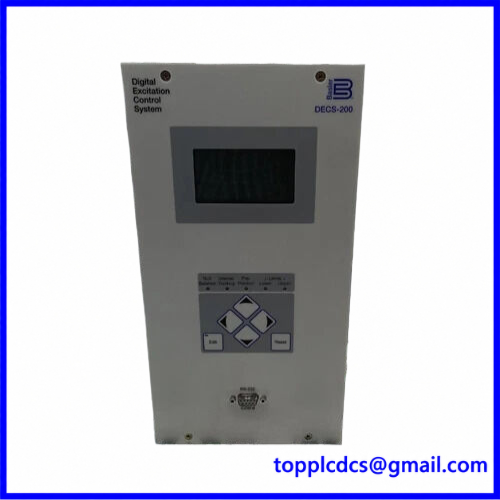
DECS-200-2C
⚙️ Main Functions & Applications
• Automatic Voltage Regulation (AVR) – Maintains generator terminal voltage according to configured operating settings.
• Field Current Regulation (FCR) – Provides manual excitation control through field current regulation.
• Power Factor Control – Supports generator power factor regulation during parallel operation.
• Reactive Power Control – Regulates generator reactive power output.
• Excitation Limiting – Includes overexcitation and underexcitation limiting functions.
• Generator Protection – Supports field overvoltage, field overcurrent, generator overvoltage, undervoltage, loss of sensing, and loss of field protection.
• Soft Start – Provides adjustable voltage buildup during startup.
• Parallel Compensation – Supports reactive droop and reactive differential compensation.
• Event Recording – Provides sequence-of-events recording and oscillography functions.
Typical applications:
• Synchronous generator excitation systems
• Diesel generator power plants
• Gas turbine generator systems
• Steam turbine generator systems
• Marine power generation
• Industrial power stations
• Generator paralleling and synchronization systems
📋 Product Datasheet & Parameters
Brand: Basler Electric
Model: DECS-200-2C
Series: DECS-200 Digital Excitation Control System
Product Name: Digital Excitation Control System
Product Type: Microprocessor-Based Automatic Voltage Regulator / Excitation Controller
Manufacturer: Basler Electric
Place of Manufacture: Highland, Illinois, USA (manufacturer headquarters; individual unit origin should be verified)
Product Condition: Verify actual inventory condition before listing
Dimensions: Approximately 216 × 146 × 76 mm; verify the exact style and enclosure configuration
Weight: Approximately 2.3 kg; verify the physical unit
Excitation Output Voltage: 32 VDC, 63 VDC, or 125 VDC applications
Maximum Continuous Field Current: 15 A DC
Voltage Regulation Accuracy: 0.25%
Control Modes: AVR, FCR, Power Factor, and VAR
Sensing: Single-phase or three-phase generator voltage sensing; single-phase bus voltage sensing
Communication: RS-232 interface; additional communication functions depend on configuration
Power Requirements: Separate AC and DC operating power inputs; exact ratings depend on the complete style number
Discontinued: Current manufacturer lifecycle status requires confirmation
🔧 Installation & Commissioning Guide
- Model Verification
Check the complete DECS-200-2C style number, nameplate ratings, terminal arrangement, and generator excitation requirements.
- System Preparation
Review the generator wiring diagram, excitation system configuration, sensing connections, and protection settings.
- Electrical Installation
Install the controller in the designated control panel and provide the required grounding and ventilation.
- Wiring Connections
Connect generator voltage sensing, current sensing, bus voltage sensing, field output, contact inputs, and relay outputs according to the official wiring diagram.
- Configuration
Use the front-panel HMI or compatible BESTCOMS software to configure generator ratings, control modes, voltage setpoints, and protection parameters.
- Initial Startup
Verify all connections and auxiliary supplies before enabling excitation. Follow the generator manufacturer’s startup sequence.
- AVR Testing
Check voltage buildup, regulation stability, and response to approved operating adjustments.
- Protection Testing
Verify excitation limiters, protective functions, alarms, and trip interfaces using approved commissioning procedures.
- Parallel Operation
When applicable, verify reactive droop compensation, reactive differential compensation, and load-sharing behavior.