
Description
Product Overview
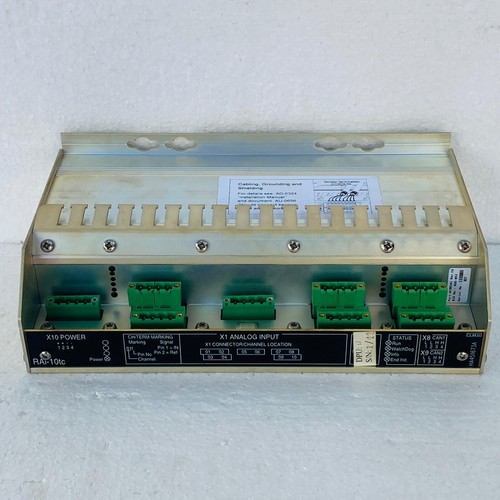
The Kongsberg RAI-10TC is a high-precision remote analog input module designed for marine automation, machinery monitoring, and vessel control systems. This specialized fieldbus interface module provides accurate processing and isolation for temperature sensors, specifically thermocouples (TC). Engineered to operate reliably in high-vibration and electronically noisy maritime environments, it converts microvolt sensor inputs into stable digital data for the master processing unit.
Technical Specifications
- Model ID: RAI-10TC
- Module Type: Remote Analog Input / Thermocouple Interface Card
- Dimensions: 150 mm x 115 mm x 45 mm
- Weight: 0.55 kg
- Country of Origin: Norway
- Input Channels: Dedicated high-resolution thermocouple measurement loops
- Interface Protocol: Proprietary high-speed internal fieldbus / serial network
Application Areas
⚓ Exhaust Gas Temperature (EGT) Monitoring for Marine Diesel Engines
🚢 Bearing and Stator Temperature Tracking in Thrusters
🌊 Cargo Hold and Liquid Tank Thermal Supervision
🏗️ Marine Engine Room Auxiliary Control Cabinets
🛰️ Integrated Automation Systems (IAS) Field I/O
Operational Guidelines
Power-Up / Power-Down Sequence
- Startup: Ensure the host I/O rail or mounting base is completely de-energized. Snap the RAI-10TC module securely onto the DIN rail interface and plug in the network bus cables. Apply the system bus logic power. The onboard status indicators will blink during initial hardware self-tests and transition to a solid operation pattern once communication with the bus coupler is established.
- Shutdown: Before removal, disable the associated input logging loops in the master control terminal to suppress sensor failure faults. Switch off the primary power supply to the I/O rack segment. Disconnect the field terminal blocks before releasing the physical module lock from the mounting rail.
Step-by-Step Standard Operation
- Sensor Wiring: Connect the thermocouple compensation leads to the terminal blocks, ensuring correct polarity matching for the specific TC type (e.g., Type K, Type J).
- Cold Junction Setup: Verify that the built-in cold junction compensation reference is securely calibrated within the system hardware profile.
- Module Insertion: Align and click the module onto its backplane baseplate using proper ESD protection.
- Signal Validation: Power up the node and check the local channel LEDs; a steady state confirms normal loop resistance and active digitization.
- Data Verification: Open the vessel’s monitoring workstation software to verify that the temperature values match the physical environmental conditions.
Frequently Asked Questions
Q: What does a flashing red channel LED on the RAI-10TC mean? A: A flashing red LED typically points to an open-circuit fault, such as a broken thermocouple wire or a disconnected terminal pin. Check the continuity of the sensor loop.
Q: Can this module accept standard 4–20 mA analog inputs? A: No, the RAI-10TC is optimized for direct millivolt inputs from thermocouples. For standard current or voltage loops, use a standard analog input variant such as the RAI-10 or RAI-16.
Q: Is it necessary to recalibrate the card when changing a sensor? A: No, the module handles signal linearization automatically based on factory parameters. However, you must ensure that the master system configuration is updated to match the correct curve profile of the new thermocouple type.