Description
-
Product Specifications
- Origin: Italy / Switzerland (Maestro Control Systems)
- Weight: 2.45 lbs (1.11 kg)
- Dimensions: 6.30 inches x 2.80 inches x 5.51 inches (160 x 71 x 140 mm)
- Peak Output Current: 14 Amps
- Continuous Output Current: 7 Amps
- DC Bus Voltage: 20 VDC to 60 VDC
- Mounting: Panel mount with integrated heatsink
- Control Interface: Analog input (±10V) or PWM/Direction signals
The Maestro 60X714 is a compact, high-performance DC servo drive designed for the precise control of brushed or brushless permanent magnet motors. This drive utilizes advanced PWM (Pulse Width Modulation) technology to provide high-efficiency power delivery with minimal thermal loss. Engineered for industrial automation and robotics, the 60X714 features comprehensive protection circuitry, including over-voltage, under-voltage, and short-circuit monitoring. Its rugged aluminum housing and vibration-resistant internal components make it ideal for demanding motion control applications where consistent torque and velocity regulation are critical for system throughput.
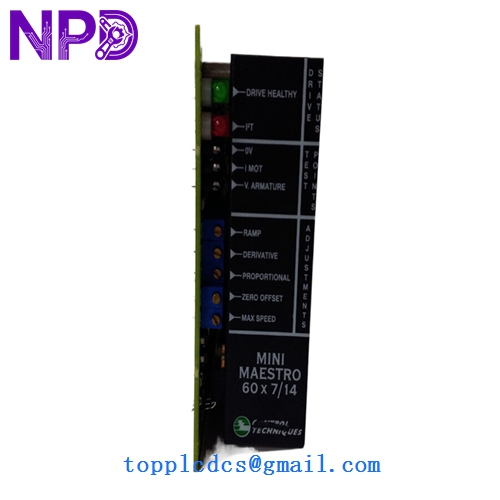
MAESTRO 60X714
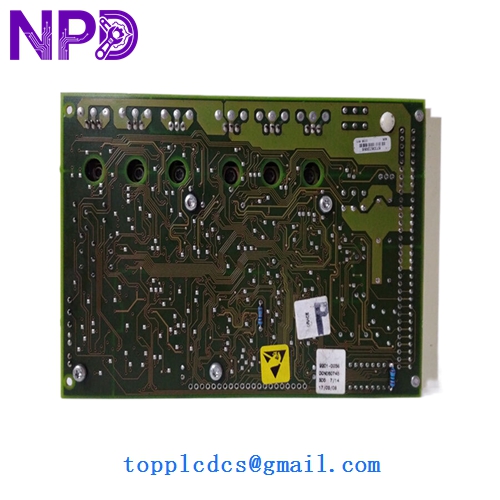
MAESTRO 60X714
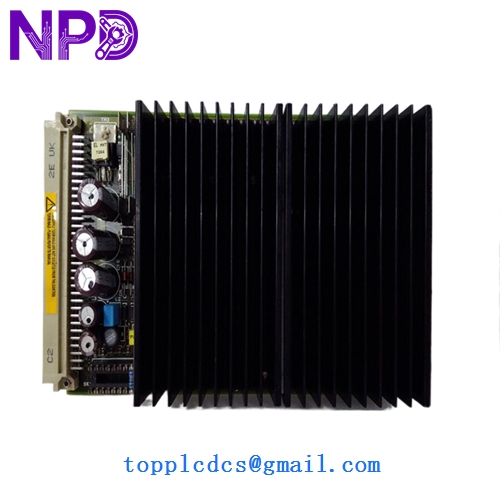
MAESTRO 60X714
Model Comparison: 60X714 vs. Similar Models
The 60X714 is a specific power variant within the Maestro 60X family, distinguishing itself from the 60X706 (6A continuous) by its higher 7A continuous / 14A peak current capability. While the physical footprint remains largely consistent across the series, the 60X714 is optimized for larger motor frames that require higher starting torque. Unlike the 90X series, which is designed for higher voltage rails up to 90V, the 60X714 is specifically tuned for 24V-48V nominal systems, offering a more refined resolution and lower switching noise for medium-voltage battery-operated or DC-fed equipment.
Operational Guidelines
- Heat Dissipation: To maintain the 7A continuous rating, the drive must be mounted vertically on a flat, metallic surface to maximize the efficiency of its integrated heatsink.
- Voltage Regulation: Ensure the DC power supply does not exceed the 60 VDC limit during regenerative braking; if using large inertial loads, an external shunt regulator (braking resistor) may be required.
- Wiring Integrity: Use shielded cables for the feedback and command signals to prevent electromagnetic interference (EMI) from the high-frequency PWM switching.
- Potentiometer Calibration: Use the onboard multi-turn potentiometers (Gain, Offset, Limit) to fine-tune the motor response; always perform these adjustments with the motor mechanically disconnected from the load during the initial setup.