
Description
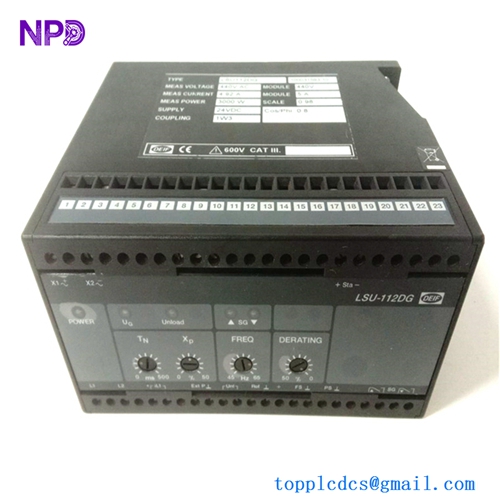
The Kongsberg RAo-8xe is an industrial-grade Remote Analog Output module engineered for critical marine and offshore automation networks. This high-reliability module provides 8 independent, galvanically isolated analog channels designed to drive proportional control elements such as governor actuators, variable speed drives, control valves, and analog indicators. Developed by Kongsberg Maritime, the “xe” designation indicates advanced environmental hardening and enhanced diagnostic capabilities, making it ideal for deployment inside engine room casings and distributed machinery spaces.

⚙️ Technical Parameters & Specifications
- Model Number: RAo-8xe
- Device Type: 8-Channel Remote Analog Output Module
- Channel Capacity: 8 Isolated Analog Outputs
- Signal Output Ranges: 4-20mA (standard process loop), 0-20mA, or 0-10V DC (software configurable)
- Dimensions: 165 mm x 115 mm x 60 mm
- Weight: 0.72 kg
- Country of Origin: Norway
🚀 Application Areas
- Propulsion Governor Control: Transmitting precise speed demand setpoints to main engine fuel actuators.
- Automated Valve Positioners: Directing modulating control valves in ballast, cargo, and cooling water subsystems.
- Thruster Speed Regulation: Supplying high-speed analog control loops to variable frequency drives (VFD) for dynamic positioning.
- Remote Metering Instrumentation: Driving legacy analog tachometers, pressure gauges, and sync meters on control room desks.
📖 Product Usage Instructions
The RAo-8xe is designed to be snapped onto standard TS35 DIN rails within a localized field termination cabinet. Maintain a minimum clear distance of 20 mm above and below the module housing to allow for natural convection cooling. All output wiring loops must utilize twisted, shielded instrumentation cables. Connect the cable shield to the cabinet’s dedicated earth ground bar at the entry point, keeping the field side of the shield isolated to prevent ground loop noise from corrupting the delicate analog control signals.
🌐 Communication Configuration Steps
- IP Address / Network Architecture: Connect the engineering workstation to the module via the dedicated network port using the Kongsberg configuration suite. Assign a static IP address, subnet mask, and gateway that align with the vessel’s primary or secondary automation network ring.
- Station Number: Define the unique node identifier (Station ID) utilizing the software configuration wizard or the physical address selectors located on the module chassis to map its position within the distributed I/O network topology.
- Baud Rate / Sync Speed: The module’s fieldbus and Ethernet transceivers feature auto-negotiation, automatically synchronizing to the system backbone speed (typically 10/100 Mbps for Ethernet or up to 1 Mbps for CAN bus configurations) to ensure deterministic control update times.
⚡ Power-Up & Commissioning Flow
- Loop Integrity Review: Audit the terminal blocks for channels 1 through 8 to ensure correct polarity wiring and verify that external loop loads (resistance) fall within the module’s rated compliance voltage.
- Auxiliary Power Verification: Confirm that the primary and secondary auxiliary power rails are delivering a stable, filtered 24V DC nominal input supply to the module power inputs.
- Boot Sequence Monitoring: Apply power. The module’s power LED will illuminate solid green, and the status indicators will flash during self-test routines before settling into a steady “Online” state.
- Forced Value Loop Test: Using the software service tool, force an output value of 12.00mA (50% span) on Channel 1 and verify with a calibrated field multimeter that the valve positioner or actuator responds precisely to the mid-point demand.
✅ Initial Operation Checklist
- Is the integrated metal DIN-rail grounding clip firmly gripping a clean, unpainted, and bonded backplane?
- Have the internal software parameters been verified to ensure the output channels match the physical device type (e.g., 4-20mA current vs. 0-10V voltage mode)?
- Are the redundant communication network cables securely seated to guarantee network fault-tolerance?
- Does the system generate a local and remote loop-fault alarm if an output wire is disconnected to simulate a field line break?
❓ Common Questions (Q&A)
Q: What does a flashing red channel LED indicate on the module front panel?
A: A blinking red indicator on a channel signifies a loop drive fault. This is most frequently caused by an open circuit (broken field wire), a disconnected actuator, or an external loop resistance that exceeds the maximum drive capability of the module.
Q: Does the RAo-8xe revert to a safe state if it loses communication with the master controller?
A: Yes. Through the configuration software, technicians can define a “Fail-Safe State” for each individual channel. In the event of a total communication timeout, the outputs can be programmed to freeze at their last known value, drop to 0mA, or default to a pre-defined safe metric (such as forcing a valve fully closed or fully open).
Q: Can this module be hot-swapped while the field cabinet is powered up?
A: While the digital network protocol supports the dynamic discovery of online modules, it is always recommended to isolate the 24V DC auxiliary power plug from the specific module before physical removal to prevent accidental short circuits or grounding transients from disrupting adjacent I/O units on the same power rail.