
Description
📝 Product Overview
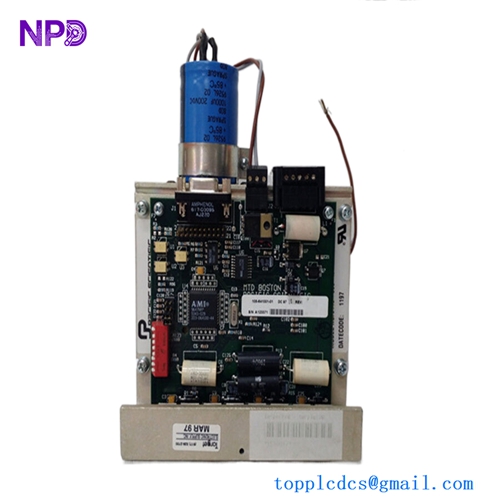
The Woodward 9905-387 ProAct Driver Model-III is a high-performance electronic actuator driver designed to position the ProAct integrated actuator series. It serves as an intelligent positioning control loop for large diesel, gas, and dual-fuel engines, as well as industrial gas turbines. The Model-III driver accepts an external position command from an engine governor or control system and translates it into a precise, high-current PWM output, driving the actuator motor to control fuel valves or air throttles with high dynamics and accuracy.
⚙️ Technical Specifications
- 📐 Dimensions: 265 mm x 215 mm x 84 mm
- ⚖️ Weight: 3.10 kg
- 🌍 Country of Origin: United States
🏭 Applications
- Large commercial marine propulsion and auxiliary engine throttling
- Industrial gas turbine fuel valve positioning control
- Remote power generation plant speed/load regulation loops
- Reciprocating gas engine air-fuel ratio butterfly valve control

🛠️ Usage Instructions
- Ensure the driver’s power supply is completely isolated before connecting or removing the high-current actuator output harness.
- Use Woodward’s Watch Window or NetSim software toolkit to perform initial calibration, software tuning, and dynamic gain optimization.
- Monitor the onboard status and error LEDs during runtime to verify the health of the internal processor and H-bridge driver.
- Do not ground either of the two actuator output lines, as this will cause an overcurrent fault or permanent driver damage.
🔧 Mechanical Installation Requirements
- Fixing Method: Surface mounted vertically inside an engine room control cabinet or engine-mounted terminal box using four M6 mounting bolts through the integrated heavy-duty chassis flanges.
- Space Clearance: Maintain a minimum clear clearance perimeter of 80 mm on all sides to allow proper routing of thick power lines and connection of the diagnostic serial cable.
- Heat Dissipation: Designed for passive natural convection cooling via its aluminum heatsink base plate. The driver must be mounted away from direct exhaust manifolds, ensuring ambient cabinet temperatures remain below 70°C.
🔌 Electrical Wiring Guide
- Terminal Definitions: * Terminals 1–2: 18–32V DC Power Supply Input (+ / -)
- Terminals 3–4: High-Current Actuator Motor Output Loop
- Terminals 5–6: 4–20 mA or 0–5V DC Position Command Input
- Terminals 7–8: 4–20 mA Actuator Actual Position Feedback Output
- Terminals 9–12: Discrete Run/Reset Inputs and Fault Relay Contacts
- Shield Stud: Heavy M5 threaded copper chassis post for system shield grounding
- Wire Gauge: Use minimum 4.0 mm² (12 AWG) heavy-duty shielded cable for the driver-to-actuator power run to minimize voltage drops. For low-voltage control signals, use 0.75 mm² to 1.5 mm² (18 to 16 AWG) twisted, shielded pairs.
- Grounding Norms: Connect the main chassis grounding stud to the control enclosure’s copper ground plane using a short, heavy, flat braided tinned-copper strap to suppress high-frequency PWM switching interference.
📡 Communication Configuration
- IP Address: Not applicable on this standalone hardware driver platform. Configuration interfaces via serial architectures.
- Station ID: Hard-addressed or mapped via proprietary software protocol parameters when linked inside multi-drop monitoring networks.
- Baud Rate: Fixed at 9600 bps or 19200 bps for the dedicated point-to-point RS-232 serial connection used for PC tuning, diagnostics, and service tool calibration.
❓ Frequently Asked Questions (Q&A)
- Q: What does a flashing red “Actuator Fault” LED mean?
- A: This indicates a feedback potentiometer mismatch, an open or short-circuit condition detected in the actuator motor coils, or a mechanical binding issue causing excessive current draw.
- Q: Can the ProAct Driver Model-III be configured to run on a 115V AC utility grid?
- A: No, the 9905-387 operates natively on a 24V DC nominal power source (18–32V DC range). Running it on an AC grid requires an external industrial-grade switching power supply module.
- Q: What should I check if the driver does not respond to the position command?
- A: Verify that the discrete “Run/Enable” input terminal is jumped or powered correctly to close the safety loop, and ensure the 4–20 mA command loop signal does not fall below the 4mA threshold.