Description
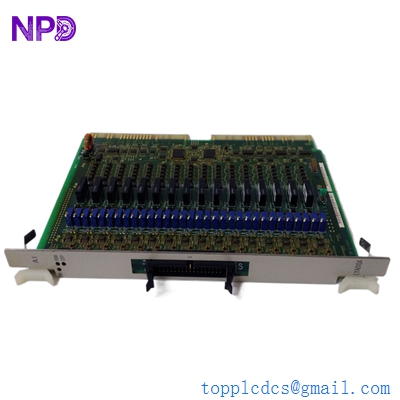
The Zygo ZMI-2002 is a high-precision, dual-axis measurement board designed for the VMEbus architecture. It is a core component of Zygo’s Precision Positioning Systems, utilizing heterodyne interferometry to provide sub-nanometer displacement measurements. The ZMI-2002 is engineered for applications requiring extreme accuracy and high update rates, such as semiconductor lithography, wafer inspection, and advanced metrology. It processes optical interference signals to provide real-time position feedback with exceptional linearity and low noise.
Find more precision metrology solutions at our Zygo ZMI Product Collection.
Product Datasheet
Basic Specifications
- Brand: Zygo Corporation
- Model Number: ZMI-2002
- Measurement Axes: 2 (Dual-Axis)
- Interface: VMEbus (Standard 6U Form Factor)
- Measurement Resolution: Sub-nanometer (typically 0.3 nm to 0.6 nm depending on optical configuration)
- Maximum Data Rate: Up to 2 MHz update frequency
Physical Characteristics
- Dimensions: 233mm x 160mm x 20mm (Standard 6U VME)
- Weight: 0.65 kg
- Optical Input: Fiber optic or direct optical receivers
- Connectors: Front panel diagnostic ports and VME backplane P1/P2
Manufacturing & Logistics
- Country of Origin: USA
- Clock Frequency: High-stability internal reference clock
- Operating Temperature: 15°C to 35°C (Stable environment required for metrology)
- Compliance: CE, semi-standard compliant
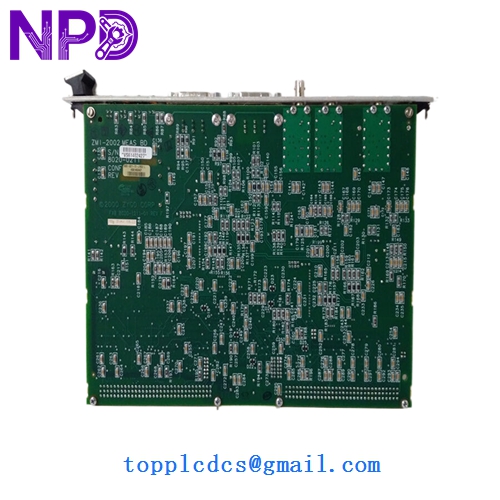
ZYGO ZMI-2002
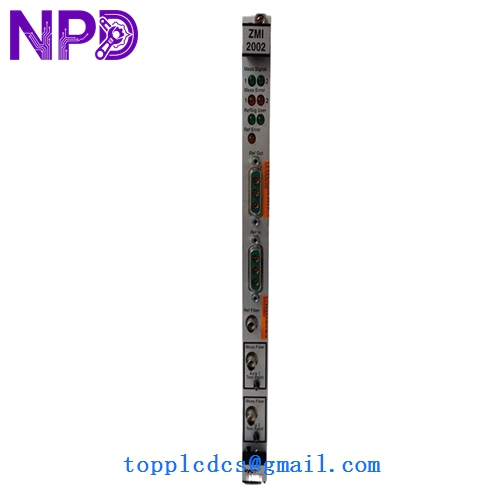
ZYGO ZMI-2002

ZYGO ZMI-2002
Application Fields
The ZMI-2002 is predominantly used in Semiconductor Manufacturing for stage positioning in steppers and scanners. It is also a vital tool in Ultra-Precision Machining, where it monitors tool-tip displacement, and in Optical Metrology for characterizing lens surfaces. In research environments, it is found in Synchrotron Beamline instrumentation and Nanopositioning stages where atomic-scale accuracy is mandatory.
Product Instructions
To install the ZMI-2002, insert the board into a VME64-compliant chassis while the power is off. Ensure that the optical fibers from the ZMI measurement receivers are connected securely to the board’s input ports; avoid sharp bends in the fiber to prevent signal attenuation. Configuration is performed via VME register access or specialized Zygo software drivers. For optimal results, the system must be allowed to thermally stabilize for at least 30 minutes. Calibration against the laser source frequency is necessary to compensate for environmental factors such as air temperature, pressure, and humidity (refractive index of air).
Comparison of Similar Models
The ZMI-2002 is the standard dual-axis workhorse for VME systems. In comparison, the ZMI-2000 is a single-axis version used for simpler displacement tasks. The newer ZMI-4104 or ZMI-5000 series transition to PCI or Ethernet interfaces and offer significantly higher resolution (picometer range) and higher axis density. Compared to the ZMI-1000 legacy boards, the 2002 version features improved signal processing algorithms that reduce cyclic error (non-linearity), resulting in smoother motion control during high-speed scans.
Frequently Asked Questions (Q&A)
Q: Does the ZMI-2002 require a specific laser source? A: Yes, it is designed to work with Zygo’s stabilized HeNe laser sources (such as the 7701 or 7702), which provide the necessary dual-frequency (heterodyne) optical signal.
Q: What is the maximum velocity the board can track? A: The maximum velocity depends on the resolution setting and the measurement frequency of the laser, but the ZMI-2002 is generally capable of tracking speeds up to 1-2 meters per second without losing fringe counts.
Q: How does the board handle signal loss? A: The ZMI-2002 includes a “Signal Error” detection circuit. If the optical signal drops below a certain threshold (due to misalignment or fiber damage), the board triggers a status bit in the VME register to alert the motion controller.