
📌 Product Introduction
The LESLIE PMC-2 is an electro-pneumatic valve controller designed for industrial process-control applications. It is used to convert an electrical control signal into pneumatic output pressure for positioning and regulating pneumatic control valves.
The controller is suited to applications where reliable pneumatic valve control is required in process systems, including steam, water, chemical, power-generation, and general industrial control equipment.
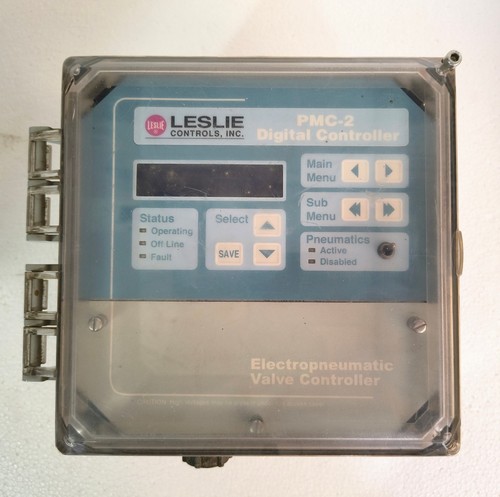
📊 Product Datasheet
| Parameter | Specification |
|---|---|
| Brand | LESLIE |
| Model | PMC-2 |
| Series | PMC Series |
| Product Name | Electro-Pneumatic Valve Controller |
| Product Type | Electro-Pneumatic Controller |
| Application | Pneumatic Control Valve Positioning |
| Control Signal | Electrical input signal |
| Output | Pneumatic control pressure |
| Operating Medium | Instrument Air |
| Mounting | Industrial / Valve Control Installation |
⚠️ Exact input signal range, pneumatic output range, supply-air pressure, dimensions, and weight can vary by configuration. Verify the unit nameplate and applicable manufacturer documentation before installation or replacement.
⚙️ Main Functions
🔹 Converts electrical control signals into pneumatic control pressure
🔹 Controls pneumatic valve actuators
🔹 Supports continuous process-control applications
🔹 Provides pneumatic output proportional to the control input
🔹 Suitable for industrial valve automation
🔹 Can be integrated with process-control systems and pneumatic actuators
🛠️ Operating Procedure & How to Use
Before installation, confirm that the PMC-2 configuration matches the control system, valve actuator, and available instrument-air supply.
- Check the model and nameplate information.
- Inspect the controller for mechanical damage or contamination.
- Confirm the required electrical control signal.
- Connect the instrument-air supply to the correct pneumatic port.
- Connect the pneumatic output to the valve actuator.
- Connect the electrical control wiring according to the applicable wiring diagram.
- Make sure the instrument-air supply is clean, dry, and regulated.
- Energize the electrical control circuit.
- Apply the control signal gradually.
- Observe the pneumatic output and valve movement.
- Check that the valve reaches the required position smoothly.
- Verify that there are no air leaks or unstable control responses.
🔌 Startup Sequence
⚠️ Follow the plant’s electrical and pneumatic safety procedures.
- Keep the process valve in a safe position.
- Confirm all electrical connections.
- Confirm pneumatic tubing connections.
- Open the regulated instrument-air supply.
- Check for pneumatic leaks.
- Energize the controller/control circuit.
- Confirm the normal control condition.
- Apply the minimum control signal first.
- Gradually increase the control signal.
- Verify proportional valve movement and stable pneumatic output.
⏹️ Shutdown Sequence
- Return the control valve to the required safe position.
- Remove or reduce the electrical control signal.
- De-energize the electrical circuit if required.
- Isolate the instrument-air supply when maintenance is necessary.
- Safely release residual pneumatic pressure.
- Only disconnect pneumatic or electrical connections after the system is fully isolated.
📖 Product Usage Notes
The PMC-2 should be used with an instrument-air system suitable for the connected pneumatic actuator. Moisture, oil, dirt, or unstable air pressure can affect pneumatic-control performance.
During commissioning, check the relationship between the electrical input signal, pneumatic output, and actual valve position. If the valve does not respond correctly, inspect the signal wiring, air supply, tubing, actuator, and controller calibration before changing system settings.
For replacement work, record the original wiring, pneumatic connections, valve fail position, and control-system settings before removing the existing unit.
❓ Common Questions & Answers
Q: What is the LESLIE PMC-2 used for?
A: It is an electro-pneumatic valve controller used to control pneumatic valve actuators from an electrical control signal.
Q: What type of equipment does it control?
A: It is intended for pneumatic control valves and associated pneumatic actuators used in industrial process systems.
Q: Does it require instrument air?
A: Yes. An electro-pneumatic controller requires a suitable regulated pneumatic supply for its output-control function.
Q: Can I install it as a direct replacement for another valve controller?
A: Not automatically. Check the electrical input, pneumatic connections, output requirements, actuator characteristics, mounting arrangement, and control range before substitution.
Q: What should be checked before startup?
A: Verify the electrical signal, instrument-air quality and pressure, pneumatic tubing, actuator connection, valve position, and control-system configuration.
Q: Why might the valve fail to move?
A: Possible causes include incorrect electrical signal, insufficient air pressure, blocked tubing, air leakage, actuator problems, or an incorrect controller configuration.
Q: Why is the valve position unstable?
A: Check for unstable instrument-air pressure, air leakage, incorrect signal wiring, actuator problems, or controller calibration issues.
Q: Is the PMC-2 suitable for modern PLC/DCS systems?
A: It can be used where the PLC/DCS provides a compatible electrical control signal and the controller’s pneumatic output is suitable for the connected valve actuator.
🔎 Recommended LESLIE Product Families
- LESLIE PMC Series — Electro-Pneumatic Valve Controllers
- LESLIE Control Valves — Industrial Process Control Valves
- LESLIE Pneumatic Actuators — Pneumatic Valve Actuation
- LESLIE Steam Conditioning Valves — Steam Process Control
- LESLIE Desuperheaters — Steam Temperature Control
- LESLIE Pressure Regulators — Pressure Control Applications
- LESLIE Pneumatic Control Systems — Industrial Valve Automation
- LESLIE Valve Positioning Equipment — Pneumatic Valve Positioning
- LESLIE Steam Control Equipment — Power & Process Applications
- LESLIE Process Control Valves — Industrial Flow Regulation


