
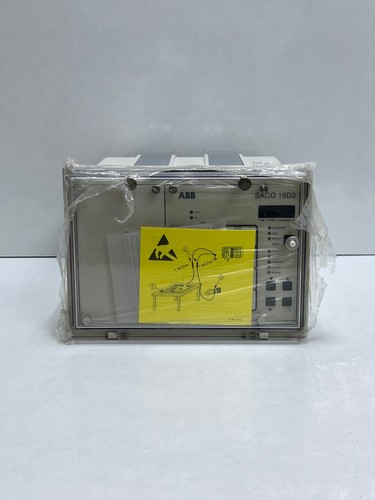
The SACO 16D3 (part number SACO16D3AA358) is a highly reliable digital annunciator unit designed for industrial alarm monitoring. It is part of the ABB SACO series, widely utilized in power utilities and process industries to monitor contact inputs and provide immediate, clear visual and audible status alerts to operators.
Product Specifications
| Feature | Details |
| Model Number | SACO 16D3 |
| Part Number | SACO16D3AA358 |
| Device Type | Digital Annunciator / Alarm Unit |
| Alarm Inputs | 16 programmable digital inputs |
| Communication | SPA bus (via fiber optic or RS-485) |
| Operating Voltage | Wide range (DC auxiliary power supply) |
| Weight | Approx. 1.2 kg – 1.5 kg |
| Country of Origin | Finland |
Application Fields
The SACO 16D3 is engineered for critical status monitoring:
- Substation Automation: Providing local alarm annunciation for circuit breaker positions, transformer status, and protection relay operations.
- Process Plant Monitoring: Centralizing fault alerts from various field sensors for quick operator response.
- Control Room Interface: acting as a localized “first-out” or general alarm panel in smaller control rooms or local control cabinets.
- System Integration: Reporting alarm data to higher-level SCADA systems via the SPA bus interface.
Product Usage Instructions
- Mounting: The unit is designed for flush mounting in a panel door. Ensure the cutout dimensions match the manufacturer’s specifications to maintain the proper IP rating.
- Wiring: Connect field alarm contacts to the input terminals on the rear of the unit. Ensure that common-mode voltages are managed according to the installation manual to prevent false triggering.
- Configuration: Use the front-panel switches or the configuration software to define alarm sequences (e.g., ISA-standard sequences), delay times, and input polarity.
- Testing: Utilize the built-in “Lamp Test” and “Alarm Test” functions regularly to ensure all visual indicators and internal logic are fully operational.
- Communication: If the unit is integrated into a network, connect the SPA bus cable to the rear communication port. Ensure the device address is set correctly to avoid conflicts on the network.
Frequently Asked Questions
Q: What does the “AA358” suffix signify?
A: The alphanumeric suffix identifies the specific hardware version, including the voltage rating of the internal auxiliary power supply and the type of communication interface (e.g., fiber optic vs. copper) installed on the board.
Q: Is this annunciator capable of remote resets?
A: Yes, it typically supports remote reset inputs, allowing operators to acknowledge and reset alarms from a secondary location or via a PLC/DCS command.
Q: How do I handle a failed LED indicator?
A: The SACO series is built for long service life; however, if an LED fails, the entire front display module or the unit may need replacement. Always check that the signal input itself is actually triggering before assuming a display failure.
Q: Can this unit replace older electromechanical flag relays?
A: Absolutely. It is a common upgrade for legacy systems, offering significantly more functionality—such as event logging and serial communication—in the same footprint as older analog annunciators.


