
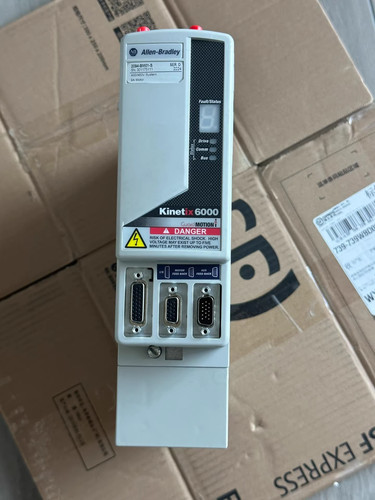
The Allen-Bradley 2094-BM01-S is a high-performance, 400V-class servo axis module within the Kinetix 6000 multi-axis drive family. Designed for precise motion control, this module operates as an inverter that draws power from a common DC bus. It is equipped with integrated Safe Torque-Off (STO) functionality, allowing for enhanced personnel safety by disabling motor torque without removing power from the entire drive. Its modular design enables rapid installation on a power rail, making it a preferred choice for complex, space-constrained automation systems.
Product Specifications
Technical Parameters
- Catalog Number: 2094-BM01-S
- Manufacturer: Allen-Bradley / Rockwell Automation
- Voltage Class: 400V Class (Nominal 460V AC Input / 650V DC Bus)
- Continuous Output Power: 3.9 kW
- Continuous Output Current (RMS): 6.1 A
- Peak Output Current: 9.2 A (Series A); 15.3 A (Series B and C)
- Efficiency: 98%
- Safety Features: Safe Torque-Off (STO) certified for SIL 2 / PLd
- Internal Shunt Resistor: 115 Ohms (50W continuous / 5.6 kW peak power)
Physical Datasheet
- Dimensions: 280mm x 72mm x 270mm (Approx. 11.02″ x 2.83″ x 10.63″)
- Weight: 2.5 kg (5.5 lbs) to 3.18 kg (7.0 lbs) depending on Series
- Country of Origin: USA
- Mounting: Kinetix 6000 Power Rail (Panel Mount)
- Operating Temperature: 0°C to 50°C (32°F to 122°F)
Application Fields
The 2094-BM01-S is engineered for high-dynamic multi-axis applications, including:
- Packaging Machinery: Coordinating high-speed wrapping, labeling, and filling lines.
- Material Handling: Driving pick-and-place robotics and automated sorting systems.
- Converting Equipment: Managing tension and positioning in web-based manufacturing.
- Automated Assembly: Providing precise torque and position control for automotive and electronics assembly.
Product Usage Instructions
- Mounting Order: Install modules on the power rail from left to right, starting with the highest power utilization module. The Integrated Axis Module (IAM) typically sits at the far left.
- Power Rail Installation: Do not remove the protective covers from the power rail pins until you are ready to mount the module to prevent damage or contamination.
- Wiring: Use shielded motor cables to minimize electromagnetic interference (EMI). Ensure the STO (Safe Torque-Off) header is correctly wired or jumpered if the safety function is not being utilized.
- Configuration: Configure the axis using Rockwell Automation’s Studio 5000 Logix Designer (formerly RSLogix 5000). Use the Motion Analyzer software to verify that the 3.9 kW power rating meets your specific motor and load requirements.
- Cooling: Maintain at least 50mm (2 in.) of clearance above and below the module to allow for adequate airflow and heat dissipation.
Q&A – Frequently Asked Questions
Q: Can I use a Series B module to replace an older Series A unit? A: Yes, Series B and C modules are generally backward compatible and offer significantly higher peak current (15.3 A vs 9.2 A), which can improve dynamic performance in high-demand cycles.
Q: What does the “-S” suffix indicate? A: The “-S” signifies that the module is “Safety” equipped, featuring the integrated Safe Torque-Off (STO) function.
Q: Where can I find pricing or check availability for the 2094-BM01-S? A: For official quotes, 12-month warranties, and stock status on new or refurbished units, please visit our Allen-Bradley 2094-BM01-S Axis Module Inquiry Page.
Product Related News
As of 2026, the Kinetix 6000 series—including the 2094-BM01-S—continues to be a vital component in the industrial “Installed Base” globally. Although Rockwell Automation has introduced the Kinetix 5700 as a successor for new high-performance designs, the 2094-BM01-S remains fully supported in the spare parts market. Many facilities are currently undergoing “Digital Maintenance” audits, where legacy Kinetix 6000 systems are being paired with modern EtherNet/IP gateways to provide real-time energy monitoring and vibration analysis. This allows manufacturers to extend the life of their existing 400V-class motion systems while moving toward predictive maintenance models without a full hardware rip-and-replace.


