
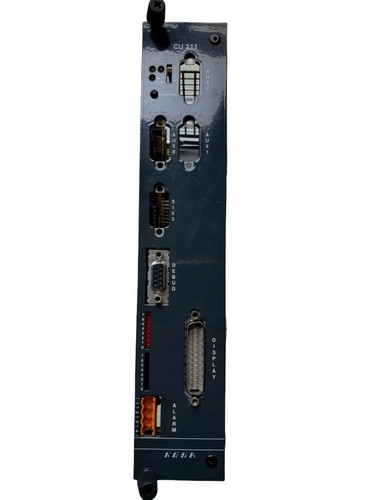
The KEBA CU211/E is a high-performance central processing unit (CPU) motherboard specifically engineered for the KePlast series of injection molding machine (IMM) control systems. As the core “brain” of the machine’s automation hardware, the CU211/E manages real-time motion control, temperature regulation, and hydraulic sequences. Its robust design is optimized for the harsh electrical and thermal environments typical of plastic manufacturing facilities, providing high-speed communication via Keba’s proprietary KeBus system.
Key Product Specifications
- Model Number: CU211/E
- Manufacturer: KEBA Automation
- System Series: KePlast (i1000, i2000, i8000 compatible)
- Processor: High-speed embedded industrial processor
- Communication Interfaces:
- KeBus: High-speed internal system bus
- Ethernet: For HMI connectivity and factory networking
- CAN/CANopen: For peripheral device integration
- RS232/RS485: For serial communication with external controllers
- Memory: Integrated flash for firmware and non-volatile RAM for process parameters
- Mounting: Backplane-integrated for rack-based installation
- Dimensions: 210 mm x 145 mm x 40 mm
- Weight: 0.78 kg
- Country of Origin: Austria
Application Fields
The CU211/E is the primary control element in advanced plastic processing:
- Injection Molding Machines (IMM): Managing high-precision injection profiles and clamping unit sequences.
- Blow Molding: Coordinating parison control and synchronized movement for complex hollow shapes.
- Extrusion Systems: Providing stable temperature control loops and screw speed regulation.
- Robotic Pick-and-Place: Interfacing with Integrated robot arms for automated part removal.
Usage Instructions
- Installation: Ensure the control cabinet power is completely OFF. Slide the CU211/E into the primary slot of the KePlast chassis. Ensure the board is fully seated into the backplane connectors and secured with the retention clips.
- Firmware Loading: The CU211/E usually requires specific machine-resident software. Insert the authorized CF (CompactFlash) card or USB drive containing the machine-specific parameters before initial power-up.
- Network Setup: Connect the Ethernet cable to the RJ45 port for connection to the operator panel (HMI). Ensure the IP addresses are correctly configured to allow data exchange between the CPU and the display unit.
- Heat Dissipation: Verify that the cabinet fans are operational. While the CU211/E is built for industrial heat, stagnant air can lead to processor throttling and intermittent control errors.
Q&A – Frequently Asked Questions
Q: Can the CU211/E be interchanged with a CU211/A? A: Generally, no. The “/E” designation often refers to specific hardware enhancements or interface configurations (such as integrated Ethernet or specific bus protocols). Always verify the hardware revision and software compatibility list before attempting a swap.
Q: What does a red “Error” LED on the front panel indicate? A: A steady red LED typically signifies a hardware watchdog timeout or a failure to load the system firmware. A flashing pattern usually corresponds to a specific diagnostic code related to a communication fault on the KeBus.
Q: Does this board manage the hydraulic valves directly? A: The KEBA CU211/E provides the high-level logic and control signals; however, it usually communicates those commands to specialized I/O modules (such as AO or PWM modules) which then drive the physical hydraulic valves.
Product News: Optimizing Plastic Production Efficiency
KEBA has highlighted the CU211/E as a key component in the modernization of the KePlast automation platform. By utilizing the enhanced processing power of the “E” revision, manufacturers can implement more complex closed-loop control algorithms, resulting in tighter part tolerances and reduced scrap rates. Recent firmware updates for the CU211/E series have also introduced enhanced OPC UA support, facilitating easier integration with Industry 4.0 data platforms and remote monitoring services. This focus on connectivity and precision ensures that injection molding facilities can maintain a competitive edge through improved cycle times and data-driven maintenance.


