
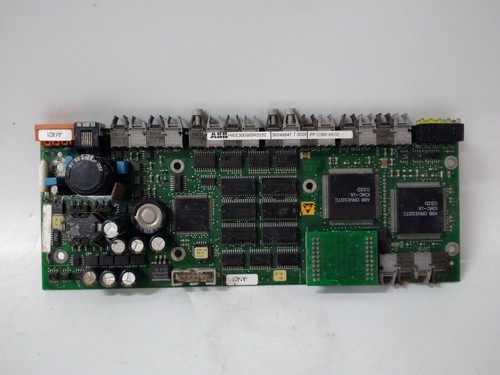
The ABB PPC380AE02 (Part Number: HIEE300885R0102) is a specialized processing unit utilized within ABB’s high-power electronics and excitation control systems. As a core member of the UNITROL and MEGATROL series, this module functions as a high-speed controller capable of managing complex arithmetic for power conversion and regulation. The PPC380AE02 is designed to operate in real-time environments where millisecond-level response times are required to maintain the stability of large synchronous motors and generators. Its architecture integrates advanced signal processing with robust communication interfaces to ensure seamless data exchange between the power bridge and the central supervisory system.
Technical Specifications
The following parameters detail the physical and technical properties of the PPC380AE02 module:
- Model Number: PPC380AE02
- Part Number: HIEE300885R0102
- Manufacturer: ABB
- Processor Type: High-performance Digital Signal Processor (DSP)
- Dimensions: 233mm x 160mm x 30mm (Standard Eurocard format)
- Weight: 0.65 kg
- Country of Origin: Switzerland
- Power Supply: 5V DC / 24V DC (internal bus powered)
- Operating Temperature: 0 to +55 degrees Celsius
- Interface: Fiber optic communication ports and local bus connectors
Application Fields
The PPC380AE02 is a critical component in heavy-duty electrical infrastructure, including:
- Excitation Systems: Serving as the control brain for UNITROL 6000 or similar high-end excitation units.
- Static Frequency Converters (SFC): Managing the start-up and synchronization of large gas turbines.
- Large Drive Systems: Controlling high-power AC/DC drives in mining and heavy industrial mills.
- Renewable Energy: Integration within large-scale wind or hydro converters for grid synchronization.
Product Instructions and Handling
The PPC380AE02 is a sensitive electronic assembly and must be handled within an ESD-protected environment. When installing the module into a subrack, ensure that the guide rails are aligned correctly to prevent bending the high-density backplane pins. The fiber optic ports on the front panel are critical for signal isolation; ensure the protective caps are removed only immediately before the cables are connected, and check that the cable ends are clean to prevent signal loss. Firmware updates for the HIEE300885R0102 should only be performed using ABB-authorized service tools, as incorrect flashing can lead to module failure. Always verify that the hardware revision (AE02) matches the existing system requirements for full compatibility.
Questions and Answers
Q: Can the PPC380AE02 be used as a direct replacement for the PPC380AE01? A: While they share the same base architecture, the AE02 revision typically includes hardware enhancements or component updates. It is generally backward compatible, but system parameters and firmware versions should be cross-referenced with your technical manual.
Q: What do the onboard LEDs indicate? A: The module features status LEDs that indicate Power (Green), Fault (Red), and Activity (Yellow). A flashing Red LED usually signifies a self-test failure or a communication timeout with the main processor.
Q: Does this module require a battery for memory retention? A: Most configurations of the PPC380 series utilize non-volatile Flash memory for the application program, but certain system variables may rely on a battery-backed RAM located on the carrier board or the CPU itself.
Product Related News: Modernizing Power Infrastructure
The PPC380AE02 continues to be a cornerstone for industries looking to optimize their energy consumption through better power factor control. With the global energy market shifting toward more volatile grid conditions due to renewable integration, the demand for fast-acting excitation controllers has surged. ABB’s HIEE300885R0102 remains a preferred choice for retrofitting older plants, allowing them to achieve modern grid compliance without replacing entire drive or excitation cabinets. This “lifecycle management” approach helps heavy industries reduce their carbon footprint by extending the useful life of existing capital equipment while improving overall electrical efficiency.


