
Product Description
The GENERAL ELECTRIC 9T21J1701 is a 15 kVA three-phase dry-type distribution transformer designed for industrial and commercial electrical power applications. It features a 480 V delta primary winding and a 240 V delta secondary winding, providing voltage transformation for compatible three-phase electrical equipment. Operating at 60 Hz, this transformer is designed for indoor and outdoor installations and features a NEMA 3R enclosure for protection against rain and environmental exposure. It is suitable for industrial distribution panels, machinery power supplies, commercial electrical systems, and facility power conversion applications. The transformer belongs to GE’s QMS three-phase transformer product family and includes four 2.5% primary voltage adjustment taps, with two taps above and two below the rated primary voltage. Its UL-listed construction supports installation in appropriately designed electrical distribution systems. Before installation, verify the nameplate ratings, grounding arrangement, primary and secondary wiring, load requirements, and applicable electrical codes.
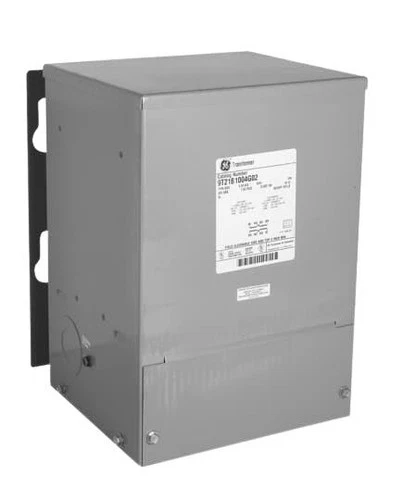
📋 Product Datasheet
| Parameter | Specification |
|---|---|
| Brand | General Electric (GE) |
| Model | 9T21J1701 |
| Series | GE QMS Three-Phase Transformer |
| Product Name | 15 kVA Dry-Type Distribution Transformer |
| Product Category | Three-Phase Power Transformer |
| Place of Manufacture | Not independently confirmed |
| Product Status | New Surplus / Subject to Seller Confirmation |
| Dimensions | Exact dimensions to be verified from nameplate/drawing |
| Weight | Approximately 9.07 kg listed by one reseller; verify actual unit |
| Country of Origin | Not confirmed |
| Rated Capacity | 15 kVA |
| Primary Voltage | 480 V AC, Delta |
| Secondary Voltage | 240 V AC, Delta |
| Phase | 3 Phase |
| Frequency | 60 Hz |
| Primary Taps | 4 taps, 2 above and 2 below rated voltage, 2.5% each |
| Enclosure | NEMA 3R |
| Installation | Indoor / Outdoor |
| Certification | UL Listed |
| Discontinued | Current production status not independently confirmed |
⚙️ Operating Guidelines and Usage
The 9T21J1701 is designed to transform three-phase electrical power from a 480 V delta primary supply to a 240 V delta secondary supply.
- Confirm the transformer nameplate and verify the 9T21J1701 model.
- Check the primary supply voltage, secondary voltage, and frequency.
- Verify that the connected load is compatible with the 15 kVA rating.
- Inspect the enclosure, terminals, insulation, and grounding connections.
- Confirm that the installation location meets NEMA 3R environmental requirements.
- Select the appropriate primary tap configuration based on the measured supply voltage.
- Connect the primary and secondary conductors according to the manufacturer’s wiring diagram.
- Verify phase sequence, grounding, and protective device ratings.
- Perform insulation resistance and electrical continuity tests as required.
- Energize the transformer under an approved electrical commissioning procedure.
🔌 Power-On and Power-Off Sequence
Power-On Procedure
- Confirm that all downstream loads are disconnected or switched off.
- Verify primary and secondary wiring connections.
- Confirm that the grounding conductor is properly installed.
- Check that all terminal covers and protective barriers are secured.
- Verify the selected primary voltage tap.
- Close the upstream circuit breaker or disconnect switch.
- Measure the secondary voltage using an appropriately rated instrument.
- Confirm that the output voltage and phase conditions are within the permitted range.
- Connect downstream loads gradually while monitoring current and temperature.
Power-Off Procedure
- Disconnect or shut down downstream electrical loads.
- Open the secondary-side disconnect where applicable.
- Open and isolate the primary-side circuit breaker.
- Apply lockout/tagout procedures.
- Verify the absence of hazardous voltage on both sides.
- Allow the transformer to cool before inspection or maintenance.
- Discharge and verify any associated stored-energy components before servicing.
⚠️ Transformer terminals can carry lethal voltages. Only qualified electrical personnel should perform installation and maintenance.
🛠️ Normal Operating Procedure
- Check the incoming three-phase 480 V supply.
- Confirm that the transformer is operating at its rated 60 Hz frequency.
- Monitor the secondary voltage across the 240 V output terminals.
- Verify balanced three-phase loading.
- Monitor load current and ensure that the total apparent power does not exceed 15 kVA.
- Check for abnormal humming, vibration, or overheating.
- Inspect the enclosure and ventilation conditions.
- Record voltage, current, and temperature readings during routine maintenance.
- Investigate abnormal operating conditions before continued service.
⚙️ Parameter Settings and Modification
The 9T21J1701 is a passive transformer and does not have software-based parameter settings. Its primary voltage adaptation is performed through physical tap connections.
Primary Tap Configuration
- Rated primary voltage: 480 V AC.
- Tap arrangement: Four 2.5% adjustment taps.
- Two taps provide voltage adjustment above the rated primary voltage.
- Two taps provide voltage adjustment below the rated primary voltage.
Configuration Procedure
- Measure the actual incoming primary voltage.
- Compare the measured voltage with the transformer nameplate.
- Consult the original GE wiring diagram for the exact tap terminal identification.
- Isolate the transformer from all power sources.
- Verify zero voltage before opening the terminal compartment.
- Select the appropriate tap connection according to the manufacturer’s instructions.
- Secure all electrical connections to the specified torque.
- Inspect insulation clearances and protective barriers.
- Re-energize under controlled conditions and measure the secondary voltage.
Never change transformer taps while energized. Incorrect tap selection can cause improper secondary voltage and damage connected equipment.
🔍 Maintenance and Troubleshooting
Low secondary voltage
- Check incoming primary voltage.
- Verify primary tap selection.
- Inspect primary and secondary connections.
- Check for excessive load conditions.
Transformer overheating
- Measure primary and secondary current.
- Check for phase imbalance.
- Inspect ventilation and ambient temperature.
- Verify that the load does not exceed 15 kVA.
Abnormal noise or vibration
- Inspect mounting bolts and installation supports.
- Check for loose electrical connections.
- Examine the transformer for signs of mechanical damage.
- Investigate harmonic distortion or abnormal supply conditions.
Insulation or grounding problems
- Perform appropriate insulation resistance testing.
- Inspect grounding conductors and terminal connections.
- Check for moisture, contamination, or damaged insulation.
- Follow applicable electrical maintenance standards.
⚠️ Safety Precautions
- Installation must be performed by qualified electrical technicians.
- Always isolate both primary and secondary circuits before maintenance.
- Follow lockout/tagout procedures.
- Never change tap connections while energized.
- Verify grounding and overcurrent protection.
- Do not exceed the 15 kVA rated capacity.
- Use properly rated cables, circuit breakers, and electrical enclosures.
- Follow applicable UL, NEC, and local electrical installation requirements.
- Do not operate a transformer with damaged insulation or exposed live terminals.
🔧 Recommended GE Models
The following GE transformer models are related products for industrial power distribution and replacement-part procurement:
- 9T21J3001
- 9T21J6001
- 9T21J9704
- 9T21J3708
- 9T21J6008
- 9T21J9705
- 9T21J1703
- 9T21J3000
- 9T21J3002
- 9T21J6000
- 9T21J6002
- 9T21J9000
- 9T21J9001
- 9T21J1702
- 9T21J1000
Compatibility Notice: These models belong to related GE three-phase transformer product families. Their kVA ratings, primary and secondary voltages, tap configurations, and enclosure specifications may differ. They are not guaranteed direct replacements for 9T21J1701. Always verify the electrical nameplate and installation requirements before ordering.


