
1. Product Description
The HIMA F 8650E (Part Number: 984865064) is a safety-related central processing module designed for the HIMA HIQuad H51q programmable electronic safety system. It serves as the central processing unit of compatible safety controller configurations, executing application logic, monitoring system operation, and coordinating communication with the system I/O modules. The F 8650E uses a dual-microprocessor architecture with synchronized processors and hardware comparison to support fail-safe operation. Its isolated RS-485 interfaces support serial communication, including configured MODBUS applications. The module is intended for safety-related process automation installations such as emergency shutdown systems, burner management, and other critical industrial protection applications. It must be installed in a compatible H51q rack with the appropriate power supply, I/O architecture, firmware, and engineering configuration. This is a central CPU module, not a standalone PLC or complete safety controller.
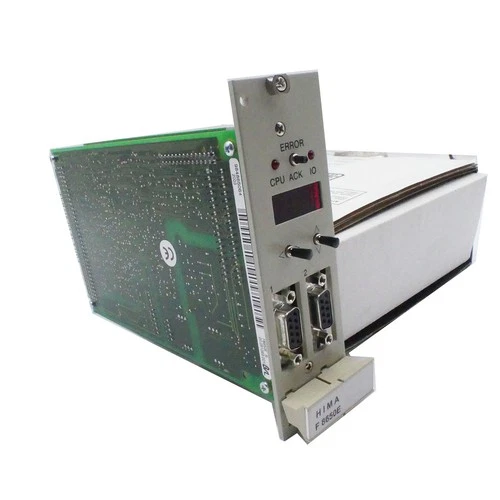
2. Key Technical Specifications
- Brand: HIMA
- Model: F 8650E
- Part Number: 984865064
- Product Type: Safety-related Central Processing Module / CPU
- Product Family: HIQuad H51q
- System Application: H51q-MS, H51q-HS, and H51q-HRS configurations, subject to system compatibility
- Processor Architecture: Dual synchronized microprocessors
- Processor Type: Intel 386EX, 32-bit, as reported in supplier technical listings
- Clock Frequency: 25 MHz, supplier-reported
- Communication Interfaces: Two electrically isolated RS-485 serial interfaces
- Communication Protocols: MODBUS and HIMA-specific communication protocols, depending on configuration
- Diagnostic Features: Front-panel diagnostic display and status indicators
- Safety Capability: HIMA documentation identifies the F 8650E for safety-related H51q applications up to SIL 3
- Rack Format: H51q central subrack installation
- Internal Supply: System 5 V DC supply through the rack, supplier-reported
- Power Consumption: Exact value should be verified against the applicable hardware revision and data sheet
- Dimensions and Weight: Not independently verified for this exact part number
- Country of Origin: Germany, as commonly listed by suppliers; verify the individual unit label
- Product Status: Confirm actual condition, hardware revision, and availability with the seller
3. Application Scenarios
- Emergency Shutdown Systems (ESD): Executes safety logic for shutdown functions in compatible HIMA installations.
- Process Safety Systems: Provides central processing for safety-related control and monitoring in industrial plants.
- Burner Management Systems (BMS): Supports safety logic in compatible combustion-control architectures.
- Fire and Gas Systems: Can form part of a configured safety controller used for fire and gas protection.
- Chemical and Petrochemical Plants: Supports safety-related process interlocks and shutdown sequences.
- Power Generation: Used in suitable safety-related auxiliary and process protection applications.
- Industrial Infrastructure: Provides central logic processing in established HIQuad H51q installations.
4. Installation and Commissioning Procedure
- Record the complete model number, part number, serial number, hardware revision, and existing system configuration.
- Confirm that the target system is an H51q configuration designed for the F 8650E.
- Verify the central rack, power modules, I/O modules, bus architecture, and redundancy arrangement.
- Back up the existing application program, configuration, and diagnostic records using the approved HIMA engineering environment.
- Isolate the relevant equipment and follow the plant’s approved shutdown and lockout/tagout procedures.
- Inspect the module, rack connector, mounting hardware, and front-panel indicators for physical damage.
- Install the module according to the HIMA hardware manual and the approved system maintenance procedure.
- Verify the power supply, rack connections, communication wiring, and applicable system settings.
- Confirm the operating-system revision and select the correct engineering software. HIMA documentation indicates that ELOP II Factory is required for operating-system versions before version 7, while SILworX is required for version 7 and later.
- Perform the prescribed system diagnostics, application verification, redundancy checks, and safety validation before authorizing the system for operation.
5. Configuration and Operating Guidelines
- Verify the H51q system configuration and CPU hardware revision before installation.
- Confirm that the application program is compatible with the installed operating-system revision.
- Use the appropriate HIMA engineering software for the installed firmware generation.
- Check RS-485 wiring, communication settings, addressing, and protocol configuration.
- Verify the I/O bus and communication paths between the central module and the installed I/O modules.
- Confirm that redundant CPU arrangements, where used, are configured and diagnosed according to HIMA requirements.
- Keep a controlled backup of application programs, configuration files, and system revision records.
- Do not transfer application software between different CPU generations without checking HIMA compatibility requirements.
6. Daily Maintenance
- Monitor the front-panel diagnostic display and status indicators.
- Review CPU, I/O bus, communication, and power-supply diagnostic messages.
- Check the system cabinet for dust, moisture, overheating, and loose connections.
- Inspect RS-485 cables and connectors for damage or poor contact.
- Review battery and memory-retention diagnostics where applicable.
- Maintain current backups of the safety application and configuration.
- Record module replacements, firmware changes, and diagnostic events.
- Schedule periodic proof testing and safety-system maintenance according to the plant’s safety lifecycle requirements.
7. Troubleshooting and FAQ
Q1: The CPU does not start normally.
A: Check the rack installation, system power supply, connector condition, and diagnostic display. Compare the displayed fault information with the applicable HIMA system manual.
Q2: The module reports an I/O bus fault.
A: Inspect the I/O bus connections, bus modules, rack configuration, and connected I/O modules. Check the diagnostic information before replacing hardware.
Q3: RS-485 communication is unavailable.
A: Verify cable polarity, shielding, termination, communication settings, and the connected device configuration. Confirm that the selected protocol is supported by the installed application.
Q4: Which programming software should be used?
A: The required engineering software depends on the CPU operating-system revision. HIMA documentation identifies ELOP II Factory for operating-system versions earlier than version 7 and SILworX for version 7 and later.
Q5: Can the F 8650E replace an F 8650X?
A: Do not assume direct interchangeability. CPU generations may differ in hardware, firmware, and application compatibility. Check the HIMA replacement instructions and the complete system configuration.
Q6: Can the F 8650E be used in an H41q rack?
A: The F 8650E is associated with the H51q system family. H41q systems use their designated central modules, such as the F 8652 family. Verify the rack and CPU designation before ordering.
Q7: Can a defective CPU be repaired on site?
A: HIMA system documentation states that user-level module repair is not permitted for safety-related modules because specialized testing is required. Use an authorized HIMA service or qualified repair provider.
8. Safety Precautions
- Maintenance must be performed by personnel qualified in functional safety and HIMA HIQuad systems.
- Follow the plant’s approved shutdown, isolation, and lockout/tagout procedures.
- Never remove or install a CPU without following the system-specific HIMA maintenance instructions.
- Do not bypass watchdog, diagnostic, redundancy, or safety-related functions.
- Do not modify the safety application without the required management-of-change and validation procedures.
- Verify the complete safety function after replacing the CPU or changing the application configuration.
- Use only approved hardware, firmware, and engineering tools.
- Maintain the required safety integrity and proof-testing records.
- Do not return the process to service until all required system checks and safety validation activities have been completed.
9. Related HIMA Models and System Components
The following models belong to the broader HIMA HIQuad H41q/H51q product family and its associated system architecture. They are useful for spare-parts identification and system planning but are not all direct replacements for the F 8650E.
- F 8650A – Related H51q central module generation.
- F 8650X – H51q central module from a different hardware generation.
- F 8651 – H51q central module used in other system configurations.
- F 8652E – H41q central processing module.
- F 8652X – H41q central module from a different hardware generation.
- F 8653X – Related HIMA central module.
- F 8621A – HIQuad communication/coprocessor module.
- F 8627X – HIMA communication module family.
- F 8628X – HIMA communication module family.
- F 7126 – HIQuad power supply module.
- F 7130A – HIQuad power supply module.
- F 7131 – Power supply monitoring module.
- F 7553 – I/O bus coupling module.
- F 3221 – Digital input module.
- F 6215 – Analog input module.
Before selecting a related module, confirm its system family, rack compatibility, firmware requirements, safety certification, and approved application configuration.


