
Product Introduction
The HIMA F 8650E (Order Number: 984865064) is a safety-related central processing module designed for HIMA H51q programmable electronic safety systems, including H51q-MS, H51q-HS, and H51q-HRS configurations. It serves as the central processing unit of the safety controller, executing configured safety logic and coordinating communication with the system’s I/O and peripheral modules. The module features two clock-synchronized 32-bit Intel 386EX microprocessors, isolated RS-485 communication interfaces, a diagnostic display, and a safety-related watchdog output. Designed for critical process automation and emergency shutdown applications, the F 8650E supports safety applications up to SIL 3 when installed in an appropriately engineered and certified system. It is a legacy HIMA component, so hardware revision, operating-system version, application configuration, and rack compatibility should be checked before replacement or commissioning.
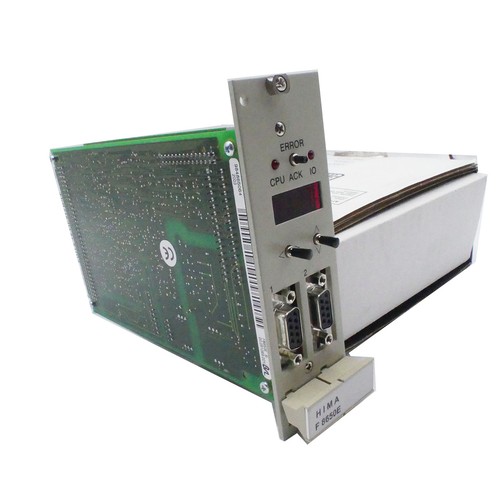
Technical Specifications
- Brand: HIMA
- Model: F 8650E
- Order Number: 984865064
- Product Name: Safety System Central CPU Module
- Product Type: Safety-Related Central Processing Unit
- Product Series: HIMA H41q / H51q HIQuad
- Applicable System: H51q-MS, H51q-HS, H51q-HRS
- Processor: Dual clock-synchronized Intel 386EX, 32-bit
- Processor Frequency: 25 MHz
- Communication Interfaces: 2 electrically isolated RS-485 serial interfaces
- Communication Protocol: MODBUS; other supported interfaces depend on system configuration
- Diagnostic Display: Four-digit matrix display
- Safety Capability: Up to SIL 3 according to IEC 61508, subject to system certification and application design
- Additional Safety Classification: AK 1–6, as listed by suppliers
- Watchdog Output: Safety-related 24 V DC output, maximum load 500 mA, short-circuit protected
- Internal Operating Supply: 5 V DC / 2 A
- Memory: Flash-EPROM and SRAM; exact usable capacity depends on operating-system version
- Rack Occupancy: 8 TE
- Place of Manufacture: Germany
- Country of Origin: Germany, subject to confirmation from the product nameplate
- Product Status: Legacy / discontinued product
- Dimensions: Not reliably established for this exact order number; confirm against the original module
- Weight: Approximately 0.29 kg (supplier-listed value; verify before shipping)
- Programming Software: ELOP II Factory or SILworX, depending on operating-system version
- Installation Type: HIMA central subrack
Key Technical Features
- Dual synchronized processor architecture: Two Intel 386EX processors operate with clock synchronization for safety-related processing.
- Safety logic execution: Performs the central processing functions required by the configured HIMA H51q safety application.
- Isolated serial communication: Two galvanically isolated RS-485 interfaces support communication with compatible external systems.
- Diagnostic display: A four-digit matrix display provides diagnostic and operating information.
- Safety watchdog: A fault-related 24 V DC output supports the configured safe-state response.
- Modular rack integration: Designed for an 8 TE position in the compatible HIMA central subrack.
- Configurable application software: Programming and configuration depend on the installed operating-system version and corresponding HIMA engineering software.
- Legacy system support: Suitable for maintenance and spare-parts requirements in existing HIMA HIQuad installations, subject to compatibility verification.
Operating Procedures
1. Pre-Installation Inspection
- Verify the complete model number F 8650E and order number 984865064.
- Compare the hardware revision, identification label, connectors, and diagnostic panel with the original module.
- Inspect the PCB and connector contacts for corrosion, contamination, or physical damage.
- Check the central rack and associated power supply for correct configuration.
- Confirm that the replacement module is approved for the installed H51q system and its operating-system version.
- Review the system configuration and application backup before any replacement work.
2. Installation
- ⚠️ Place the safety system in an approved maintenance state before removing or installing the central module.
- Follow the site’s lockout/tagout procedure and HIMA installation instructions.
- Use ESD protection when handling the module.
- Confirm the correct rack position and module orientation.
- Insert the module carefully into the designated slot and secure it using the original mounting hardware.
- Check the associated power, communication, and system connections.
- Do not modify safety-system wiring or bypass interlocks to facilitate installation.
3. Startup and Power-On
- Inspect the installed module and verify that all rack connections are secure.
- Confirm that the central rack power supply is operating within the specified limits.
- Restore system power according to the HIMA commissioning procedure.
- Observe the diagnostic display and available status indicators.
- Check for processor, communication, watchdog, and system configuration faults.
- Verify that the controller recognizes the module and that the configured safety application is running correctly.
- Complete the required proof tests and safety validation before returning the process to service.
4. Normal Operation
During normal operation, the F 8650E executes the configured safety application and communicates with compatible system components. Maintenance personnel should monitor diagnostic messages, communication status, system alarms, and watchdog-related indications. Any unexplained fault or discrepancy between redundant processing channels must be investigated using the HIMA diagnostic documentation.
5. Parameter Configuration and Modification
The F 8650E is configured through HIMA engineering software rather than treated as a general-purpose standalone PLC CPU. The required software depends on the installed operating-system version:
- ELOP II Factory: Used with operating-system versions earlier than version 7.
- SILworX: Required for operating-system version 7 and later, according to supplier technical guidance.
Before modifying the application, verify the firmware version, engineering environment, system configuration, and project backup. Changes to safety logic must follow the organization’s management-of-change process and require appropriate verification, validation, and authorization. Do not download an unverified project to an operating safety controller.
6. Shutdown Procedure
- Place the controlled process in its approved safe condition.
- Follow the plant’s shutdown and isolation procedures.
- Confirm that safety functions remain available through the approved alternative or maintenance arrangement.
- Isolate the relevant rack power supply before removing the module.
- Observe the manufacturer’s instructions for module removal and system restart.
- Record diagnostic information and configuration details before maintenance.
Daily Maintenance
- Check the controller diagnostic display for abnormal messages.
- Review system alarms and communication faults.
- Inspect the control cabinet for dust, moisture, excessive temperature, and vibration.
- Check that cabinet cooling and ventilation are operating correctly.
- Verify that module mounting and accessible connectors remain secure.
- Review controller event records and recurring fault indications.
- Maintain current backups of the safety application and configuration.
- Schedule periodic functional testing according to the site’s safety lifecycle and HIMA documentation.
Troubleshooting
Problem 1: Central module fails to start
Possible causes: Rack power supply problems, poor backplane contact, incompatible module revision, or internal CPU failure.
Recommended action: Check the rack supply and installation, record diagnostic indications, and verify hardware compatibility before replacing the module.
Problem 2: Diagnostic display shows a fault
Possible causes: Processor diagnostics, configuration errors, communication faults, or problems with associated modules.
Recommended action: Record the complete diagnostic code and consult the applicable HIMA system manual. Do not clear or acknowledge faults without understanding their cause.
Problem 3: RS-485 communication failure
Possible causes: Incorrect wiring, wrong bus address, baud-rate mismatch, grounding problems, or a fault in the connected device.
Recommended action: Verify the RS-485 wiring, bus configuration, termination, and communication settings against the project documentation.
Problem 4: Safety watchdog output indicates a fault
Possible causes: Internal processor discrepancy, system fault, power instability, or an application-related safety condition.
Recommended action: Place the process in the approved safe state and investigate the diagnostic information. Never bypass the watchdog or force its output to maintain production.
Problem 5: Controller rejects the application configuration
Possible causes: Operating-system version mismatch, incompatible engineering software, incorrect project revision, or unsupported hardware configuration.
Recommended action: Verify the CPU operating-system version and project compatibility. Use the correct HIMA engineering environment and an approved application backup.
Frequently Asked Questions
Q1: What is the HIMA F 8650E?
It is a safety-related central CPU module for HIMA H51q HIQuad programmable electronic safety systems.
Q2: Which systems use the F 8650E?
It is specified for H51q-MS, H51q-HS, and H51q-HRS configurations. Confirm the exact rack and system revision before ordering.
Q3: What processor does the F 8650E use?
The module uses two clock-synchronized Intel 386EX 32-bit processors operating at 25 MHz.
Q4: What communication interfaces are available?
It provides two electrically isolated RS-485 serial interfaces. Protocol availability and configuration depend on the installed system.
Q5: Does the F 8650E support SIL 3 applications?
The module is identified for safety-related applications up to SIL 3. The achieved safety integrity level depends on the complete system architecture, application design, certification, and lifecycle procedures.
Q6: Can the F 8650E be replaced by an F 8650X?
Do not assume direct interchangeability. Although both are H51q central module models, hardware, firmware, configuration, and system compatibility must be confirmed with HIMA documentation.
Q7: Which programming software is required?
ELOP II Factory or SILworX may be required depending on the operating-system version installed on the module.
Q8: Is the F 8650E discontinued?
Industrial spare-parts suppliers identify the F 8650E as discontinued. It is generally sourced through specialist automation spare-parts channels.
Safety Precautions
- ⚠️ The F 8650E is part of a safety-related control system. Installation and maintenance must be performed by qualified personnel.
- ⚠️ Never remove or replace the CPU without following the approved process safety and maintenance procedures.
- ⚠️ Do not bypass watchdog outputs, safety interlocks, or redundant system checks.
- ⚠️ Verify the correct operating-system version and application configuration before commissioning.
- ⚠️ Use ESD protection and appropriate handling procedures for electronic modules.
- ⚠️ Back up the safety application and document all configuration changes.
- ⚠️ Complete the required functional tests and safety validation before returning the system to operation.
Related HIMA Models
The following HIMA modules are relevant to HIQuad safety-system maintenance, system architecture, and spare-parts identification. They are not all direct replacements for the F 8650E.
- F 8650X – H51q safety central module
- F 8650A – H51q central module variant
- F 8650 – H51q central module
- F 8652E – H41q safety central module
- F 8652X – H41q central module
- F 8652A – H41q central module variant
- F 8621A – HIMA communication module
- F 8627X – HIMA communication module
- F 8628 – HIMA communication module
- F 8628X – HIMA communication module variant
- F 7130 – HIMA power distribution module
- F 7131 – HIMA power distribution module
- F 7133 – HIMA power distribution module
- F 7553 – HIMA I/O bus link module
- F 6217 – HIMA analog input module
Compatibility Notice: Related HIMA models may belong to different system generations or perform different functions. Confirm rack type, hardware revision, firmware, engineering software, safety certification, and application compatibility before selecting a replacement.


